

Discover infinity


Subscribe to our newsletter
Get the latest updates, insights, and tips delivered straight to your inbox.
Razorpay can help Indian businesses accept payments from overseas customers, but that doesn’t automatically make it the right fit for every business.
Before turning it on, it helps to get a few things clear first:
Who’s eligible?
Which payment methods are supported?
What are the fees?
How long does settlement take?
What documents are required?
Can a payment be put on hold after the customer has already paid?
I know that concern firsthand.
Razorpay once held a $300 international payment from a client. What should have been a simple transaction turned into months of follow-ups and uncertainty, and I didn’t get the money for nearly six months.
The hardest part wasn’t just waiting. It was not knowing why the money was held, how long support would take, or whether I had already sent everything they needed.
If you are a freelancer or run a small business, you know even a small delay can disrupt salaries, subscriptions, vendor bills, and cash flow.
That’s why I wrote this guide. Before switching on international payments, it’s worth understanding the fees, eligibility rules, settlement process, compliance requirements, customer experience, and the risks of account review.
This review covers how setup works, what you may pay, how settlement and currency conversion are handled, what support is like, and when another option may be more predictable.
TL;DR: Should You Use Razorpay for International Payments?
Razorpay is a good fit for Indian businesses that want to accept international cards through checkout, Payment Links, or an existing Razorpay setup.
It’s a less obvious choice if your main goal is simply to collect a few large overseas invoices at the lowest possible cost.
Here's a quick overview:
International cards: Around 3% platform fee + GST on the fee under standard pricing
MoneySaver bank transfers: Around 1% + GST under standard pricing
MoneySaver FX markup: Razorpay advertises zero forex markup for this route
International card settlement: Often around T+7 working days under the standard international settlement cycle, although your account-specific schedule should be checked in the dashboard
MoneySaver settlement: Uses a different settlement flow and can settle faster after the required invoice information is captured
International activation: Requires approval
Settlement: Generally received in INR
Best suited for: Businesses that need checkout, international cards, Payment Links, or an existing Razorpay payment stack
Best Alternative - Infinity
My view: Razorpay makes the most sense when payment acceptance and checkout experience matter as much as transaction cost.
For large B2B invoices where a customer is happy to make a bank transfer, compare the total fee and FX outcome before choosing the card route.

How Does Razorpay International Payments Work?
Razorpay International Payments lets Indian businesses collect payments from customers located outside India.
Depending on the setup, your customer can pay using an international card or send an international bank transfer. Razorpay then processes the transaction and settles the eligible amount into your Indian bank account.
The important thing to understand is that there isn't one single “Razorpay international payment.”
There are different collection routes, and they have different fees and settlement processes.
The four most relevant options are:
International credit and debit cards
MoneySaver international bank transfers
Razorpay Payment Links
Razorpay Checkout
Let's look at them separately.
1. Razorpay International Credit and Debit Cards
International cards make the most sense for SaaS, e-commerce, online courses, digital products, and any business where customers pay directly at checkout.
In practice, the customer just enters their international card details and completes the payment the same way they would on any other online store.
It’s a convenient option, but that convenience usually comes with higher processing fees than a standard international bank transfer.
Best for
SaaS subscriptions
Ecommerce
D2C exporters
Online courses
Digital products
Productised services
Businesses where checkout conversion matters
2. Razorpay MoneySaver Export Account
MoneySaver is quite different from accepting an international card.
It is designed around international bank transfers.
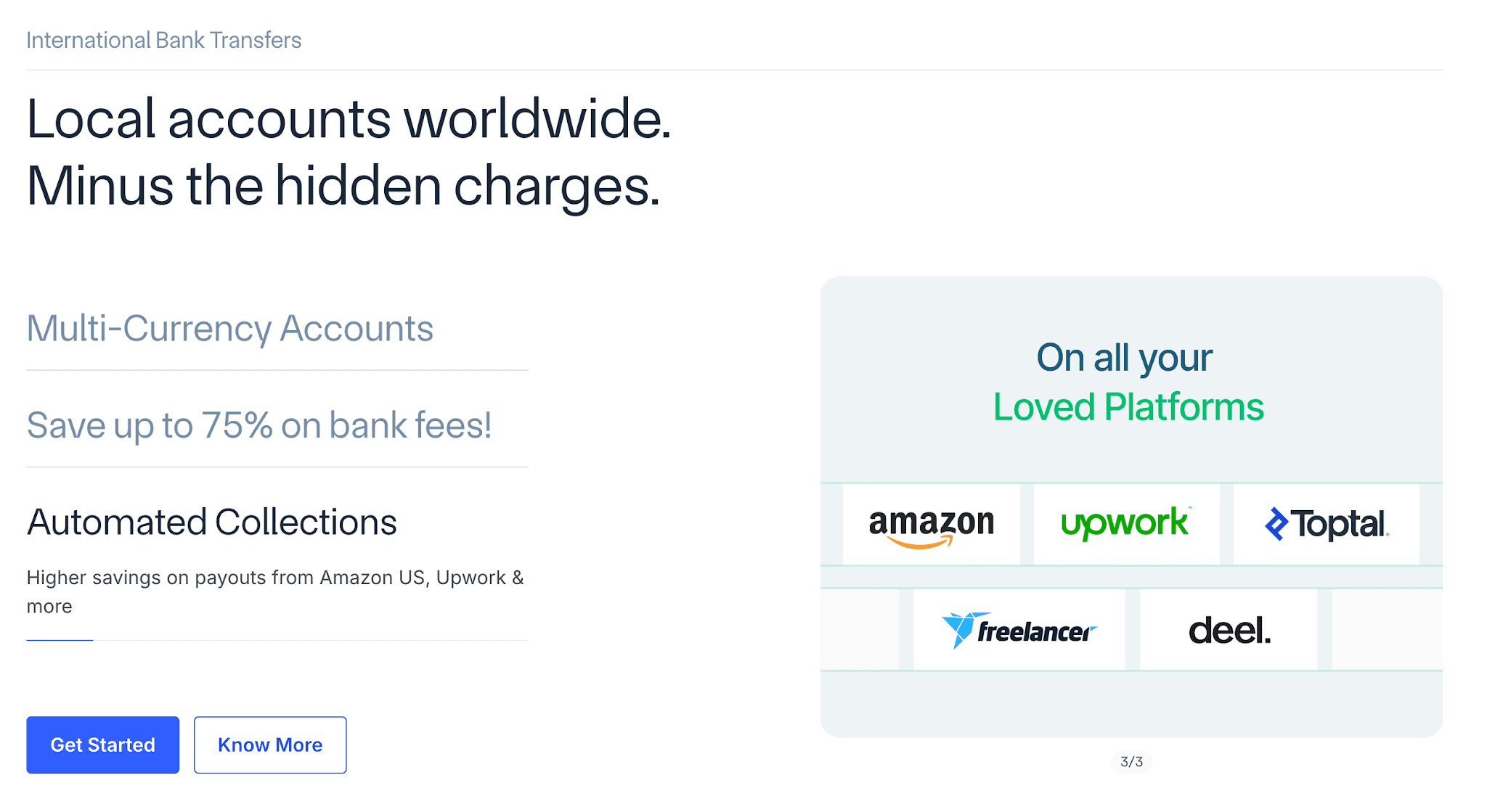
For eligible businesses, Razorpay provides virtual account details that overseas customers can use to send payments through supported local or international banking networks.
This can make more sense for:
Freelancers
Agencies
Consultants
Exporters
B2B SaaS companies
Businesses receiving large invoices
The main appeal here is the pricing.
Razorpay currently advertises MoneySaver at around 1% + GST, with no forex markup on this route under its standard pricing.
That can make a big difference compared with a 3% international card payment.
3. Razorpay Payment Links
Payment Links are a good fit when you don’t need to build a full storefront.
Say you run an agency and need to collect a $2,000 monthly retainer from a US client. Instead of setting up a complete checkout flow, you can simply create a Razorpay Payment Link and share it over email, WhatsApp, or through your invoicing process.
What the customer can pay with depends on your Razorpay setup and the payment methods you’ve enabled.
Payment Links are especially useful for:
Freelancers
Agencies
Consultants
One-time services
Deposits
Retainers
Manual invoicing workflows
4. Razorpay International Checkout
Razorpay Checkout makes more sense when customers need to pay directly on your website or application.
It works well for businesses that already use Razorpay domestically and want international customers to move through a similar checkout experience.
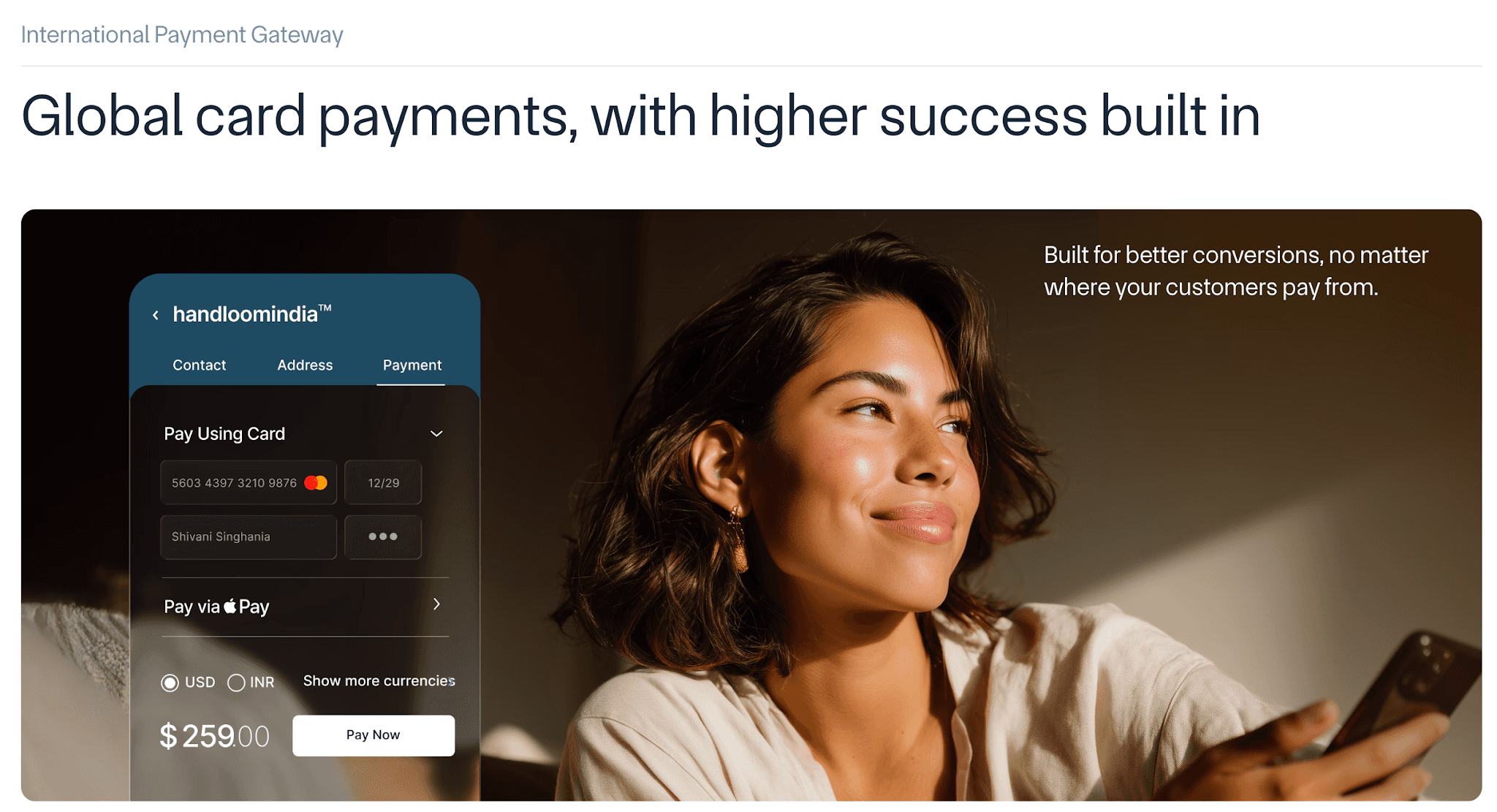
This is where Razorpay becomes more valuable than a simple international bank-transfer provider.
A bank-transfer service may help you collect an invoice more cheaply, but it generally won't replace the checkout layer required by an e-commerce store or SaaS product.
Razorpay International Payments Fees
Here is what Razorpay actually charges. It has been verified against Razorpay's own documentation and pricing pages:
International cards: 3% + GST on the platform fee.
International bank transfers (MoneySaver Export Account): 1% + GST, with no additional forex markup on this route.
GST: applies only to Razorpay's platform fee, not to your entire transaction value. On a ₹1,000 fee, GST adds ₹180, not 18% of the customer's payment.
FX conversion: for card payments, the conversion happens at Razorpay's banking partner rate. Always check the applied rate against the mid-market rate for that day; a wide spread here can add real cost even when the headline fee looks low.
Settlement: domestic payments settle in T+2 business days by default. International payments settle in T+7 business days by default, which is significantly slower than domestic payments. Instant Settlement is available on request for a small additional fee if T+7 doesn't work for your cash flow.
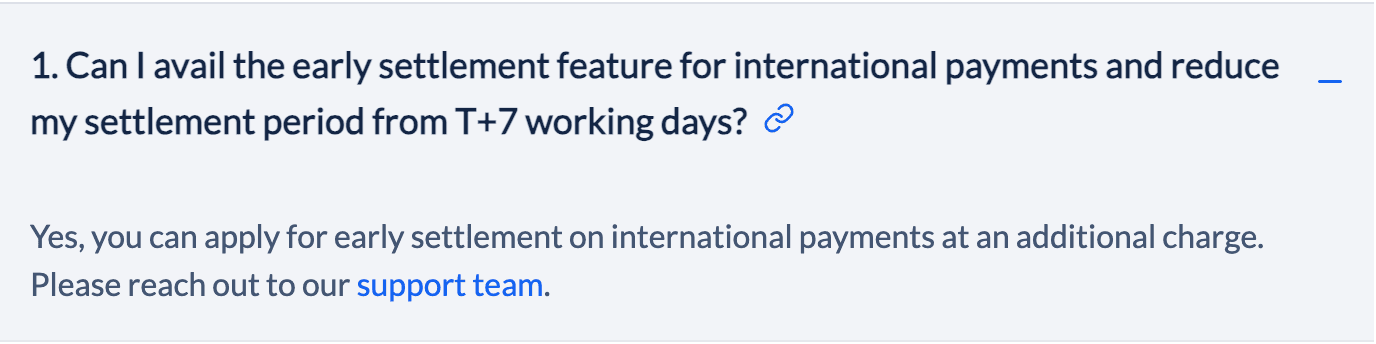
Example Fee Calculation
Take a $1,000 international card payment, converted at a mid-market rate of roughly ₹85.5/USD:
Gross amount: $1,000 → ₹85,500
Platform fee (3%): ₹2,565
GST on fee (18% of ₹2,565): ₹461.70
Total deducted: ₹3,026.70
Net settlement (before FX spread): approximately ₹82,473.30
Before you accept this as your real payout, verify three things: the exact FX rate Razorpay applied that day versus the mid-market rate, whether any chargeback protection or optional add-on was enabled, and whether your account is on Standard pricing or a negotiated rate.
Hidden Cost Checklist
Platform fee (3% cards / 1% bank transfer)
GST on the platform fee
FX markup on the conversion rate applied
Refund and chargeback charges
FIRC/eFIRC issuance and any associated cost
Intermediary or correspondent bank charges on wire transfers
Time spent on reconciliation between what the customer sent and what actually settled
What Can Affect Your Final Razorpay Payout?
I would avoid looking at the advertised processing fee in isolation.
Check all of these:
Razorpay platform fee
GST on the platform fee
Currency conversion rate
Refund-related charges
Chargeback-related costs
International banking or intermediary charges where applicable
Settlement timing
Reconciliation effort
Documentation requirements
The correct question isn't simply:
“What percentage does Razorpay charge?”
It is:
“How much INR reaches my bank account after the entire transaction is complete?”
How Long Does Razorpay Take to Settle International Payments?
This is another area where international cards and MoneySaver should not be grouped together.
International card settlements
Razorpay’s standard documentation has historically said that international settlements usually take around T+7 working days, but you should always check the exact timeline in your Razorpay dashboard.
That timing can vary depending on your account, risk profile, and payment setup.
In some cases, eligible businesses may also be able to opt for faster or early settlement for an extra fee.
MoneySaver bank-transfer settlements
MoneySaver works a little differently.
Razorpay’s MoneySaver documentation points to a faster settlement flow once the required invoice or transaction details are in place.
That makes it especially useful for service exporters who don’t need card checkout.
This is an important distinction, because not every international payment received through Razorpay follows the same T+7 timeline.
My Experience With a Razorpay International Payment Hold
This is something I wish I had understood better before I relied on Razorpay for an international client payment.
I once received an international payment of about $300 through Razorpay.
Instead of being settled normally, the payment was put on hold.
What followed was a long series of support messages and follow-ups. I sent the requested information, waited for replies, and kept trying to figure out what was still blocking the payment release.
I did eventually receive the money.
But the whole process took nearly six months.
I’m not saying this proves Razorpay routinely holds international payments. One transaction can’t tell you how millions of others will play out.
Still, it completely changed what I look for in an international payment provider.
A slightly lower transaction fee doesn’t mean much when money you expected this week ends up tied up for months.
If I were collecting significant international payments today, I’d make sure I had a few things ready in advance:
Client contract
Invoice
A clear description of the services or products provided
Customer details
Proof of delivery, where relevant
Website
Terms and Conditions
Privacy Policy
Refund/Cancellation Policy
Any relevant communication with the customer
You may never need most of these documents during a payment review.
But if a compliance or risk question does come up, having everything organised makes the process much easier.
Who Is Eligible for Razorpay International Payments?
Razorpay International Payments requires more than simply opening a Razorpay account.
You should generally have:
An active Razorpay account
Completed KYC
A functioning business website
Terms and Conditions
Privacy Policy
Refund and Cancellation Policy
Shipping Policy where physical products are involved
A clearly explained business model
A supported business category
Approval for international payments
Razorpay and its banking partners may need to run a few extra checks before international payments can be enabled.
So even if domestic Razorpay payments are already active, that doesn’t automatically mean international payments will be approved too.
How to Activate International Payments on Razorpay
Here’s how you can activate International payments on Razorpay
First, create a Razorpay account or log in to your Razorpay account.
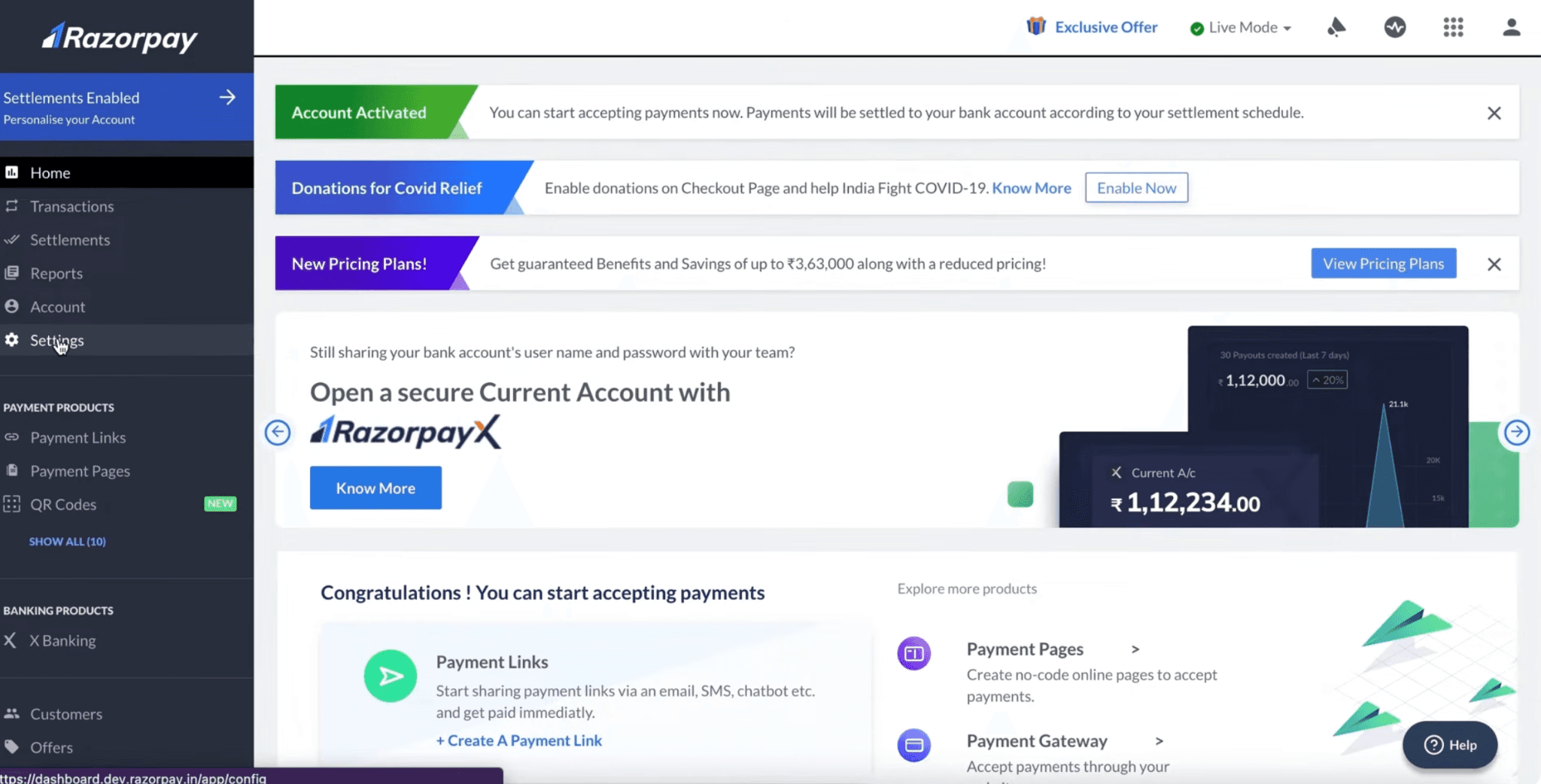
Then complete the KYC verification.
After that, publish the required website policy pages (Terms, Privacy, Refund/Cancellation, and Shipping, if applicable).
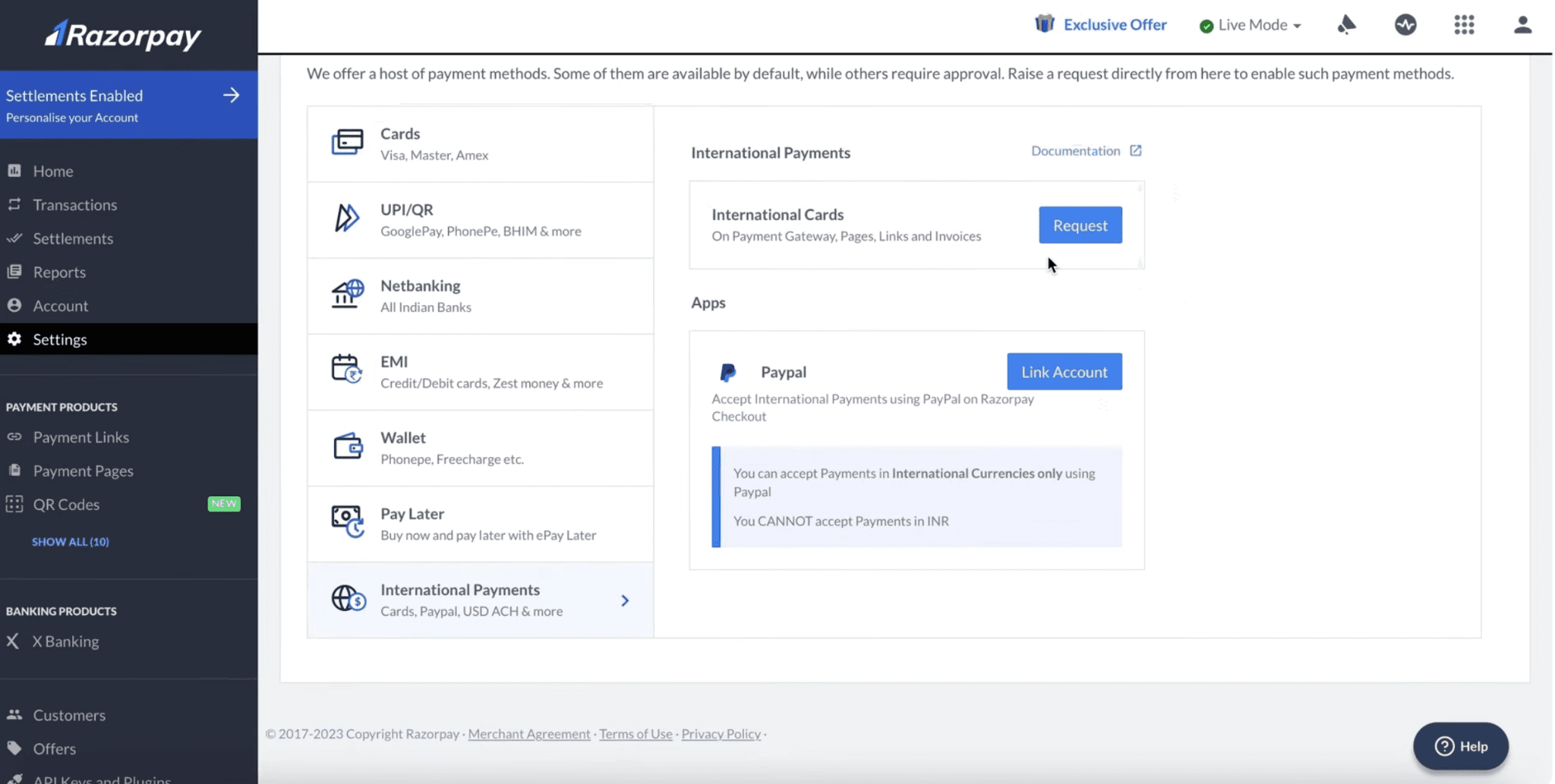
Use the dashboard to activate international payments.
Submit details on your business model, website, and intended use case.
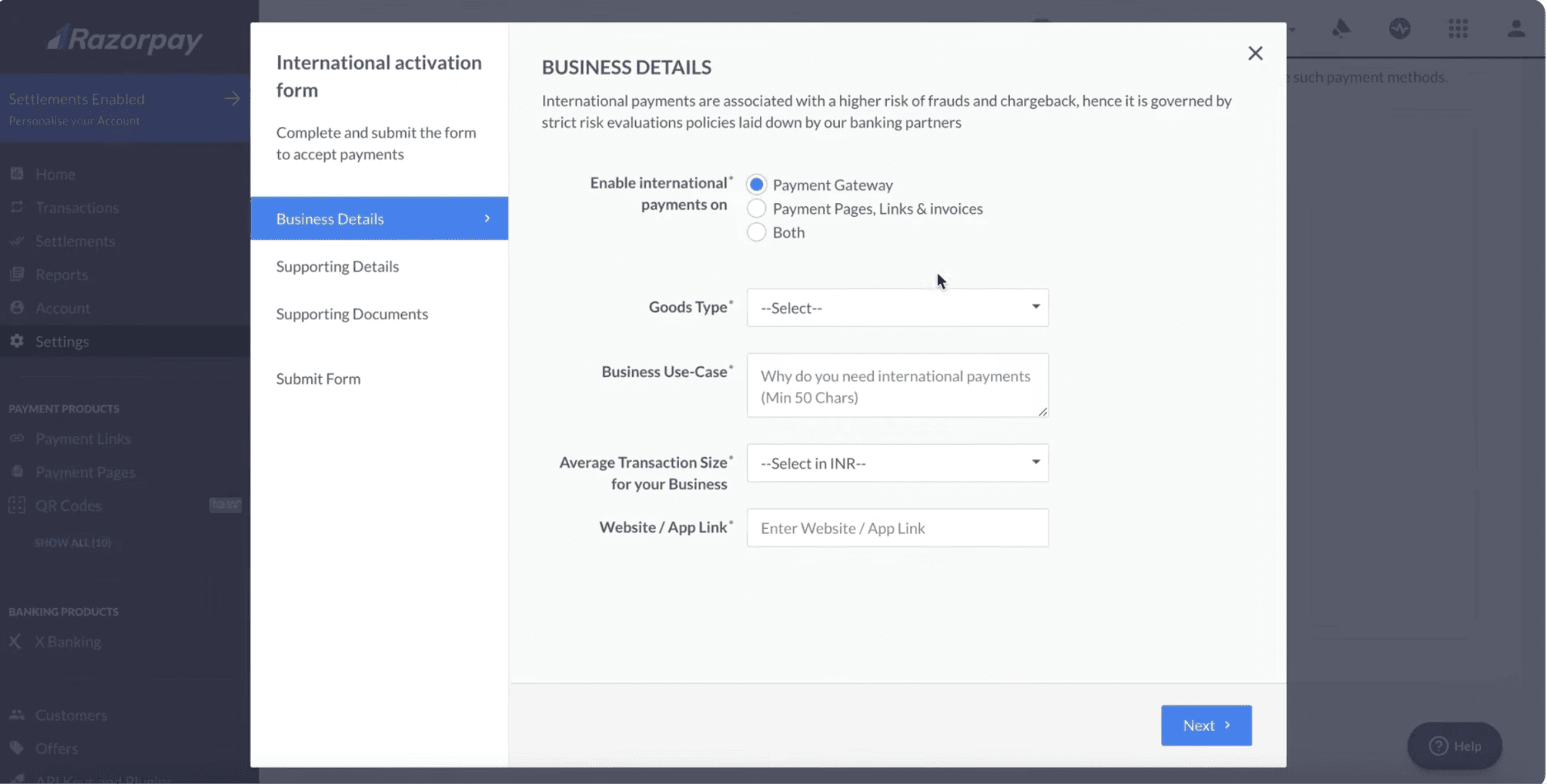
Wait for the review from Razorpay and its banking partner.
Once approved, enable the specific international payment methods you need.
Test checkout, payment links, webhooks, refunds, and settlement reports before going live with real customers.
Documents and Compliance Indian Businesses Should Understand
You don't need to become a compliance expert. But you should definitely know what these does and when you'll need it:
KYC: identity and business verification, required before any settlement.
GST and export invoicing: your invoices to overseas clients still need to follow GST rules for the export of services.
LUT (Letter of Undertaking): lets qualifying exporters bill without charging IGST upfront, where applicable.
IEC (Import Export Code): relevant if your business model involves goods or falls under specific export categories.
FIRC/eFIRC: proof that money came in from abroad through a bank; exporters need this for GST and RBI compliance.
RBI/FEMA compliance: the regulatory framework governing how foreign currency can be received and converted in India.
Refund and chargeback records: You must keep these organised; they matter for both reconciliation and dispute resolution.
Settlement and reconciliation reports: your source of truth for what actually landed versus what was invoiced.
Keep a simple folder (physical or in Drive) for each client or quarter with these documents. It saves hours when you're filing GST returns or responding to a bank query.
Razorpay vs Other Ways to Receive International Payments in India
There isn't one payment provider that is best for every Indian business.
The correct option depends primarily on how your customers want to pay.
Method | Best For | Main Advantage | Main Limitation |
Razorpay | SaaS, e-commerce and businesses needing cards | Checkout, cards, Payment Links and domestic + international payments | Card fees and additional international approval |
Razorpay MoneySaver | Freelancers, agencies and exporters | Lower-cost bank-transfer route within Razorpay | Doesn't replace card checkout |
PayPal | Businesses whose customers already prefer PayPal | Strong global consumer familiarity | Total fees and FX can be relatively high |
Wise-style bank transfers | Freelancers and B2B invoices | Bank-transfer-focused experience and transparent conversion | Not a complete e-commerce checkout |
Traditional SWIFT transfer | Large B2B invoices | Universally understood banking route | Intermediary fees, reconciliation and paperwork |
Stripe | SaaS and developer-led e-commerce | Strong APIs and global payments ecosystem | Indian availability and account fit should be verified before committing |
Infinity | Indian businesses primarily collect cross-border client payments | Built around international collections and exporter workflows | Not intended to replace a full domestic payment gateway |
The easiest way to choose is to start with the customer's payment behaviour.
An e-commerce buyer wants to check out.
A US enterprise paying a $20,000 agency invoice may prefer an ACH or bank transfer.
Those are fundamentally different payment problems.
Razorpay vs Infinity: Which Should You Use?
Razorpay and Infinity overlap in international payments, but they solve the problem from different starting points.
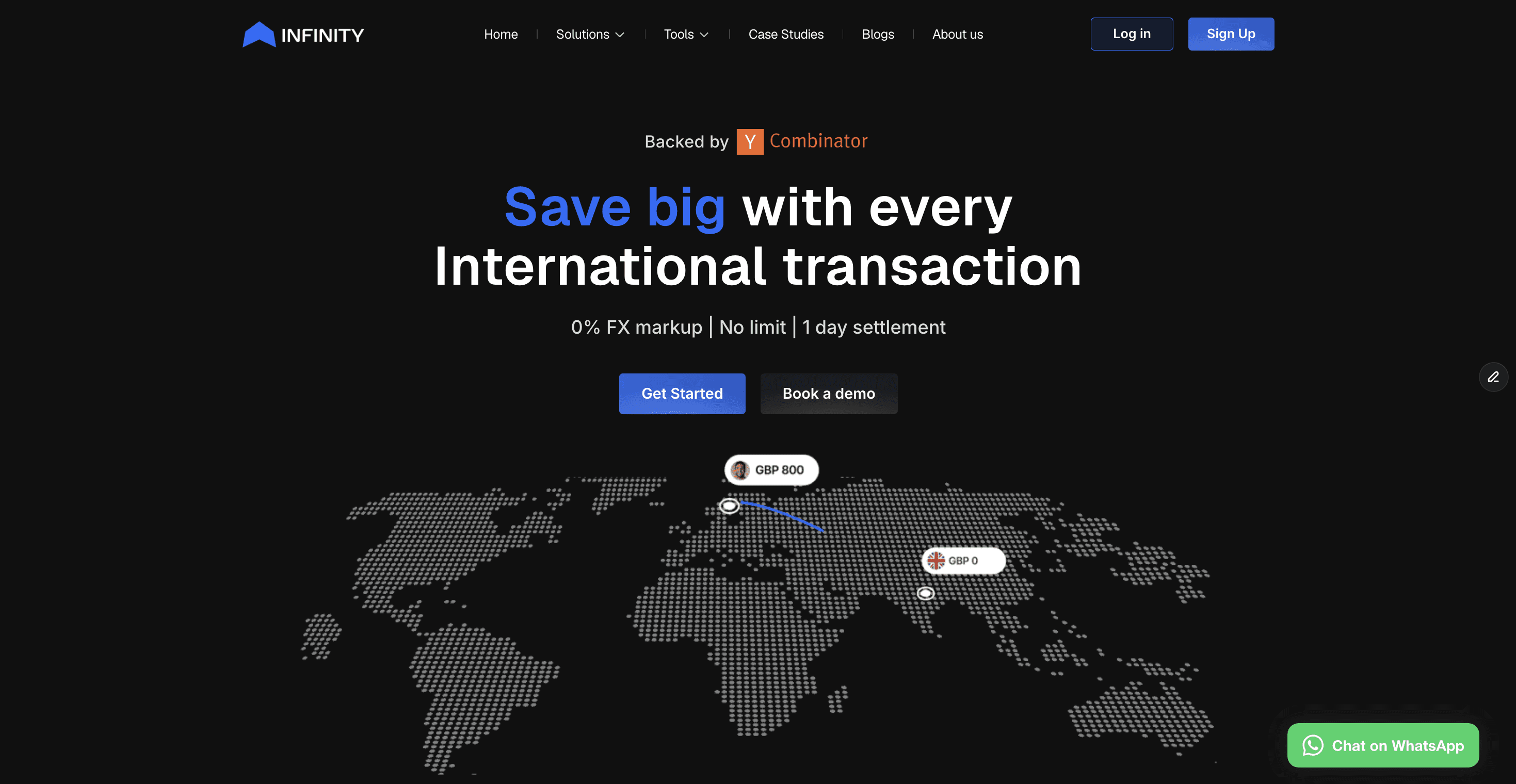
Choose Razorpay when:
You need international card payments
Customers need to pay directly on your website
You run e-commerce or SaaS
You want Payment Links
You already use Razorpay for Indian payments
Domestic and international payments need to remain in one stack
Consider Infinity when:
Most of your international revenue arrives through client invoices
You primarily work with overseas B2B customers
Bank transfers are acceptable to your clients
FX cost and final INR received matter heavily
Export-payment documentation is an important part of your workflow
You don't need Infinity to replace a domestic INR payment gateway
For example, a D2C brand selling a ₹5,000 product to individual customers in multiple countries would probably value Razorpay's checkout more.
An Indian agency billing three US customers $10,000 each per month has a very different problem.
For that agency, I would compare the total INR received after fees and FX rather than choosing a provider based on checkout features.
When Razorpay Is a Good Choice for International Payments
Razorpay makes sense when:
You're an Indian business selling internationally
You need international credit or debit cards
You need a proper online checkout
You already use Razorpay for domestic payments
You want Payment Links for overseas customers
Checkout conversion matters
You want multiple collection methods within the same payment ecosystem
When Razorpay May Not Be the Best Choice
Compare other options when:
You receive only a handful of large international invoices
Customers already prefer bank transfers
Every percentage point in fees materially affects your margins
Your website and KYC aren't ready
You need a dedicated cross-border account rather than a payment gateway
Settlement predictability is one of your highest priorities
You don't need online card checkout at all
Final Verdict: Should You Use Razorpay for International Payments?
Razorpay is a strong option for international payments when you need more than just a bank account number.
Its real advantage is the checkout experience.
International cards, Checkout, and Payment Links make Razorpay a useful choice for SaaS companies, e-commerce businesses, digital sellers, and businesses that already use Razorpay for domestic collections.
I’d look at it a little differently if I were an agency, freelancer, or consultant handling a few large invoices each month.
In that case, the customer’s payment preference, processing fee, FX rate, settlement timeline, and final INR amount matter more than having a polished card checkout.
Razorpay’s MoneySaver product helps address part of that by offering a cheaper international bank transfer option.
Even so, I’d compare it with dedicated cross-border collection platforms before relying on one provider for large recurring invoices.
My own experience with a held international payment also means I wouldn’t trust any provider without keeping proper invoices, contracts, and payment records ready.
So the real question isn’t just, “Is Razorpay good for international payments?”
For international checkout and card acceptance, Razorpay is one of the more practical options for an Indian business.
For large B2B international invoices, I’d compare bank-transfer options first.
That’s where fees, FX, and settlement timing can have a much bigger impact on how much money actually reaches your bank account.


