

Discover infinity

Subscribe to our newsletter
Get the latest updates, insights, and tips delivered straight to your inbox.
TL;DR
Cash Reserve Ratio (CRR) is the mandatory percentage of a bank's total deposits that must be held as liquid cash with the Reserve Bank of India (RBI). Indian banks cannot use this money for lending or investment.
The current CRR in India is 3% . This percentage is held unchanged at the RBI's Monetary Policy Committee (MPC) 60th meeting held on April 6–8, 2026, chaired by Governor Sanjay Malhotra.
Higher CRR = less money to lend = lower inflation. Lower CRR = more money to lend = economic growth stimulus.
Banks earn zero interest on the cash they hold with the RBI as CRR. This makes CRR as one of the most powerful and direct tools in the RBI's monetary policy arsenal.
Introduction to CRR
When you walk into a bank branch in Mumbai to apply for a home loan, you are not thinking about the Cash Reserve Ratio. And yet, CRR is silently influencing every one of these transactions.
The Cash Reserve Ratio is one of the most fundamental tools used by the RBI to manage the Indian economy. It determines how much money is available with banks to lend. This in turn shapes interest rates, credit availability, business investment, consumer spending, and ultimately the pace of India's economic growth.
In 2026, India's banking and monetary landscape is at a pivotal point. The RBI cut CRR by a cumulative 100 basis points in 2025 from 4% to as low as 3%. In the April 2026 MPC meeting, the RBI held CRR steady at 3%.
What Is Cash Reserve Ratio (CRR)?
The Cash Reserve Ratio (CRR) is a monetary policy tool. It is mandated by the Reserve Bank of India under Section 42(1) of the RBI Act, 1934. It refers to the minimum percentage of a commercial bank's total deposits that must be maintained as liquid cash with the RBI at all times.
In the simplest terms: every rupee that Indians deposit into their bank accounts forms the bank's total liability base. Out of this total, the bank is legally required to set aside a fixed percentage and keep it as cash with the RBI. This reserved cash cannot be used by the bank for any purpose . This includes lending to retail or corporate borrowers, not for investing in government securities, and not for any income-generating activity whatsoever.
The RBI holds this cash in a separate reserve account maintained by each scheduled commercial bank. The bank earns absolutely zero interest on this reserved amount. This becomes a significant financial cost for banks, since that money would otherwise be earning returns through lending or investment.
A simple example to illustrate CRR:
Suppose a bank has total deposits (NDTL) of ₹1,00,000. With the current CRR of 3%, the bank must keep ₹3,000 with the RBI as a mandatory cash reserve. The remaining ₹97,000 is what the bank can use for lending, investment, and other banking activities.
Which banks are required to maintain CRR?
All Scheduled Commercial Banks in India are required to maintain CRR. This includes public sector banks (SBI, PNB, Bank of Baroda), private sector banks (HDFC Bank, ICICI Bank, Axis Bank), foreign banks operating in India, and small finance banks.
However, Regional Rural Banks (RRBs) and Non-Banking Financial Companies (NBFCs) are not required to maintain CRR.
What is the Current CRR Rate in India (2026)
As of April 2026, the current Cash Reserve Ratio (CRR) in India is 3%. This is historically the lowest record since the inception of the modern CRR framework.
The 60th Monetary Policy Committee (MPC) meeting was held from April 6 to 8, 2026. The MPC voted to keep the CRR unchanged, that is at 3%. It was announced that no phased adjustments or modifications were to be made to CRR. This decision was consistent with the broader policy framework. This included frameworks like the Repo Rate (5.25%), Standing Deposit Facility rate (5.00%), and Marginal Standing Facility/Bank Rate (5.50%).
Current RBI Policy Rates at a Glance (April 2026)
Policy Instrument | Current Rate |
|---|---|
Cash Reserve Ratio (CRR) | 3.00% |
Repo Rate | 5.25% |
Reverse Repo Rate | 3.35% |
Standing Deposit Facility (SDF) | 5.00% |
Marginal Standing Facility (MSF) | 5.50% |
Bank Rate | 5.50% |
How Is CRR Calculated?
Understanding how CRR is calculated first requires the understanding of what NDTL (Net Demand and Time Liabilities) means. This is because CRR is always expressed as a percentage of a bank's NDTL, and not just its total deposits.
What Is NDTL?
Net Demand and Time Liabilities (NDTL) is the total deposits and borrowings of a bank, adjusted for certain inter-bank positions. In practical terms, it includes demand liabilities and time liabilities.
Demand Liabilities —It is a liability that a bank must repay on demand, without any advance notice. These include balances in current accounts, savings account deposits, overdue fixed deposits, demand drafts issued but not yet encashed, and cash certificates.
Time Liabilities —These are the liabilities that a bank repays after a fixed period of time. These include fixed deposits (FDs), recurring deposits (RDs), staff security deposits, gold deposits, and certain borrowings with a defined maturity.
The "Net" in NDTL refers to the fact that the bank's assets with other banks (such as interbank deposits) are netted against its liabilities to other banks. This is done to avoid double-counting across the banking system.
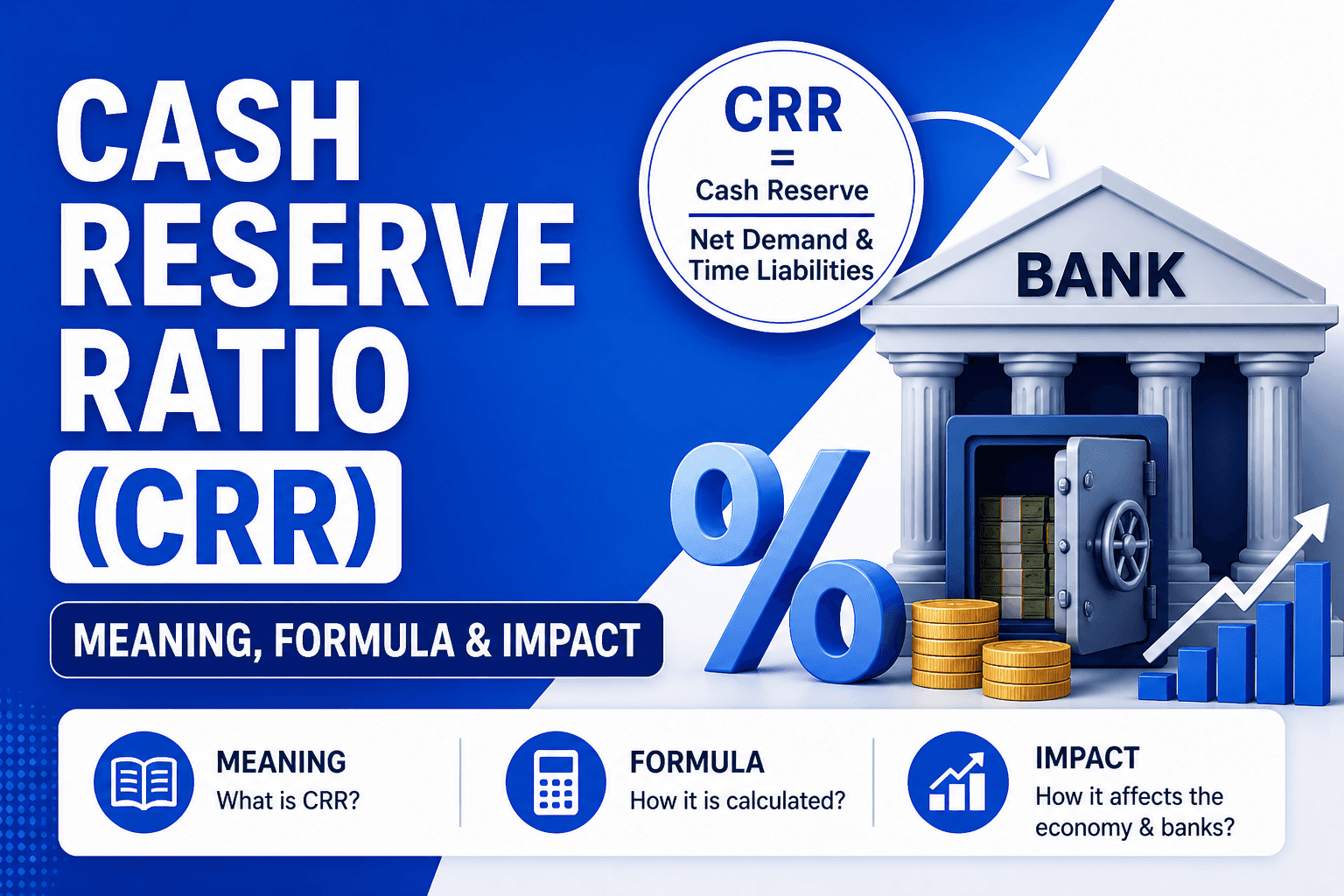
What is the CRR formula?
CRR Reserve Required = CRR% × NDTL
Step-by-Step Calculation Example
Let us walk through a detailed example to understand exactly how CRR is calculated in practice.
Suppose Bank ABC has the following liability structure:
Savings Account Deposits: ₹500 crore
Current Account Deposits: ₹200 crore
Fixed Deposits (various maturities): ₹700 crore
Recurring Deposits: ₹100 crore
Net Inter-bank Liabilities: ₹50 crore
Total NDTL = ₹1,550 crore
With a CRR of 3%:
CRR Reserve Required = 3% × ₹1,550 crore = ₹46.50 crore
This ₹46.50 crore must be maintained as cash with the RBI at all times. Bank ABC cannot use this amount for lending to home loan applicants, business borrowers, or any other purpose. It earns zero return on this ₹46.50 crore.

Why does the RBI uses CRR?
The Cash Reserve Ratio serves multiple interconnected objectives in India's monetary and financial framework. Understanding each objective helps explain why the RBI maintains a CRR.
Controlling Inflation
Controlling inflation is the most critical and visible role of CRR as a monetary policy tool. When the Indian economy experiences excess liquidity inflationary pressures build up. Prices rise, purchasing power erodes, and economic stability is threatened.
By raising the CRR, the RBI forces banks to park a larger proportion of their deposits with the central bank. This helps in directly reducing the pool of money available for lending.
Conversely, during periods of deflationary pressure or economic slowdown, the RBI can lower the CRR to release more money into the system. This stimulates lending, spending, and growth.
Ensuring Bank Liquidity and Depositor Safety
The CRR serves as a critical safety mechanism for India's banking system. Banks are required to maintain a minimum cash reserve with the RBI. This framework ensures that every scheduled commercial bank always has a baseline level of liquidity.
This is the "safety net" function of CRR. When depositors, whether individuals in Bangalore, businesses in Hyderabad, or institutions in Delhi, need to withdraw their money, the banking system must be able to honour those demands. The CRR ensures that a portion of every bank's deposits is always available in cash form with the country's central bank, providing a fundamental guarantee of liquidity.
Impact of CRR on the Economy
The CRR is not an abstract banking regulation. CRR changes have very real, tangible impacts on businesses, borrowers, depositors, and the broader Indian economy.
CRR vs Repo Rate — How They Work Together
CRR and the Repo Rate are the two most powerful tools in the RBI's monetary policy toolkit. They work best when used together in coordination. Understanding the difference between them, and how they complement each other, is essential for understanding how monetary policy in India works.
What Is the Repo Rate?
The Repo Rate is the interest rate at which the RBI lends short-term funds to commercial banks. It is India's primary short-term interest rate benchmark.
When the RBI cuts the Repo Rate, it becomes cheaper for banks to borrow from the RBI. Banks, in turn, can afford to lend at lower rates to their customers. This helps in making home loans, auto loans, business loans, and personal loans cheaper. Conversely, when the Repo Rate rises, bank borrowing from the RBI becomes more expensive. This causes the lending rates to go up, credit becomes costlier, and economic activity moderates.
As of April 2026, the Repo Rate stands at 5.25%. This remained unchanged at the April MPC meeting.
What is the difference between CRR and Repo Rate?
CRR and the Repo Rate operate through fundamentally different mechanisms and address different dimensions of liquidity.
CRR manages structural, long-term liquidity- Repo rate determines how much money the banking system holds in reserve on a permanent, ongoing basis. A CRR change affects the total pool of lendable funds across the entire banking system. This impacts every bank simultaneously and permanently until the next change.
Repo Rate manages short-term, transactional liquidity — Repo rate determines the cost at which banks can borrow from the RBI on a day-to-day basis to manage temporary cash flow mismatches. Repo Rate changes work through banks' decisions about whether and how much to borrow from the RBI. Banks earn no interest on CRR balances, but they pay interest (at the Repo Rate) when they borrow from the RBI under the repo window.
CRR Quick Reference — Comparison Table
For a clear, at-a-glance understanding of how CRR compares to India's other key monetary policy instruments, here is a comprehensive comparison table.
Parameter | CRR | SLR | Repo Rate | Reverse Repo Rate |
|---|---|---|---|---|
Full Form | Cash Reserve Ratio | Statutory Liquidity Ratio | Repurchase Rate | Reverse Repurchase Rate |
Current Rate (April 2026) | 3.00% | 18.00% | 5.25% | 3.35% |
Set By | RBI / MPC | RBI / MPC | MPC | RBI |
What It Is | % of deposits held as cash with RBI | % of deposits held in liquid assets by bank | Rate RBI lends to banks | Rate RBI borrows from banks |
Where Funds Are Held | With RBI (cash only) | With bank itself (cash, gold, govt. securities) | N/A (rate, not reserve) | N/A (rate, not reserve) |
Interest Earned by Bank | Zero | Can earn returns on govt. securities | Banks pay this to RBI | Banks earn this from RBI |
Applies To | Scheduled commercial banks | Scheduled commercial banks | All banks borrowing from RBI | All banks parking funds with RBI |
Frequently Asked Questions (FAQs) about Cash Reserve Ratio
Q1. What is the current CRR rate in India in 2026?
The current Cash Reserve Ratio (CRR) in India is 3%. It remained unchanged at the RBI's Monetary Policy Committee (MPC) 60th meeting held from April 6 to 8, 2026.
Q2. What is the difference between CRR and SLR?
CRR (Cash Reserve Ratio) requires banks to hold a percentage of their deposits as pure cash with the RBI. Banks earn zero interest on this amount and cannot use it for lending or investment. SLR (Statutory Liquidity Ratio) requires banks to hold a percentage of deposits in liquid assets. This includes cash, gold, and approved government securities.
Q3. What is NDTL and why does it matter for CRR?
NDTL stands for Net Demand and Time Liabilities. It is the base figure on which CRR is calculated. It includes a bank's demand liabilities (savings accounts, current accounts, overdue deposits) and time liabilities (fixed deposits, recurring deposits) net of inter-bank positions. CRR is calculated as a percentage of NDTL, not just a bank's headline deposit figure.
Q4. What happens if a bank fails to maintain CRR?
If a scheduled commercial bank fails to maintain its required average CRR balance during a reporting fortnight, the RBI imposes financial penalties.