
Export essentials


Subscribe to our newsletter
Get the latest updates, insights, and tips delivered straight to your inbox.
Two years ago, a friend who runs a small handicrafts export business from Jaipur called me in a panic. His shipment to a buyer in Germany was sitting at the port; customs would not clear it, and his bank was refusing to process the advance payment that had already landed in his account. The reason? His IEC code, the one he had applied for years ago and forgotten about, had gone inactive. He had not done the annual update DGFT requires, and nobody had told him that skipping it could freeze his ability to trade.
He got it sorted in a couple of days, but it cost him a shipment deadline and a lot of stress that could have been avoided with one online form filled out on time.
If you are exporting or importing anything from India, or even just planning to, the IEC code is one of those things you cannot afford to get wrong. In this guide, I will walk you through what it actually is, who needs it (and who does not), how to apply, and the one compliance step almost everyone forgets.
TL;DR
An IEC (Import Export Code) is a 10-digit code issued by the DGFT. It is required to import goods, export goods, or receive export payments in India.
It is linked to your PAN. One PAN number can have only one IEC.
Most goods and service exporters need an IEC, but there are exemptions (government bodies, personal use imports, small border trade, diplomats).
IEC has lifetime validity, but you must confirm or update your details on the DGFT portal every year between April and June. If not done, it gets deactivated.
IEC registration is fully online and costs around ₹500. It usually takes 1 to 3 working days.
Once your IEC is active, tools built for cross-border payments, like Infinity, make it easier to receive and document your international payments correctly.
What Is an IEC Code?
An IEC, short for Import Export Code (also called Importer Exporter Code), is a 10-digit business identification number issued by the Directorate General of Foreign Trade (DGFT), under the Ministry of Commerce and Industry. It is what allows you to legally import goods into India, export goods out of India, or receive payments in foreign currency for exports.
Since GST rolled out, your IEC is structurally tied to your PAN. Having a PAN does not automatically give you an IEC, though. You still need to apply for it separately through the DGFT portal, even if the number that gets issued matches your PAN. And in most cases, one PAN can have only one IEC linked to it.
Who Needs an IEC Code?
Whether you need an IEC depends largely on what you are trading and how.
Business type | Is IEC required? | Why |
Goods exporter | Yes | Mandatory for customs clearance of any commercial shipment |
Goods importer | Yes | Required by customs to clear incoming shipments |
Service exporter (consultant, freelancer, agency) | Usually yes | Banks typically ask for it to process inward foreign currency payments |
Business receiving export payments in USD/GBP/EUR | Yes | Banks require IEC to route and report foreign currency inward remittances |
Domestic-only business | No | Not needed if you are not importing, exporting, or receiving payments from abroad |
In short, if money or goods are crossing India's borders as part of your business, you almost certainly need an IEC.
Who Does Not Need an IEC Code
There are a few categories the government has specifically exempted:
Government entities – Central and State Government ministries and departments do not need an IEC for their trade activities.
Personal use imports or exports – If goods are being imported or exported for personal use and are not connected to trade, manufacturing, or agriculture, no IEC is required.
Small border trade – Trade with Nepal, Bhutan, or Myanmar through specified border posts is exempt, as long as the CIF (Cost, Insurance, and Freight) value of the consignment does not exceed ₹25,000.
Diplomatic personnel – Officials of foreign diplomatic missions and UN agencies posted in India are exempt.
If you fall outside these categories and you are dealing in cross-border trade or payments, you will need to register.

Documents Required for IEC Registration
Keep these documents ready before you start applying for IEC registration:
PAN card of the business entity (individual PAN for proprietorships, company PAN for registered entities)
Aadhaar card of the applicant or authorised signatory
Address proof of the registered office (rent agreement, utility bill, or similar)
Bank account details or a cancelled cheque
A recent passport-size photograph
Digital Signature Certificate (DSC), needed to sign the application online
Having these scanned and ready before you log in to the DGFT portal saves a lot of back-and-forth.
How to Apply for IEC Code: Step by Step
The following are the steps to apply for IEC code registration:
1. Go to the DGFT portal and register using your PAN and business details.
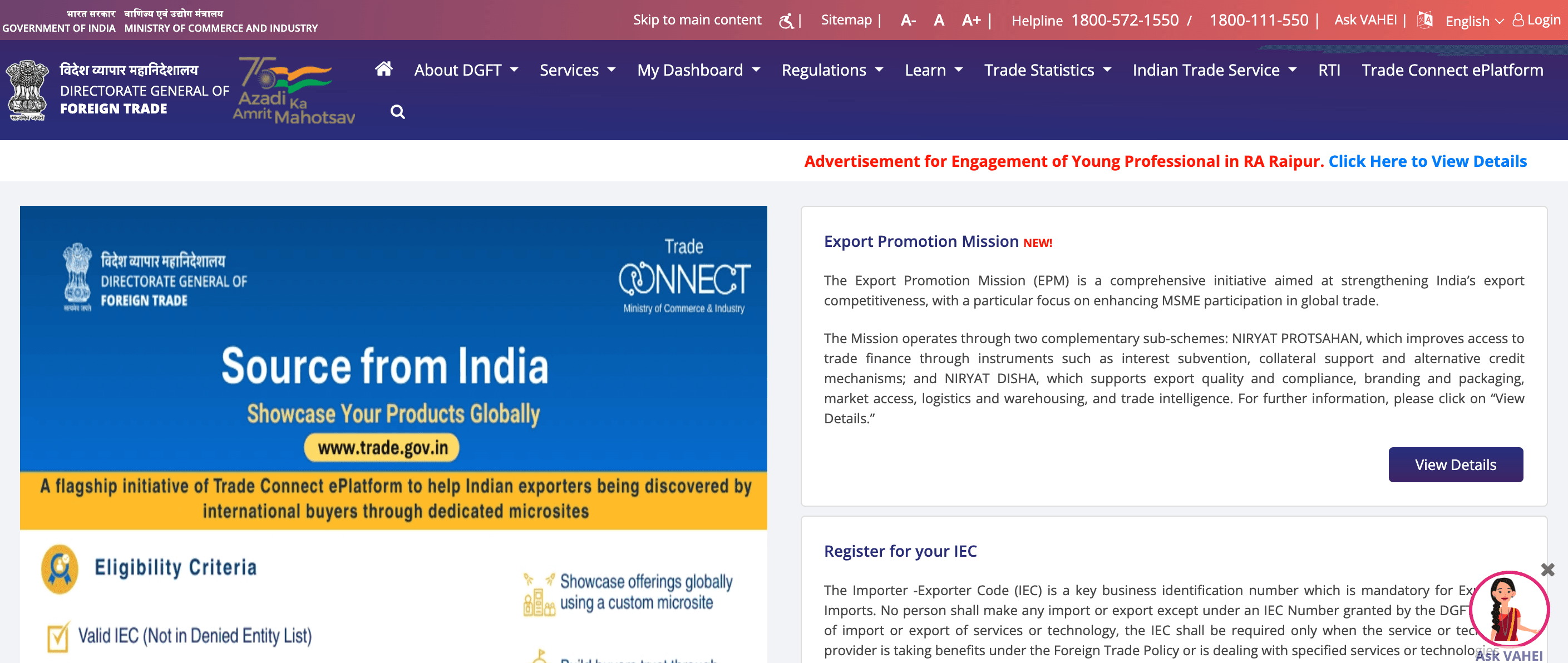
2. Register to create a new IEC account.
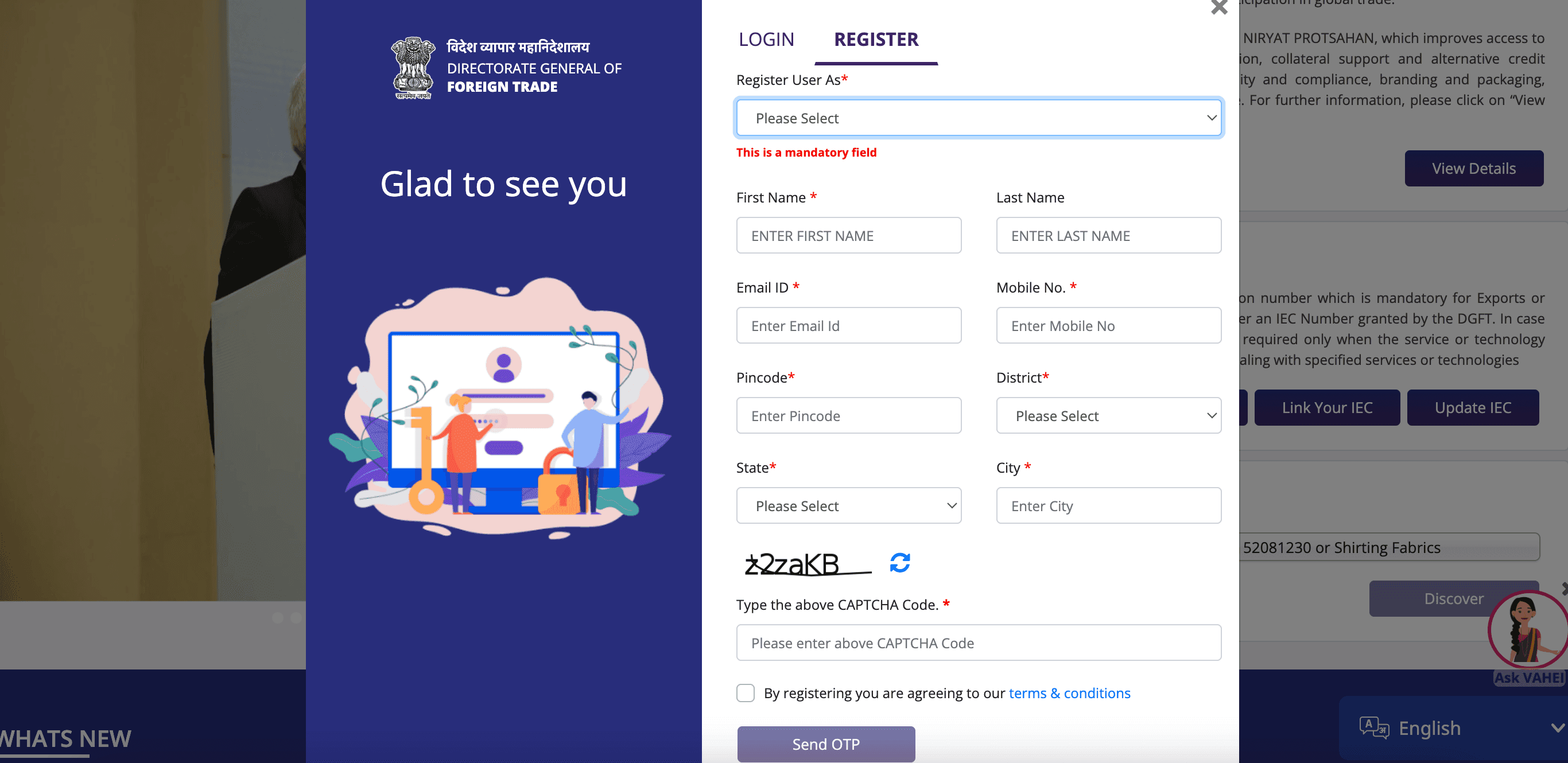
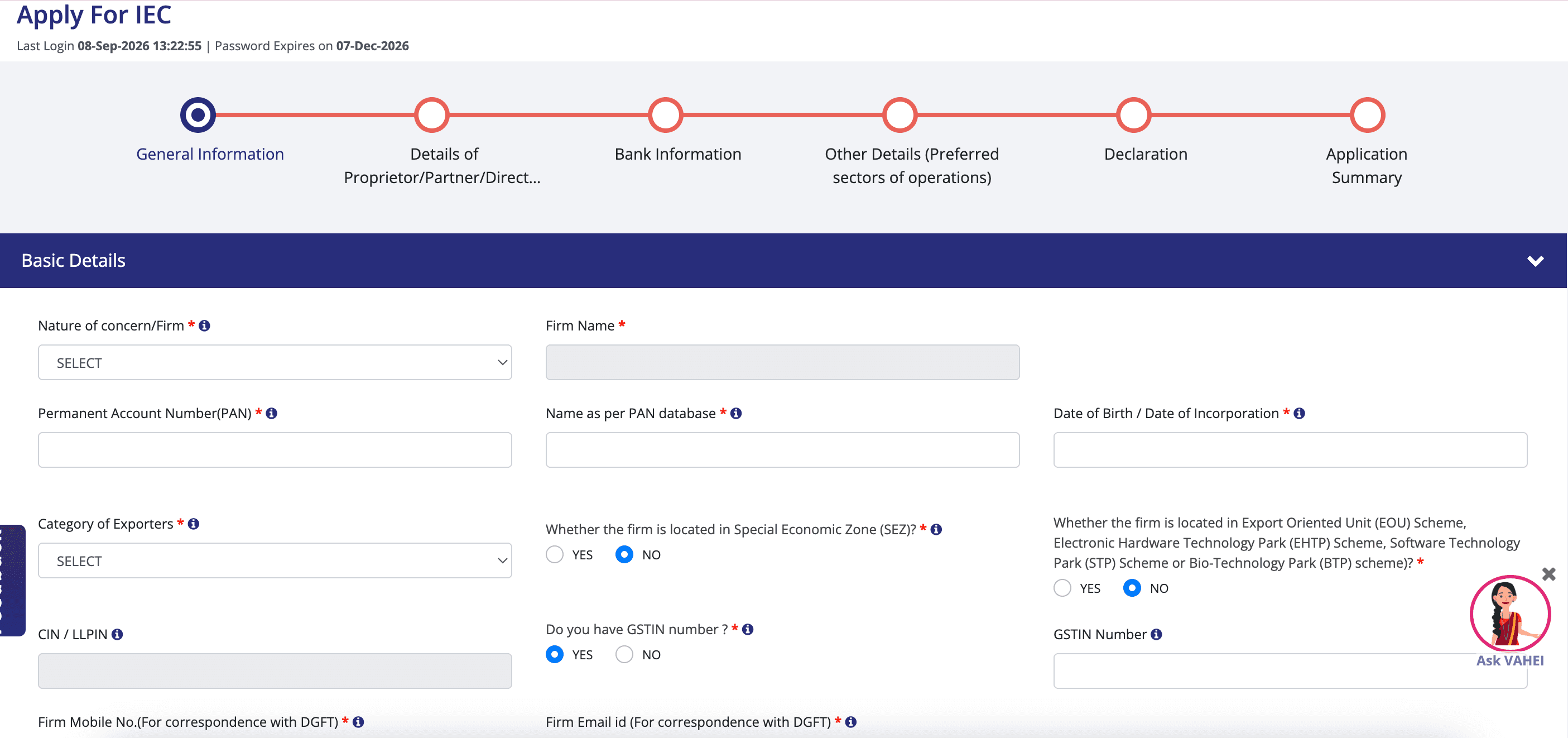
3. Fill out the IEC application form (ANF-2A) with your business type, address, and bank details.
4. Upload the required documents listed above.
5. Complete Aadhaar- or DSC-based authentication to verify your identity.
6. Pay the application fee, which is typically around ₹500, through the portal's payment gateway.
7. Submit the application. If everything is in order, the IEC is usually issued within 1 to 3 working days, sometimes the same day.
Once issued, you can download your IEC certificate directly from the portal.
IEC vs a Separate Import/Export License
This is a point of confusion for a lot of first-time exporters. For most regular goods, textiles, handicrafts, pharma, food products, and IT services, the IEC code itself is the only authorisation you need to export or import. You do not need a separate license on top of it.
Certain restricted categories are the exception. Items like weapons, specific chemicals, or hazardous waste require an additional import or export license from the relevant authority, on top of your IEC. If you are dealing in standard goods or services, this likely does not apply to you, but it is worth checking your product category against the DGFT's restricted list before you assume you are covered.
IEC Validity, Annual Update, and Common Mistakes
Here is the part that catches people out, including my friend from the Jaipur shipment story.
An IEC has lifetime validity. It does not expire the way a license or certificate might. However, DGFT requires every IEC holder to electronically confirm or update their IEC details once a year, typically between April and June. If you skip this, your IEC gets deactivated. A deactivated IEC means customs will not clear your shipments and banks will not process your foreign currency payments, even though the code itself technically still "exists."
Common mistakes to avoid:
Forgetting the annual update because nothing seems to have changed in your business
Assuming IEC issuance is a one-time task with no ongoing compliance
Not updating the IEC after a change in business address or bank details
Applying for a new IEC when you already have one linked to your PAN, instead of just updating the existing one
Set a yearly reminder for this. It takes a few minutes on the DGFT portal and can save you from the exact situation my friend went through.
How to Verify an IEC Code
If you want to check whether an IEC (yours or someone else's, for due diligence purposes) is valid and active, you can do this through either portal:
Via DGFT:
Go to the DGFT website and find the option to check or manage IEC details.
Enter the IEC number in the field provided.
Click Validate to see the current status.
Via ICEGATE:
ICEGATE also allows IEC verification, which is useful if you are checking the code in the context of a specific shipment or customs filing.
IEC Code and International Payments
Getting your IEC in order is really just the first step. What happens after is actually receiving and documenting your foreign currency payments correctly.
This is where a platform like Infinity comes into the picture. Once your IEC is active, every inward international payment you receive still needs to be tagged with the correct purpose code and documented properly for your bank and for compliance.
Infinity's purpose code finder and dedicated account manager help you identify the right code for your specific type of export. This removes the hurdle of guessing or calling your bank's support line. Infinity also auto-generates your FIRA (Foreign Inward Remittance Advice) for every payment received. FIRA is a document that you will need for GST refunds, tax filings, and RBI compliance. If you are new to this and unsure what documentation applies to your situation, Infinity's dedicated account managers can walk you through it based on your specific export setup.
If you have your IEC and your payment documentation both in order, it means that one less thing is standing between you and receiving international payment on time.
Sign up with Infinity today and start receiving payments seamlessly.
Frequently Asked Questions
Is IEC code mandatory for goods exporters?
Yes. An IEC is mandatory for customs clearance of any commercial goods shipment being exported or imported from India.
What is the cost and validity of an IEC code?
IEC registration costs around ₹500, and it has a lifetime validity. However, you must electronically confirm or update your details annually, typically between April and June. If this is not done, then your IEC gets deactivated.
What happens if I do not update my IEC annually?
Your IEC gets deactivated. This means customs will not clear your shipments, and banks will not process your foreign currency payments until you reactivate it by completing the update.
Can one IEC code be used for multiple businesses?
No. An IEC is linked to your PAN, and one PAN can have only one IEC. If you operate multiple businesses under different PANs, each will need its own IEC.
Is an IEC code required for service exports too?
Generally yes. Freelancers, consultants, and agencies exporting services and receiving foreign currency payments typically need an IEC, since banks require it to process inward remittances, even though the compliance nuances can differ slightly from goods exports.
Can I apply for an IEC code without a GST number?
Yes. Your PAN is sufficient to apply for an IEC, even if you are not GST-registered.