


Discover infinity


Subscribe to our newsletter
Get the latest updates, insights, and tips delivered straight to your inbox.
If you are a freelancer in India, getting paid by an international client should be simple. You finish the work, send the invoice, and receive the money in your bank account.
In practice, it is rarely that clean. A $1,000 invoice can shrink because of transfer charges, poor exchange rates, card fees, intermediary bank deductions, and unclear compliance paperwork. Many freelancers only notice the problem after comparing the invoice amount with the INR amount that finally lands in their bank account.
I am writing this as the founder of Infinity, so I will be direct about our point of view. We built Infinity because Indian freelancers, consultants, founders, and service exporters deserve a better way to receive international payments. Low fees matter, but they are only one part of the story. FX markup, settlement speed, and FIRA documentation matter just as much.
This guide compares the best payment gateways and international payment platforms for freelancers in India. Infinity is listed first because it is built specifically for this use case. The rest of the list is still honest. Some tools are better for card payments, some are better for marketplace payouts, and some are better for invoice management.
Quick Answer: Best Payment Gateways for Freelancers By Use Case
Infinity is the best first option for Indian freelancers who want to accept international payments with low fees, transparent FX, fast settlement, and FIRA support.
Choose Skydo if you want global accounts and flat-fee B2B payment collection.
Choose Xflow if you are a service exporter or agency that needs stronger compliance support.
Choose Wise if transparent FX and eFIRC are your main priorities.
Choose Razorpay or Cashfree if you need a full Indian payment gateway with payment links and card support.
Choose PayPal if your client insists on it and the invoice amount is small enough that the fee is acceptable.
Choose Payoneer if most of your income comes through global marketplaces.
Choose Refrens if you want invoicing and payment collection in one place.
The bigger point is simple. Do not choose a payment platform only by brand name. Compare the final INR received, FX markup, settlement speed, and compliance documents. That is what decides how much of your international income you actually keep.
Also Read - How to Receive International Payments as a Freelancer
Payment Gateway vs. International Payment Account: What Freelancers Actually Need
These two payment terms are often used interchangeably, but they serve very different purposes.
A payment gateway is a checkout payment infrastructure that lets a payer complete a payment. This can be done using UPI, cards, net banking, or wallets. The payment gateway collects payment from the payer and then settles the INR into your bank account. Razorpay, Cashfree, and Instamojo are classic payment gateways in India.
An international payment collection account (sometimes called a cross-border payment platform or virtual account) works differently. Your client makes a bank transfer or card payment in their local currency — USD, EUR, GBP — and the platform converts and settles INR into your account. Infinity and other cross-border payment platforms operate this way.
The reason why most Indian freelancers will eventually need both is that your Indian clients will pay via UPI or bank transfer and expect a local payment experience. On the other side, your international clients will wire in foreign currency, and they may not even have a UPI handle. One tool rarely handles both routes cleanly.
Also Read - How to Get Paid as a Freelancer
How We Ranked These Payment Gateways
Each platform was evaluated on the basis of the following criteria. It is evaluated in the context of an individual Indian freelancer or small agency:
Domestic payment modes supported: UPI, credit/debit cards, net banking.
International support: USD, EUR, GBP, CAD; card payments; local bank transfers; SWIFT
Landed INR after all costs: gateway fee + GST on fee + FX markup + withdrawal or intermediary fees
FIRA/ FIRC/e-FIRA availability: required for export income documentation
Purpose-code handling: clarity on RBI purpose codes for software/service exports
Settlement speed: T+1 vs T+2 vs T+5 or longer
Individual freelancer onboarding: whether you need a GST number, a current account, or a registered company
No-code invoicing and payment links: usable without a website or developer
Client-side friction: how familiar or easy the payment experience is for a foreign client
Account stability and support: history of holds, freezes, or slow dispute resolution.
9 Best Payment Gateways for Freelancers in India (2026)
Platform | Domestic payments | Bank transfer / ACH | Card payments | Payment links/checkout | Global receiving accounts | 0% FX markup | FIRA / eFIRC | Built-in invoicing |
|---|---|---|---|---|---|---|---|---|
Infinity | No | Yes | No | No | No* | Yes | Yes | No* |
Skydo | No | Yes | No | No | Yes | Yes | Yes | Yes |
Xflow | No | Yes | No | No | Yes | No* | No* | Yes |
Wise Business | No | Yes | No | No | Yes | Yes* | Yes | No* |
Razorpay | Yes | No* | Yes | Yes | No | No | No* | No* |
Cashfree Payments | Yes | Yes* | Yes | Yes | No | No | Yes | No* |
PayPal | No | No | Yes | Yes | No | No | No* | No |
Payoneer | No | Yes | Yes | No* | Yes | No | No* | No |
Refrens | No* | Yes | Yes | Yes | No | No* | No* | Yes |
#1. Infinity- Best for International Payments for Freelancers in India

Infinity is best for Indian freelancers, consultants, agencies, and service exporters who want to receive international payments in India without losing money to hidden FX markup or slow bank processes.
Why Infinity is best for freelancers
Most freelancers do not need a complicated enterprise payment stack. They need a simple way to receive money from foreign clients, settle it into their Indian bank account, and keep the right compliance documents ready.
That is the exact problem Infinity is built for. Freelancers working with clients in the US, UK, Europe, Canada, Singapore, Australia, and other global markets often lose money in three places: platform fees, currency conversion, and bank-side deductions. The visible fee is not always the real fee. FX markup can quietly become the highest cost.
Infinity focuses on making this clearer. The platform offers a flat 0.5% transaction fee, 0% FX markup, one-day settlement, and free FIRA with every withdrawal. For a freelancer who receives payments every month, those differences can add up to a meaningful amount over a year.
Fees
Flat 0.5% transaction fee.
0% FX markup claim.
Free FIRA with every withdrawal.
Custom fee for transactions above USD 50,000.
For example, on a USD 1,000 payment, the platform fee would be about USD 5 based on the 0.5% fee. The final INR amount will still depend on the live exchange rate and the exact payment route.
Compliance
Infinity provides FIRA with withdrawals and works through an RBI-approved framework with RBI-authorised banks. This matters because Indian freelancers receiving foreign income should maintain proof that the money came from outside India.
Freelancers should keep their invoice, client details, work agreement or email approval, purpose code, PAN, bank records, FIRA, and GST or LUT documents if applicable.
Pros
Built for Indian freelancers and exporters.
A flat 0.5% fee is simple to understand.
0% FX markup claim helps reduce hidden deductions.
Free FIRA support helps with compliance records.
One-day settlement helps freelancers manage cash flow.
Good fit for recurring clients and larger international invoices.
Cons
Infinity is newer than PayPal, Payoneer, Razorpay, and Cashfree.
Some overseas clients may not know the name yet.
It may not be the right fit if a client insists on paying only through PayPal.
Freelancers should confirm supported currencies and payment routes before moving all client payments.
2. Skydo
Best for
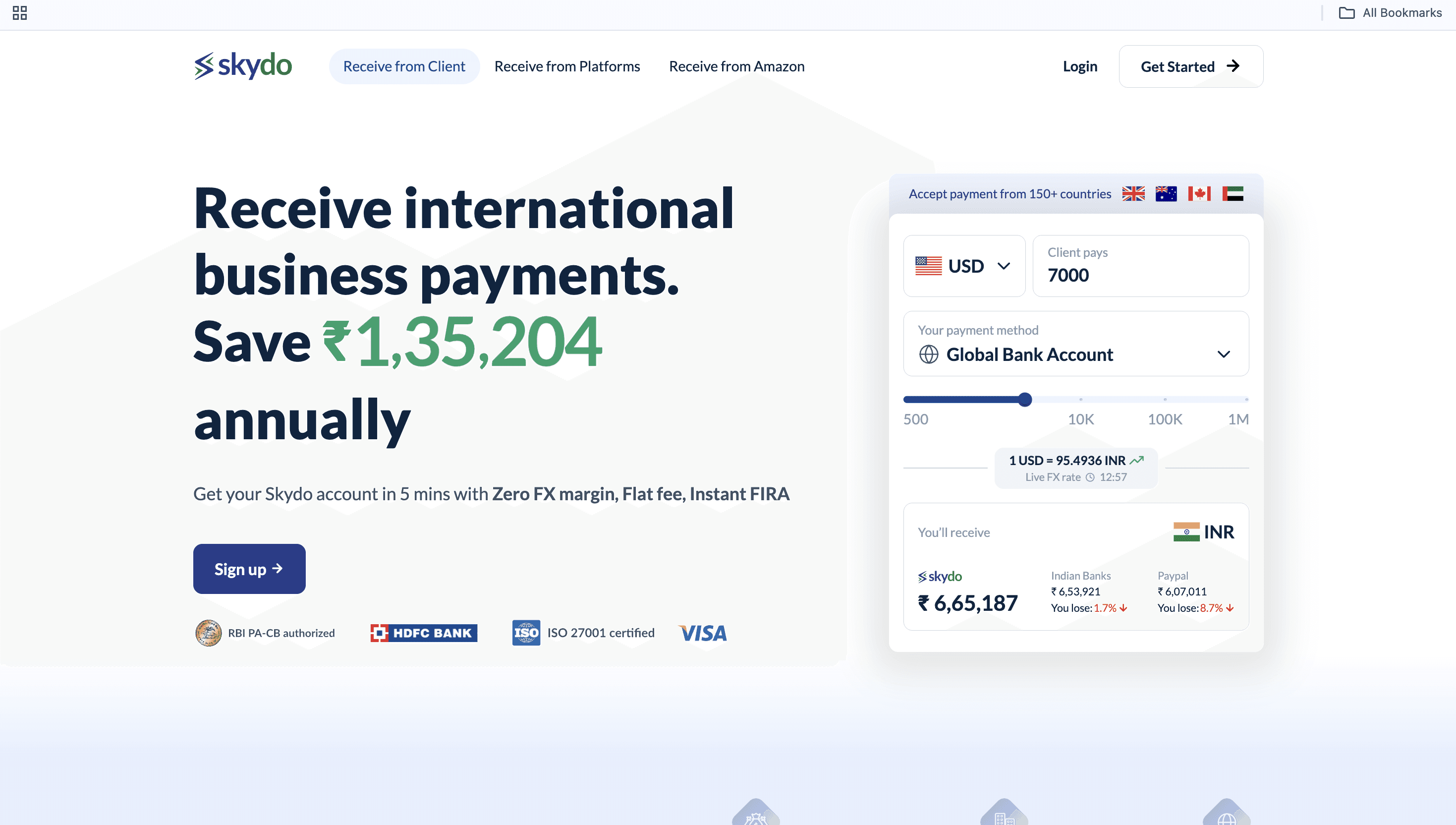
Skydo is best for freelancers and service exporters who want global receiving accounts, flat fees, zero FX margin, and instant FIRA.
Why Skydo is good for freelancers
Skydo works well when your client prefers paying through a bank transfer instead of a card. Many B2B clients, agencies, and overseas companies are more comfortable paying invoices through local bank transfer, ACH, or wire-style rails.
Skydo gives Indian exporters global account details, so clients can pay in a way that feels familiar to them. The freelancer receives INR in India. This can reduce the confusion that often comes with traditional SWIFT payments.
Fees
Payments up to USD 2,000: USD 19.
Payments from USD 2,001 to USD 10,000: USD 29.
Payments above USD 10,000: 0.3%.
Custom pricing for higher monthly volumes.
GST applies to the transaction fee.
On a USD 1,000 payment, the fee would be around USD 19. This can be higher than percentage-based platforms for small invoices, but it can work well for larger invoices.
Compliance
Skydo highlights instant FIRA, RBI PA-CB authorisation, GST-compliant invoicing, and global accounts for service exporters. These features make it useful for freelancers who want cleaner export documentation.
Pros
Strong India-specific international payment product.
Instant FIRA support.
Good for B2B bank-transfer clients.
Transparent flat-fee model.
Useful for freelancers with higher invoice values.
Cons
A flat USD 19 fee may feel high for small invoices.
Not a traditional checkout gateway for card-heavy clients.
Better for export payments than casual one-off client payments.
3. Xflow
Best for
Xflow is best for freelancers, IT consultants, service exporters, and small agencies that want foreign currency receiving accounts with stronger compliance support.
Why Xflow is good for freelancers
Xflow is useful when a freelancer is moving from solo freelancing into a more formal export business. It supports receiving accounts, invoicing, next-day settlement, 24x7 withdrawals, and compliance support for inward remittance documentation.
This makes it a practical option for developers, software consultants, marketing agencies, and service exporters who need more than a basic wallet or payment link.
Fees
For USD invoices up to USD 2,000: USD 12.
Above USD 2,000: 0.6%.
For invoices from USD 2,000 to USD 10,000: USD 20 up to USD 5,000, then 0.4% above USD 5,000.
Custom pricing for USD 10,000+ invoices.
On a USD 1,000 payment, the fee would be around USD 12 based on public pricing.
Compliance
Xflow mentions bank confirmation letters on inward remittance, support for SOFTEX and EDPMS flows, and a compliance desk. This is useful for software exporters and Indian service businesses that need formal documentation.
Pros
Transparent pricing.
Good for B2B export payments.
Useful compliance support.
Helpful for freelancers growing into small agencies.
Cons
More business-focused than casual freelancer-focused.
Clients may need to use bank transfer routes.
Not as globally recognised as PayPal or Payoneer.
4. Wise Business
Best for
Wise Business is best for Indian freelancers who want transparent FX rates and eFIRC support for international transfers.
Why Wise is good for freelancers
Wise is not a classic payment gateway. It is better described as an international transfer and receiving platform. Still, it belongs in this list because many freelancers searching for payment gateways are really looking for a cheaper way to receive money from abroad.
Wise is strong because it shows fees clearly and uses the mid-market exchange rate. This helps freelancers understand what they are paying instead of guessing how much they lost in conversion.
Fees
Wise fees vary by currency and route. Wise’s India page showed a USD 1,000 example where the total, including fees, was around USD 21.37, including Wise fee, eFIRC fee, and GST on Wise fees.
Compliance
Wise says it provides eFIRC for every transfer and works with a local bank partner in India with RBI approval. Freelancers should confirm whether their business type and payment route are eligible before using it for all payments.
Pros
Transparent fees and FX.
eFIRC support.
Good for clients who already use Wise.
Strong global brand.
Cons
Not a full checkout payment gateway.
Not ideal if clients want to pay by card.
Fees vary by currency and route.
Product availability can change by region.
5. Razorpay
Best for
Razorpay is best for freelancers and small businesses that want a mainstream Indian payment gateway with domestic and international payment support.
Why Razorpay is good for freelancers
Razorpay is one of India’s most recognised payment gateways. It is useful for freelancers who want to look more like a formal business and collect payments through payment links, checkout pages, cards, UPI, and other methods.
It is especially useful for consultants, designers, developers, coaches, agencies, and productised service providers who accept both Indian and international payments.
Fees
Razorpay pricing depends on payment method, product, business type, and international payment activation. Freelancers should check the exact international pricing inside Razorpay before choosing it. International card payments usually cost more than domestic payments.
Compliance
Razorpay states that its payment aggregation services are provided by an RBI-authorised Payment Aggregator. Freelancers should confirm whether FIRA or FIRC is available for their specific international payment flow.
Pros
Strong Indian brand.
Good dashboard and payment links.
Useful for domestic and international collections.
Developer-friendly APIs.
Good for freelancers becoming small businesses.
Cons
International payment activation may require approval.
Fees can be higher than those on bank-transfer-focused platforms.
FX and compliance documents need to be verified for the exact setup.
More complex than Infinity, Skydo, or Wise for simple inward payments.
6. Cashfree Payments
Best for
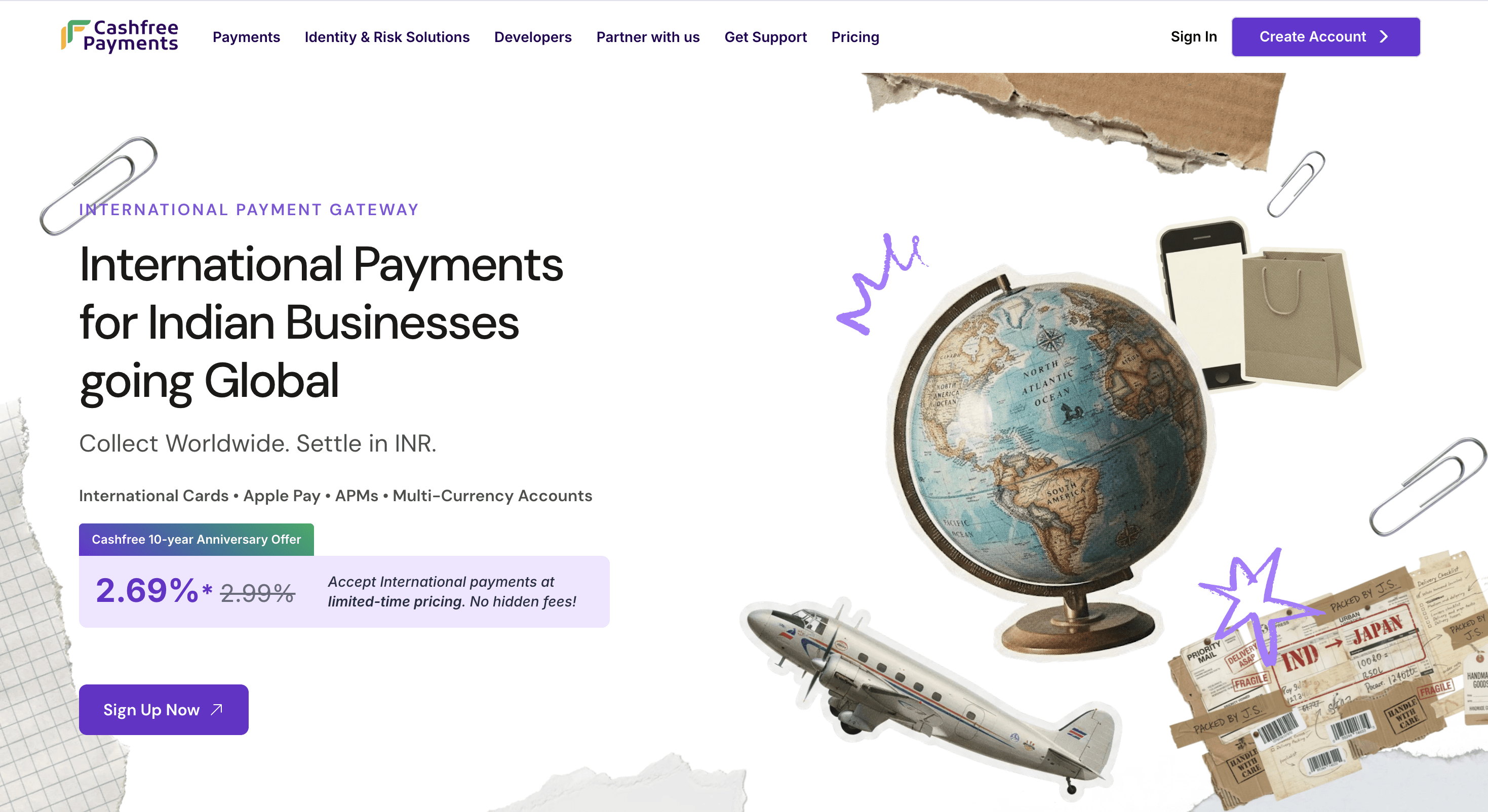
Cashfree is best for freelancers and consultants who want no-code payment links, domestic payment methods, international cards, PayPal support, and FIRC support.
Why Cashfree is good for freelancers
Cashfree works well when a freelancer needs a proper payment gateway rather than only a receiving account. If a client wants to pay by card, PayPal, or a payment link, Cashfree can be more suitable than bank-transfer-first tools.
It is also useful for freelancers who serve both Indian and international clients because it supports a broad range of domestic payment methods along with international payment collection.
Fees
Cashfree’s pricing page showed limited-time pricing around 2.69% to 2.99% for international card transactions, subject to conditions. Custom pricing is also available.
On a USD 1,000 international card payment at 2.69%, the fee would be about USD 26.90 before considering other applicable charges or currency effects.
Compliance
Cashfree’s freelancer page mentions automated FIRCs for international payments, INR settlement, KYC, and secure checkout.
Pros
Strong Indian payment gateway.
Good no-code payment links and forms.
Supports domestic and international payments.
FIRC support.
Useful when clients prefer cards.
Cons
International card fees can be higher than those of bank-transfer-based tools.
Promotional pricing may have conditions.
Final INR settlement depends on FX and payment route.
Better for payment collection than pure low-cost remittance.
7. PayPal
Best for
PayPal is best for freelancers whose clients already use PayPal or insist on paying through PayPal.
Why PayPal is good for freelancers
PayPal’s biggest advantage is client familiarity. Many international clients already trust it. If a client wants to pay quickly and does not want to deal with a bank transfer, PayPal can reduce friction.
The tradeoff is cost. PayPal is convenient, but for Indian freelancers, it can be expensive once international transaction fees and FX conversion are included.
Fees
PayPal India’s merchant fee page states that Indian users are supported for international payments. It lists receiving international transactions from outside India at 4.40% plus a fixed fee. It also lists currency conversion for payments received in another currency at 3.0% above the base exchange rate.
On a USD 1,000 payment, the fee plus FX impact can become significant. A rough estimate using 4.4%, a USD 0.30 fixed fee, and 3% FX markup comes to about USD 74.30. The actual amount depends on the currency and route.
Compliance
Freelancers should keep PayPal transaction records, invoices, client details, bank credit entries, purpose codes, and tax records. If FIRA or eFIRC is required, confirm the process before using PayPal for large payments.
Pros
Globally recognised.
Easy for foreign clients.
Supports cards and PayPal wallet.
Fast to start.
Good for small or occasional payments.
Cons
High fees.
FX markup can reduce earnings.
Limited India-specific account features.
Not ideal for large invoices.
Compliance documents can be less direct than freelancer-focused platforms.
8. Payoneer
Best for
Payoneer is best for freelancers who receive money from global marketplaces such as Upwork, Fiverr, Amazon, and international platforms.
Why Payoneer is good for freelancers
Payoneer is widely used by freelancers, marketplace sellers, affiliate marketers, and platform-based service providers. It is useful when the platform you work on already supports Payoneer as a payout method.
It can also provide receiving accounts in major currencies, which may make it easier for some clients or platforms to pay you.
Fees
Payoneer’s fee page states that receiving from a payer using a credit card can cost up to 3.99% plus USD 0.49 or equivalent. Fees depend on sender location, recipient location, payment method, and currency. Currency conversion charges may also apply.
On a USD 1,000 card payment with a 3% FX assumption, the total cost can approach USD 70.39. The real charge depends on the route and account setup.
Compliance
Indian freelancers should verify whether eFIRA or FIRA is available for their exact receiving route. They should also check whether marketplace payout documents are enough for their accountant and tax records.
Pros
Strong marketplace support.
Multi-currency receiving.
Well-known among freelancers.
Useful for recurring marketplace income.
Cons
Fee structure can be confusing.
FX markup can reduce earnings.
Less transparent than Wise, Infinity, or Skydo.
Not always the best option for direct client invoices.
9. Refrens
Best for
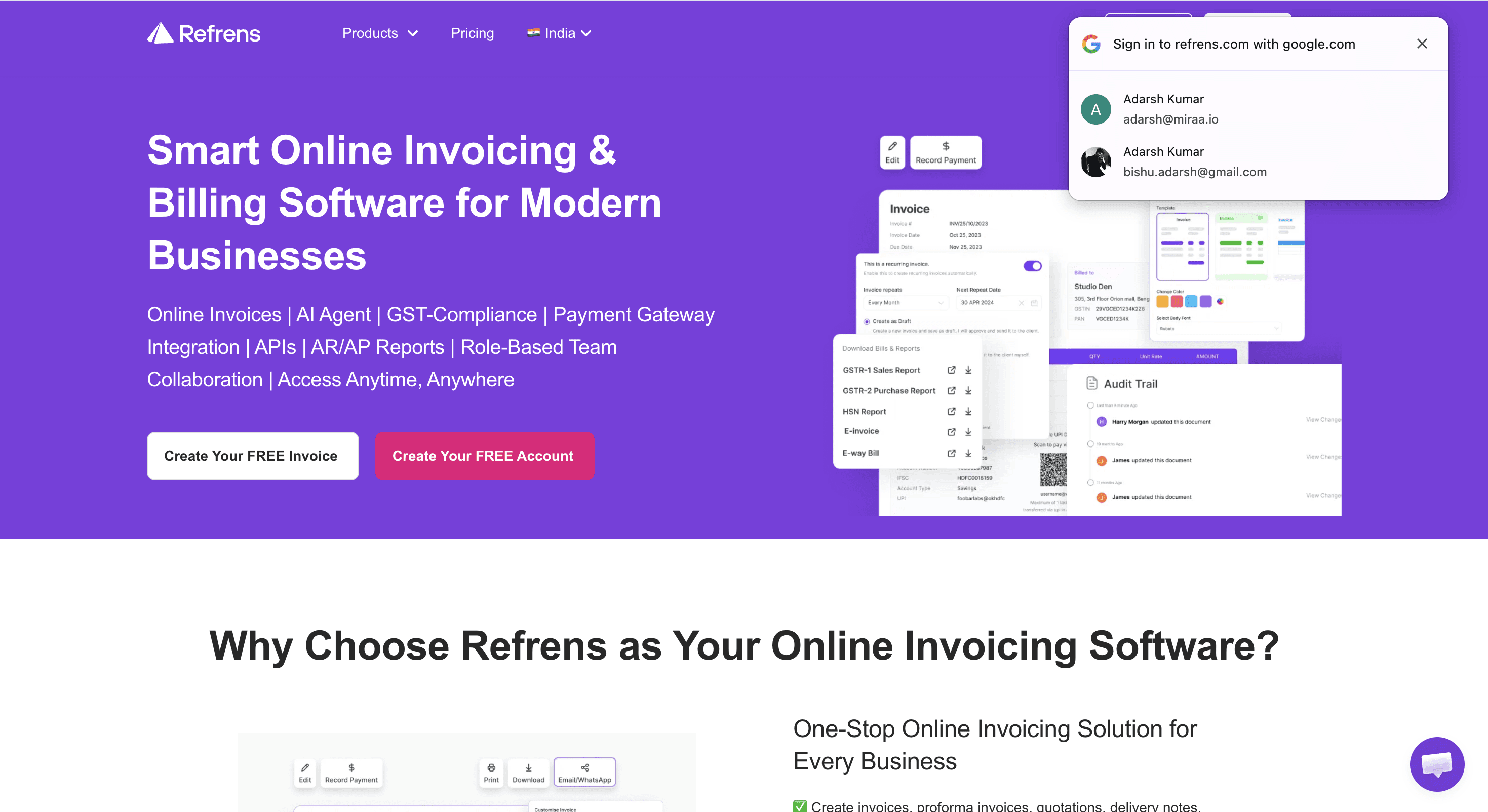
Refrens is best for freelancers who want invoicing and international payment collection in the same workflow.
Why Refrens is good for freelancers
Refrens is not just a payment gateway. It is an invoicing and business management platform with international payment acceptance. This makes it useful for freelancers who want to create invoices, send them to clients, track payments, and collect money through card, ACH, wire, Wise, or bank transfer.
For consultants, designers, writers, developers, and agencies, the invoicing workflow can be just as important as the payment method.
Fees
ACH or wire transfer: 1.5%.
Credit or debit card: 4% or less.
No hidden charges or setup fees, according to Refrens.
Settlement up to T+2 business days.
Refrens says 95% of payments settle in T+1 days.
On a USD 1,000 payment, ACH or wire would cost around USD 15. A card payment may cost up to USD 40.
Compliance
Refrens requires KYC for international payments. For freelancers, it lists documents such as address proof, past invoices, bank statements showing payments against invoices, and online presence such as a website, professional profile, Upwork profile, or Fiverr profile.
Pros
Strong invoicing workflow.
Good for professional billing.
ACH, wire, and card options.
Clear public pricing.
Useful KYC and compliance flow.
Cons
Not always the cheapest option.
Card payments cost more than ACH or wire.
Not as focused on FX savings as Infinity, Wise, or Skydo.
Best for invoice-led freelancers, not every payment use case.
Best Payment Gateway For Freelancers in India: (Quick Cost Comparison)
Platform | Approximate cost on USD 1,000 | Best use case |
|---|---|---|
Infinity | About USD 5 | Low-cost international payments with FIRA. |
Xflow | About USD 12 | Export payments and compliance support. |
Refrens ACH or wire | About USD 15 | Invoice-led payments. |
Skydo | About USD 19 | Bank-transfer-led B2B payments. |
Wise | About USD 21.37 in a sample shown by Wise | Transparent FX and eFIRC. |
Cashfree | About USD 26.90 at 2.69% | International card payments and payment links. |
Refrens card | Up to USD 40 | Invoice payments by card. |
Payoneer | Can approach USD 70+ | Marketplace payouts. |
PayPal | Can approach USD 74+ | Client familiarity and quick, small payments. |
How To Choose the Right Payment Gateway as a Freelancer
If your priority is the lowest cost
Start with Infinity. The 0.5% fee and 0% FX markup claim make it a strong first choice for Indian freelancers receiving international payments.
If your client wants to pay by bank transfer
Compare Infinity, Skydo, Xflow, and Wise. These options are usually better suited for foreign bank-transfer-style payments than traditional card gateways.
If your client wants to pay by card
Look at Razorpay, Cashfree, PayPal, Stripe, or Refrens. Card payments are convenient for clients, but the fees are often higher.
If you work through marketplaces
Payoneer can be useful because many global platforms already support it. But compare the FX and withdrawal costs before using it for direct client payments.
If you need invoices and payments together
Refrens is a good fit because it combines invoicing with payment collection. This is useful for freelancers who want professional billing, reminders, and client records.
Compliance Checklist for Indian Freelancers
Documents to keep
Invoice sent to the client.
Client name, country, and address.
Work agreement, contract, email approval, or purchase order.
Purpose code for inward remittance.
FIRA or eFIRC, where available.
Bank credit statement.
PAN.
GST registration details, if applicable.
LUT, if exporting services without IGST.
SOFTEX records, if applicable for software export cases.
Common mistakes to avoid
Choosing a platform only because the client already knows it.
Ignoring FX markup.
Not collecting FIRA or eFIRC.
Mixing personal and business payments.
Not adding payment terms to invoices.
Accepting large international payments without checking compliance requirements.
Documents Indian Freelancers Should Keep for International Payments
Good documentation habits protect you at tax time and during any FEMA compliance query. Keep these for every international payment you receive:
Invoice — with invoice number, date, client name, currency, and service description
Client contract or email approval — proving the payment is for a legitimate service export
Payment receipt — from the platform or your bank, confirming the inward remittance
FIRA / FIRC / e-FIRA — the Foreign Inward Remittance Advice or Certificate from your bank or platform
RBI Purpose Code — the correct code for the nature of services (software, consulting, creative services, etc.)
GST invoice or LUT letter — if your turnover requires GST registration; LUT is relevant for zero-rated export invoices
Platform payout statement — monthly or per-transaction download from your payment platform
Fee invoice from the payment platform — for the fee deducted at source, useful for input cost accounting
Missing a FIRC or FIRA is one of the most common year-end problems for freelancers. Set a habit of downloading documentation within 7 days of every international payment.
Do Freelancers Need GST, a Current Account, or an IEC?
These questions come up constantly, and the honest answer is: it depends on your situation. Here is the practical guidance, with the caveat that you should confirm specifics with a CA.
GST: Registration is required once your turnover exceeds ₹20 lakh (₹10 lakh for special category states) in a financial year. For export of services, international freelance income is treated as zero-rated under GST, meaning you do not charge GST to foreign clients, but you may still need to register and file a LUT (Letter of Undertaking) to avoid paying IGST on exports. If your turnover is below the threshold, GST registration is optional.
LUT (Letter of Undertaking): LUT is relevant if you are GST-registered and exporting services. LUT allows you to export without paying any GST and then claim a refund.
IEC (Importer-Exporter Code): The IEC code is beneficial for the export and import of goods and provides some export-related benefits. Service exporters like freelancers usually do not require an IEC code. But you must confirm with your bank or CA if you are pursuing other DGFT incentives.
Current Account: Most payment platforms can work with a savings account, but many larger platforms and banks prefer or require a current account once your transaction volumes grow. Some cross-border platforms may require a current account as part of their onboarding. Check platform-specific requirements.
The payment platforms' onboarding rules are stricter than the underlying tax law. A payment platform may require you to activate certain features to make sure you are legally compliant.
Common Mistakes Freelancers Make with Payment Gateways
Choosing PayPal by default because the client recognises the name. PayPal is often the most expensive route. Present alternatives — Payoneer virtual accounts, Infinity, or a SWIFT transfer, with a brief explanation of why it is better for both parties.
Comparing fees without checking the FX rate. A 1% gateway fee with a 3% FX markup costs more than a 2% gateway fee at mid-market. Always get the all-in number.
Not collecting FIRA or FIRC for every foreign payment. Missing documentation creates problems with IT filing and can flag FEMA queries. Collect it every time.
Using the wrong RBI purpose code. Miscoding your export income (software services as "miscellaneous" rather than the correct IT/software code) can cause complications during FEMA compliance checks. Look up the correct code for your service category.
Mixing domestic UPI collections with international export income without documentation. UPI payments from Indian clients and wire transfers from foreign clients should be tracked separately.
Assuming one platform handles everything. Most freelancers need two tools — one for Indian clients, one for international clients. Using only one often means accepting either poor FX rates or limited domestic payment modes.
Final Verdict: Which Payment Gateway Should Freelancers Choose?
The best payment gateway depends on how your clients pay and what matters most to your business.
For international client payments, Infinity is the strongest overall option for Indian freelancers who want lower fees, no FX markup, faster settlement, and FIRA support. It is especially suitable for recurring invoices and larger payments where even a small difference in fees can significantly affect your earnings.
For domestic and international card payments, Cashfree or Razorpay may be more practical. Payoneer works well for marketplace payouts, while Refrens is a good option when invoicing and payment collection need to happen in one place. PayPal remains useful when a client insists on using it, but its higher transaction and currency-conversion costs make it less suitable as a default option.
In practice, many freelancers will benefit from using two payment platforms: one for Indian clients and another for international payments. A combination such as Cashfree or Razorpay for domestic collections and Infinity for overseas invoices can cover most payment scenarios without forcing you to compromise on fees, convenience, or compliance.
Before choosing, compare the complete cost—not just the advertised transaction fee. Check the FX rate, settlement time, supported currencies, payment method, and whether FIRA or eFIRC is included. The right platform is the one that lets your client pay easily while ensuring that more of the payment reaches your bank account.


