

Global payments


Subscribe to our newsletter
Get the latest updates, insights, and tips delivered straight to your inbox.
Your UAE client is ready to pay. Should they send a bank transfer, use a payment platform, or pay through an online link?
The right option depends on how your client wants to pay, which currencies the provider supports, and how much you will receive after fees and currency conversion. If your invoice is in UAE dirhams (AED), confirm that your chosen payment route accepts AED before sharing your payment details.
This guide covers the main ways to receive payments from the UAE, the costs to consider, what to do if a transfer is delayed, and which documents to keep for your records.
TL;DR
Choose a payment method: Use an international bank transfer, global receiving account, or payment link.
Check AED support: Confirm that your bank or provider supports the payment route before sharing details.
Compare costs: Check fees, exchange rates, and the final INR amount you’ll receive.
Check settlement time: Timelines vary by payment method. Infinity settles eligible transactions within one business day.
Keep payment records: Save your invoices, payment confirmations, and FIRA documents, where available.
How Can You Receive Money From the UAE in India?
You can receive payments from UAE clients through an international bank transfer, a global receiving account or an online payment link. The best choice depends on your client's preferred payment method, your invoice currency, and the fees involved.

1. International Bank Transfer
Your UAE client can send money to your Indian bank account through a supported international transfer route, such as SWIFT.
First, ask your Indian bank for its instructions for incoming international payments. You will generally need to share your beneficiary name, account number, bank details, and SWIFT/BIC code. Use the exact details your bank provides for the transfer.
Check the payment currency before your client sends the money. If they want to pay in AED, ask your bank whether it can receive AED through that route, how the funds will be converted into INR, and which charges may apply.
The sending bank or intermediary banks may deduct fees before the money reaches your account. Ask your bank for an estimated credit amount and processing time so you know what to expect.
Best for: Large or occasional invoices, especially when your client prefers paying directly from a business bank account.
2. Global Receiving Account
A global receiving account lets you receive payments in supported foreign currencies. Share your account details with your client, who sends the payment using an available transfer method. The provider processes the payment and transfers the funds to your account according to its settlement terms.
Apart from AED, Infinity offers global receiving accounts for supported currencies, including USD, EUR, GBP, AUD and CAD. Eligible transactions also support payment tracking and settlement in INR.
If your client can pay in a supported currency, agree on the invoice currency first. Then compare the transaction fee, exchange rate, and estimated INR payout before sharing your receiving details.
Best for: Businesses and independent professionals who receive international payments regularly and want to manage their receiving details and payment tracking through one platform.
3. Payment Link
A payment link lets you request money online without asking your client to manually arrange a bank transfer. Depending on the provider and your account eligibility, your client may be able to pay through an online checkout method, such as a card.
Infinity QuickLinks lets eligible users create payment requests for overseas clients. For eligible card-payment links, the client does not need an Infinity account to make the payment.
Before sharing the link, check the invoice amount, payment currency, available payment methods, and processing fee. If you have quoted a fixed amount, agree on who will cover the fee so it does not reduce the amount you expect to receive.
Payment links can make collection easier for clients who prefer to pay online. However, card payments may cost more than bank transfers, so compare the fee for the method your client will use.
Best for: Clients who prefer paying online rather than arranging an international bank transfer.
Can UAEFTS or Aani Transfer Money Directly to India?
No. UAEFTS and Aani are part of the UAE's domestic payment infrastructure. Neither is, by itself, a payment instruction for sending money directly to an Indian bank account.
UAEFTS supports fund transfers between participating financial institutions within the UAE. Aani is the UAE's instant-payment platform for domestic digital payments.
If your client suggests using either service, ask their bank or payment provider whether it can arrange the full cross-border transfer to your Indian account. The payment still needs a supported international route to reach India.

Which is the Best Way to Receive Payments From UAE Clients?
The best option depends on your invoice amount, how often you receive payments, and how your client prefers to pay. Compare the amount you are likely to receive in INR, not just the transaction fee.
Payment Method | Best Suited For | What To Compare |
International bank transfer | Large or occasional invoices | Bank charges, exchange rate, intermediary fees and transfer time |
Global receiving account | Regular payments in supported currencies | Currency support, transaction fee, conversion rate and settlement process |
Payment link or card payment | Clients who prefer online checkout | Card fee, supported currencies, refunds, chargebacks and settlement terms |
You can choose a payment method based on your needs:
Large invoices: Compare fees and exchange rates to estimate how much you’ll receive after conversion.
Recurring payments: Check whether the provider supports your clients’ currencies and payment frequency.
AED invoices: Confirm that the provider can receive AED through a supported payment route before sharing payment details.
Card payments: Check processing fees in advance, especially for high-value invoices.
If your client is open to different payment methods, compare the expected INR payout and processing time before making a decision.
How Much Does It Cost to Receive Payments From the UAE?
The total cost may include transaction fees, currency-conversion costs, and charges from the sending or intermediary banks. As a result, the amount credited to your account may be lower than the amount your client sends.
Infinity has separate fees for its standard global bank-payment service and QuickLinks card payments.
Payment Method | Fee |
Standard global bank payment service | 0.5% transaction fee, with no added FX markup |
QuickLinks card payment | 5%, subject to a minimum fee of USD 5 |
Note: These fees apply to different services. The 0.5% transaction fee is for the standard global bank-payment service, not QuickLinks card payments. Check the applicable bank-transfer pricing and QuickLinks card fees before requesting payment.
No added FX markup means the provider does not add its own markup to the exchange rate for the service described. It does not automatically mean that every possible bank, card, or transfer-related charge is covered. Check the terms for your chosen payment method before confirming the transaction.
How much is a 0.5% transaction fee?
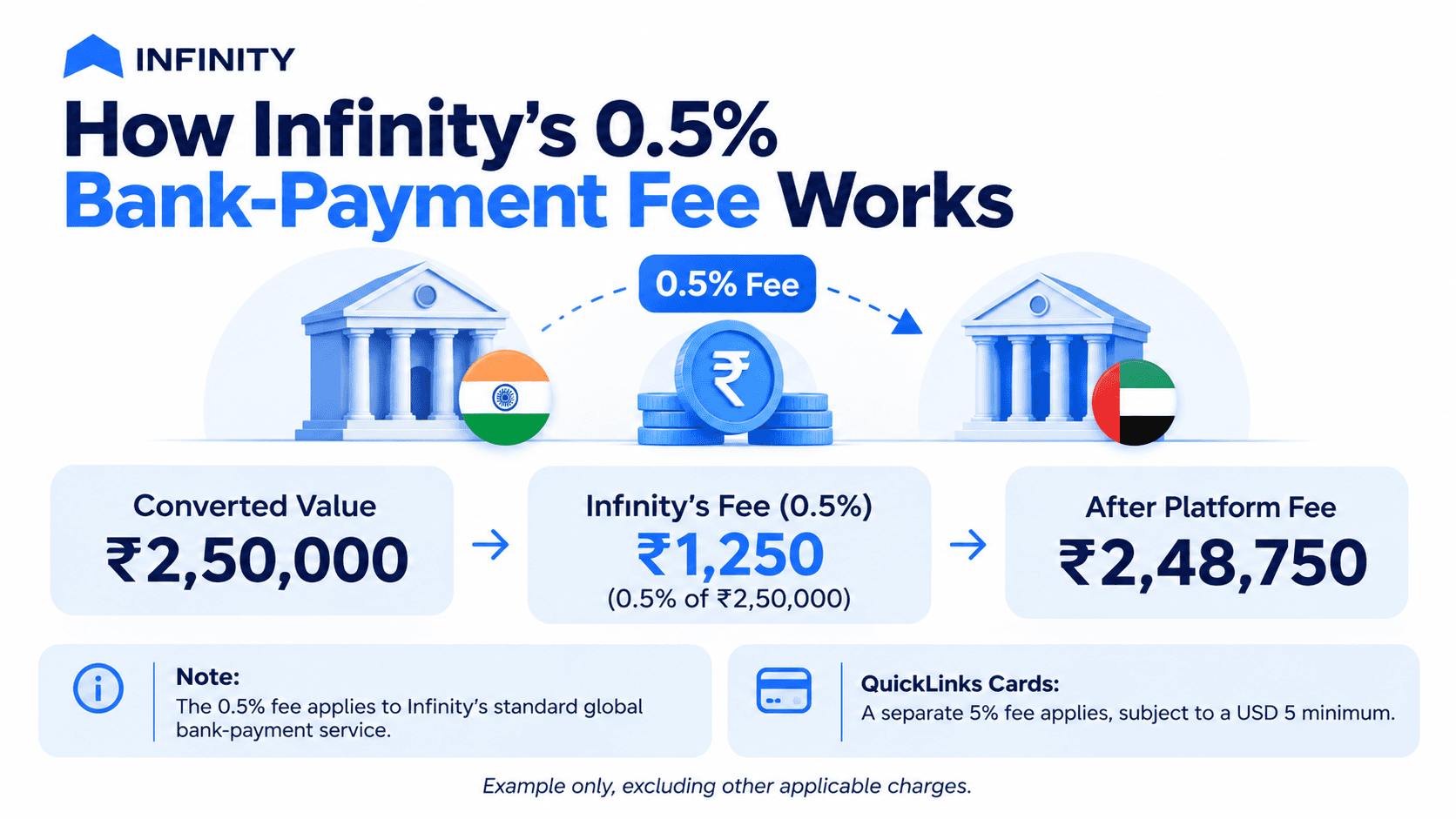
Suppose you receive an eligible payment worth ₹2,50,000 after currency conversion but before the platform fee.
Calculation | Amount |
Converted payment value | ₹2,50,000 |
Fee at 0.5% | ₹1,250 |
Amount after the fee | ₹2,48,750 |
The calculation is straightforward: 0.5% of ₹2,50,000 is ₹1,250, leaving ₹2,48,750 after the fee.
This example explains how the percentage works. It is not a quote for an AED transfer or a guarantee of your final payout. The actual amount depends on the supported payment route, the exchange rate, and any other applicable charges.
Before your client pays, check the fee and estimated INR amount for your specific transaction.
How Do You Convert AED to INR?
The INR value of an AED payment depends on the exchange rate used when you convert the money. To estimate the amount before fees, multiply the AED invoice value by the applicable AED-to-INR rate.
For example, the INR value of an AED 10,000 invoice will change as exchange rates move. The rate you check when preparing the invoice may also differ from the rate used when the payment is processed.
An AED-to-INR currency converter can help you estimate the value. Infinity also offers an AED-to-INR converter that displays the live mid-market rate. However, the converter does not confirm whether your bank or provider can collect AED through your required payment route, and its displayed rate does not guarantee the amount you will receive.
Before your client makes the payment, check the exchange rate, fees, and how much INR you’ll receive. Also, make sure the money reaches the right bank account, and confirm how long it should take.
Compare the final amount you’ll receive, not just the transaction fee. A provider with lower fees may still give you less money if it offers a less favourable exchange rate or charges extra fees.
How Long Does It Take to Receive a Payment From the UAE?
An international bank transfer usually takes several business days to reach your Indian bank account. The exact time depends on the transfer route, the banks involved, cut-off times, holidays, and any verification checks.
Infinity offers settlement within one business day for eligible international payments. However, not every payment from the UAE will reach your account within 24 hours. The time it takes to send the money and the time it takes to reach your account can differ. Check the expected timeline for your payment before choosing a method.
You can avoid preventable delays by sharing the correct receiving details and ensuring the payment amount, currency, and invoice information match.
What Should You Do if Your UAE Client's Payment is Delayed?
Start by asking your client whether their bank has processed the transfer. Request the payment confirmation and transaction reference so that the sending bank, receiving bank, or payment provider can trace the payment.
Follow these steps:
Check the payment details: Make sure the amount, currency, recipient’s bank details, and transfer date are correct.
Ask for proof of transfer: If the payment was sent through SWIFT, ask your client for the MT103 copy or other payment confirmation from their bank, if available.
Contact the sending bank: Ask whether the payment is still being processed, has been held for checks, or has been returned.
Contact your receiving bank or provider: Share the transaction reference and invoice so the team can investigate.
Provide supporting documents: Your bank or provider may ask for an invoice, contract, or explanation of the payment's purpose.
Do not ask your client to send the money again until the original transfer has been investigated. A second transfer could lead to duplicate payments and reconciliation problems.
Two terms may come up while tracking a SWIFT transfer:
MT103: A SWIFT customer credit transfer message traditionally used to provide details about an international payment. Your bank may provide an MT103 or equivalent confirmation, depending on the payment.
UETR (Unique End-to-End Transaction Reference): A unique reference used to track a SWIFT payment across participating banks.
Which Documents Should You Keep After Receiving an International Payment?
Keep the invoice, payment confirmation, and transaction or bank record for every international payment. These records help you match the money received with the goods or services you billed for.
Depending on the transaction, you may also need:

FIRA (Foreign Inward Remittance Advice): Records details of an inward remittance and provides evidence of the payment.
Contract or purchase order: Helps establish the commercial purpose of the payment.
Supporting records: Your bank or provider may request additional information about the goods, services or purpose of the payment.
Infinity provides FIRA documentation for eligible transactions under its service terms. When you receive it, check that the details match the relevant payment and save it with the invoice and transaction record.
A FIRA is evidence of an inward remittance, but it does not automatically fulfil every tax, GST or export-reporting requirement. Your obligations depend on your business and the nature of the transaction, so check which requirements apply to your work.
How Can You Receive Payments Safely?
A few simple checks can help you avoid payment delays, duplicate transfers and fraud.
Check your receiving details: Make sure the account and beneficiary details are correct before sharing payment instructions with your client.
Confirm the payment has arrived: Don’t rely on a screenshot or email alone. Check your bank balance or transaction history.
Be careful with overpayments: If a client pays extra and asks for a refund, confirm with your bank or payment provider that the money has arrived before sending anything back.
Keep your records handy: Save your invoices, payment confirmations, transaction references, and remittance documents.
Use official channels: Share documents and respond to verification requests only through your bank’s or payment provider’s official channels.
Receive Payments From UAE Clients Through Infinity
Before sending an invoice to a UAE client, confirm the payment currency and available route. Check the transaction fee, expected INR payout, and settlement timeline so you know what to expect.
Infinity helps eligible Indian businesses and independent professionals receive international payments through supported global receiving arrangements and QuickLinks. The standard global bank-payment service has a 0.5% transaction fee with no added FX markup. QuickLinks card payments have a separate 5% fee, subject to a minimum charge of USD 5.
The available currencies, payment methods, fees and settlement times depend on the service and transaction. If your client wants to pay in AED, you confirm the supported route with Infinity before proceeding.
See how Infinity makes it easier to receive international payments with clear fees and zero FX markup.
Frequently Asked Questions About Receiving International Payments From UAE to India
1. Can I receive AED directly into my Indian bank account?
It depends on your bank and the transfer method. Check whether your bank accepts AED transfers, how it will convert the money to INR, and what fees apply. It’s best to confirm these details before your client sends the payment.
2. Can I use Infinity to receive payments from UAE clients?
Yes, for eligible payments through supported routes. Infinity offers global receiving accounts in supported currencies, including USD, EUR, GBP, AUD and CAD. You can also use QuickLinks for eligible payment requests. If your client wants to pay in AED, check with Infinity first to confirm the available payment options.
3. What fee does Infinity charge for international payments?
Infinity charges a 0.5% transaction fee with no added FX markup for its standard global bank-payment service. QuickLinks card payments have a separate 5% fee, subject to a minimum charge of USD 5. Check the applicable pricing for your chosen payment method before requesting payment.
4. How long does a UAE-to-India payment take?
A bank transfer from the UAE to India can take a few business days, depending on the banks and transfer method. With Infinity, eligible payments can be settled within one business day. Check the expected timeline for your payment before choosing a transfer method.
5. What is a FIRA and will I receive one?
A FIRA (Foreign Inward Remittance Advice) is a document that shows details of money received from abroad. Infinity provides a FIRA for eligible transactions. Keep it along with your invoice and payment records, and check if you need any other documents for tax or compliance purposes.


