

Global payments


Subscribe to our newsletter
Get the latest updates, insights, and tips delivered straight to your inbox.
Infinity vs PayPal
You have just wrapped up a month of solid client work. The invoice went out. The payment came in.
You open your PayPal dashboard for payments, and instead, you see a notification: "Your account has been limited." Or you do the maths on what you actually received versus what you have invoiced. And then you realise that PayPal quietly took 7–9% of your hard-earned money across transaction fees and a currency conversion rate.
If this sounds familiar, you are not the only one. Across freelancer communities, startup forums, and export business groups in India, the frustration with PayPal is the same. It is too expensive and unpredictable. And in reality, Indian professionals have far better options.
In this blog, we have evaluated the 7 best PayPal alternatives available to Indian freelancers, exporters, SaaS businesses, and agency owners in 2026. We will be covering fees, FX markup, settlement speed, FIRA compliance, and real-world usability. This will help you in making an informed switch and keep more of what you earn.
7 Best PayPal Alternatives
Platform | Best For | Platform Fee | FX Markup | Settlement | FIRA/eFIRC | Indian Freelancers/Exporters/SaaS |
All-round lowest cost | 0.5% all-in | Zero | 24 hours | Free, auto | All types | |
Wise | Multi-currency flexibility | ~1.65% + GST | Zero | 1–2 days | $2/cert | Freelancers/sole props only |
Payoneer | Marketplace freelancers | 1–3% | Up to 3% | 2–5 days | Free | All types |
Stripe | SaaS/e-commerce dev | 4.3% + 2% FX | 2% | 7+ days | No | Invite-only |
Xflow | Enterprise, B2B, API | $12/$20/custom | Zero | 1 business day | Free, auto | All types |
Dodo Payments | Digital products, SaaS MoR | 4% + $0.40 + 1.5% intl | Included | 5–7 days | No (MoR model) | SaaS/digital products |
Razorpay | Domestic + intl combo | 1–3% + GST | Zero (export a/c) | T+7 days | Available | All types |
PayPal (reference) | Occasional small invoices | 4.4% + $0.30 | 3–4% | 2–5 days | Monthly batch | Restrictions apply |
Common Issues With PayPal in India
Before diving into alternatives, it is important to understand why so many Indian professionals are looking for alternatives. Let's have a look at them one by one-
1. Devastating Fees: 7–9% Per Transaction
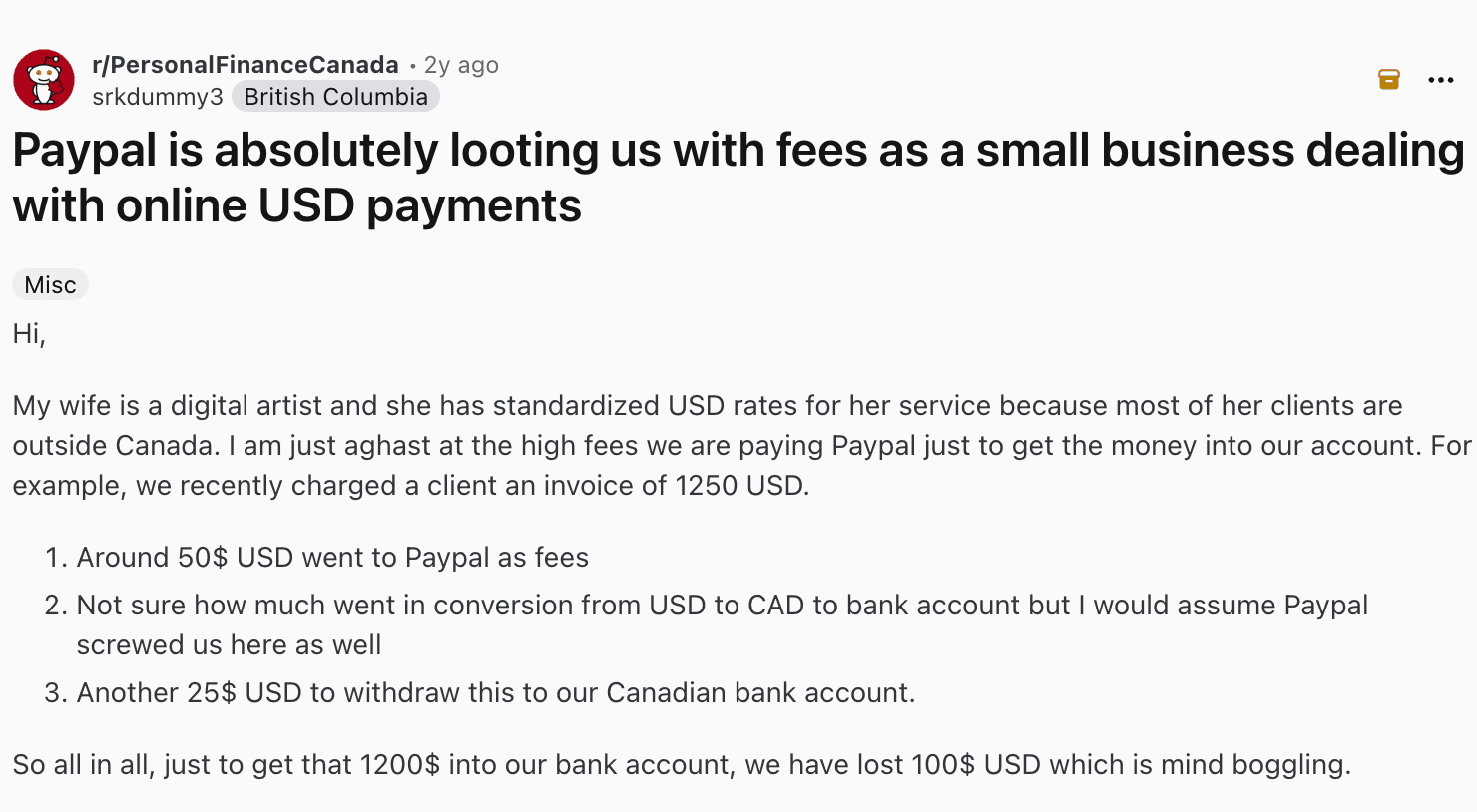
PayPal charges a 4.4% transaction fee plus a $0.30 fixed fee on every international payment received. On top of that, when the international payment is converted into INR, PayPal applies a 3–4% markup above the mid-market rate. The combined effective cost sits between 7% and 9% per transaction.
Source: Reddit
2. Account Freezes: Funds Held for 21 to 180 Days
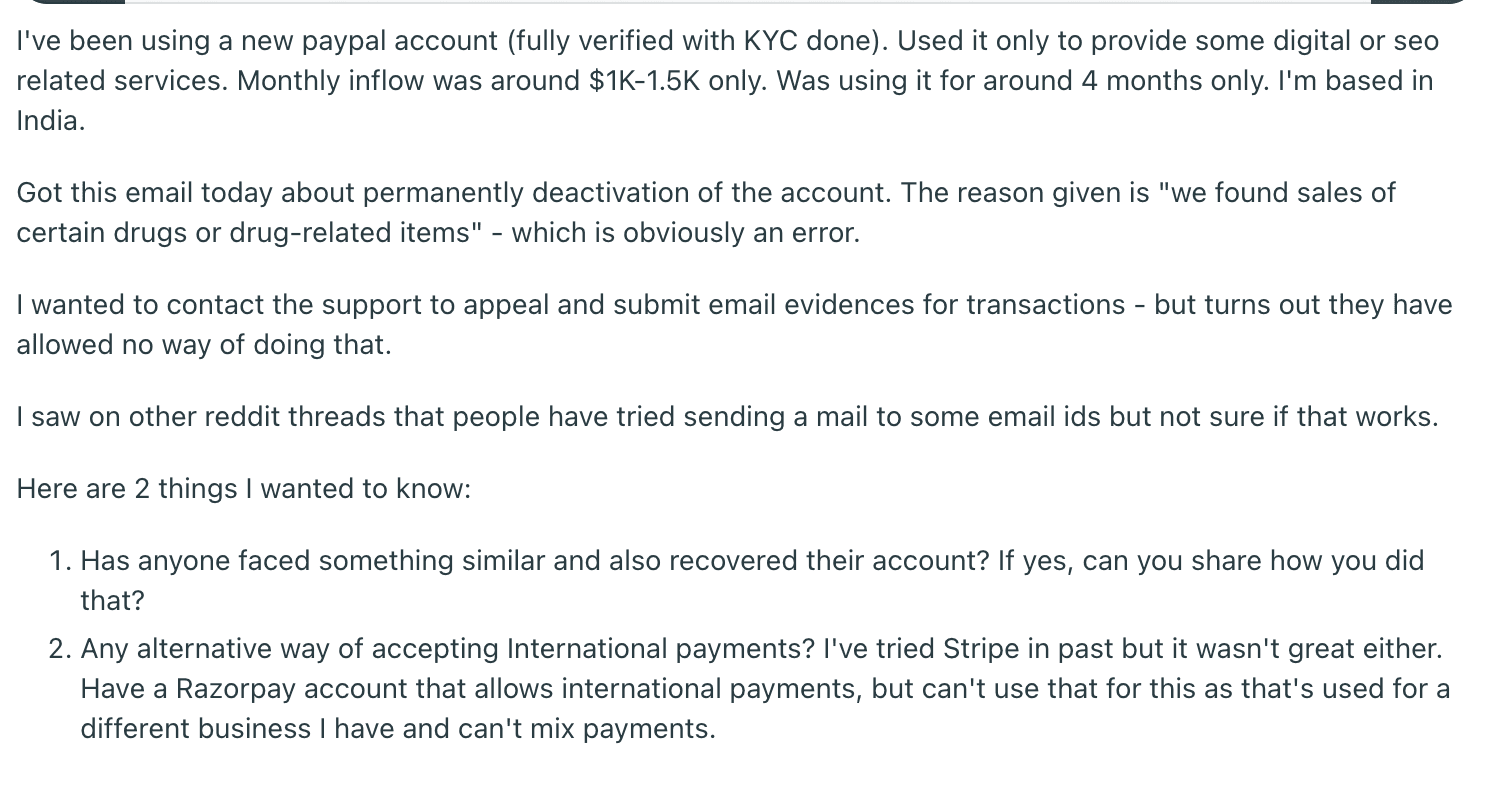
This is arguably the most damaging issue for Indian PayPal users. "PayPal's automated security systems are aggressive. If they detect a 'spike' in your sales or a 'suspicious' login, they can freeze your balance for 21 to 180 days. For small businesses or freelancers, this can be devastating for cash flow.
Many Indian PayPal users report facing account limitations regularly, with 60–70% of them having no unusual activity.
Source: Reddit
Or

Source: Justanswer
3. Forced Mandatory INR Conversion, No Rate Control
Indian RBI regulations require PayPal to automatically convert all international payments to INR immediately. The converted funds have to be deposited in the Indian account in 3-5 days. You have zero ability to hold USD, time your conversion, or benefit from favourable exchange rate movements. You always receive PayPal's rate, not the market rate.
4. No Domestic India Functionality
PayPal only allows users to receive international payments and does not support sending money abroad or making domestic payments. This means you cannot use PayPal for vendor payments, team payroll, or any domestic Indian transaction.
5. Monthly Batch FIRA, Not Per Transaction
PayPal issues FIRA on a monthly batch basis rather than per transaction. For businesses managing multiple clients and needing per-invoice compliance documentation for GST filings and FEMA records, this creates significant administrative friction.
Read More - FIRA vs FIRC: Key Differences Explained
6. Slow and Difficult Customer Support
It is not easy to reach to PayPal customer support. Even when reached, they are slow to respond, making it time-consuming to resolve urgent problems.
What Indian Businesses Should Check Before Choosing a PayPal Alternative
Not every PayPal alternative is built for India. Before committing to any platform, evaluate it against these key parameters:
Total effective fee — The total effective cost includes transaction fees, conversion fees, FX markup, and GST (if applicable).
FX markup policy — You need to check if the platform is applying any FX markup on the conversion or converting your payments at zero FX markup.
Settlement speed to the Indian bank — You need to check how many hours or business days the platform takes to settle money to an Indian bank account.
FIRA/eFIRC generation — Please check if the FIRA is automatic, free, and per-transaction. Or manual, paid, and batched monthly?
Per-invoice transaction limits — Are there caps that would block your large-value B2B payments?
RBI and FEMA compliance — Before initiating the transaction, check if the platform holds a PA-CB licence or operates through AD-1 certified banks?
Onboarding speed — How quickly can you get your virtual accounts and start receiving?
Customer support quality — Is there responsive, India-knowledgeable support when things go wrong?
7 Best PayPal Alternatives in India (2026)
Platform | All-in Fee | FX Markup | Settlement | Free FIRA | Invoice Cap | Entity Types | Best For |
Infinity | 0.5% | Zero | 24 hrs | Auto and Free | None | All | Freelancers, exporters, SaaS |
Wise | ~1.65% + GST | Zero | 1–2 days | $2/cert | $10,000 | Freelancers/sole props | Multi-currency wallet |
Payoneer | 4–7% (effective) | Up to 3% | 2–5 days | Free | None | All | Marketplace payouts |
Stripe | ~6–7% (effective) | 2% | 7+ days | No | None | All (invite-only) | SaaS card payments |
Xflow | $12/$20/0.4% | Zero | 1 business day | Auto | None | All | Enterprise, B2B, API |
Dodo Payments | 4% + $0.40 + 1.5% intl | Included | 5–7 days | MoR model | None | SaaS/digital | Digital products, MoR |
Razorpay | 1–3% + 18% GST | Zero (export a/c) | T+7 days | Available | None | All | Domestic + international |

1. Infinity
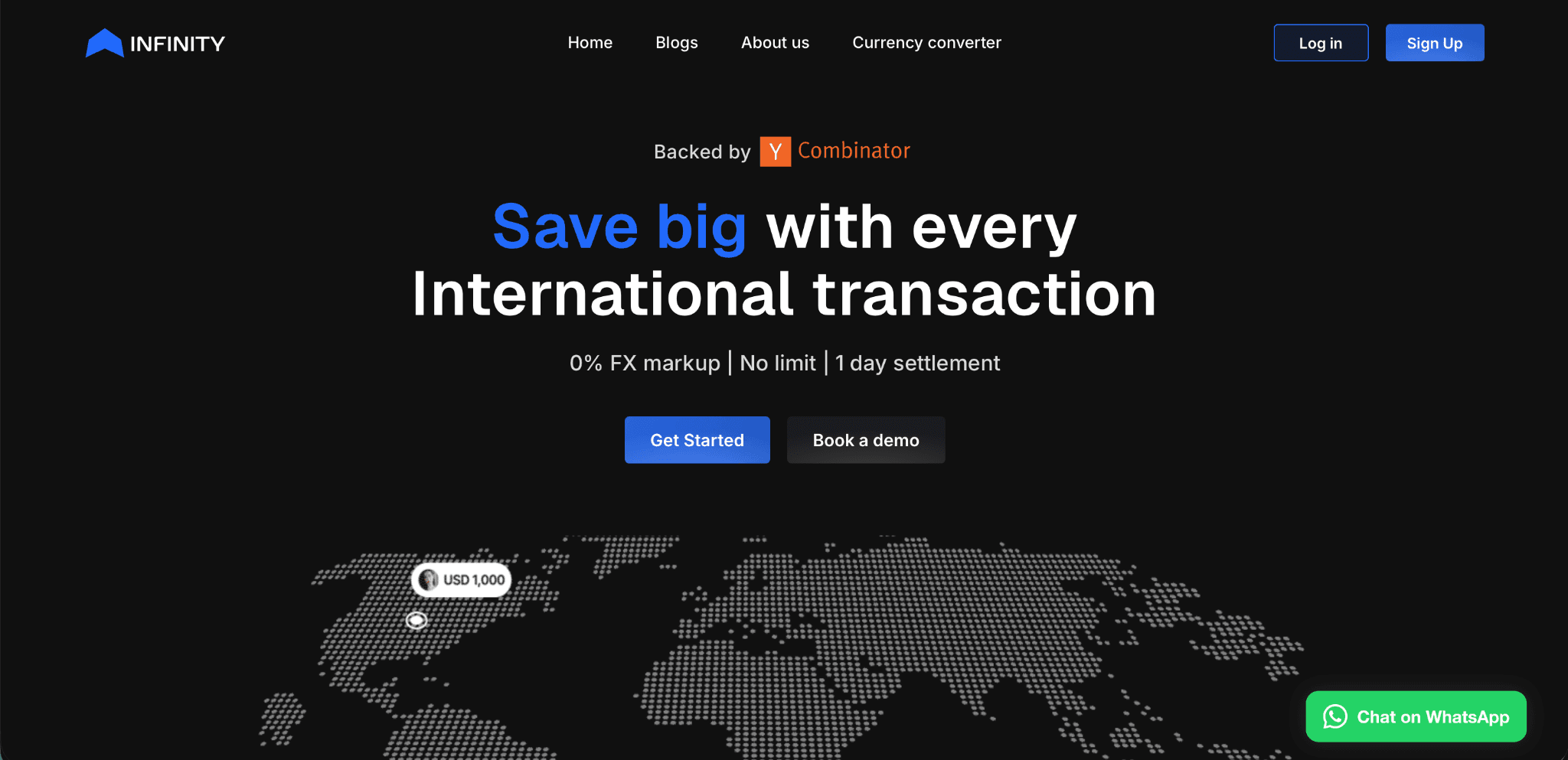
Infinity is a Bengaluru-based, Y Combinator (YC)-backed fintech platform built to help Indian professionals receive international payments. The idea of Infinity is to operate with the lowest fees, fastest settlement, and full compliance automation. All transactions are processed through AD-1 certified, RBI-authorised banks (the highest regulatory tier available for cross-border payments in India).
Unlike PayPal, which was built as a global consumer platform, Infinity was designed from day one around the specific needs of Indian inward remittances.
When you receive a payment through Infinity, your overseas client pays into your virtual local account (ACH for US clients, Faster Payments for UK clients, SEPA for European clients) as though making a domestic transfer.
Infinity converts at the live mid-market rate with zero FX markup, settles INR to your Indian bank within 24 hours, and automatically generates a free FIRA, all for a single flat 0.5% fee that covers everything.
Pricing and Fees
Fee Component | Infinity | PayPal |
Transaction/platform fee | 0.5% (all-inclusive) | 4.4% + $0.30 |
FX markup | Zero | 3–4% |
FIRA | Free, automatic | Monthly batch |
GST | Included in 0.5% | N/A |
Total effective cost | 0.5% | 7–9% |
Real-world savings on different invoice sizes:
Invoice Amount | Infinity Cost | PayPal Cost | You Save |
$500 | $2.50 | $37–$44 | $34.50–$41.50 |
$1,000 | $5.00 | $74–$84 | $69–$79 |
$3,000 | $15.00 | $222–$252 | $207–$237 |
$5,000 | $25.00 | $370–$420 | $345–$395 |
$10,000 | $50.00 | $740–$840 | $690–$790 |
On $5,000/month in international income, switching from PayPal to Infinity saves approximately ₹29,000–₹33,000 per month or ₹3.5–₹4 lakh per year.
Infinity vs PayPal
Parameter | Infinity | PayPal |
Platform fee | 0.5% all-in | 4.4% + $0.30 |
FX markup | Zero | 3–4% |
Effective total cost | 0.5% | 7–9% |
INR settlement | 24 hours | 2–5 days |
FIRA | Free, auto, per transaction | Monthly batch |
Account freezes | No reported pattern | Widely documented |
Invoice cap | None | $10,000 |
RBI compliance | AD-1 banks | PA-CB |
Customer support | Responsive, India-focused | Widely criticised |
Summary
Infinity is the best PayPal alternative for the vast majority of Indian professionals receiving international payments in 2026. At 0.5% all-in versus PayPal's 7–9%, it is the single most impactful switch you can make to immediately increase your income.
The 24-hour settlement, free automated FIRA, and zero FX markup make it the complete package. It is not just cheaper, but genuinely better across every dimension that matters.
2. Wise
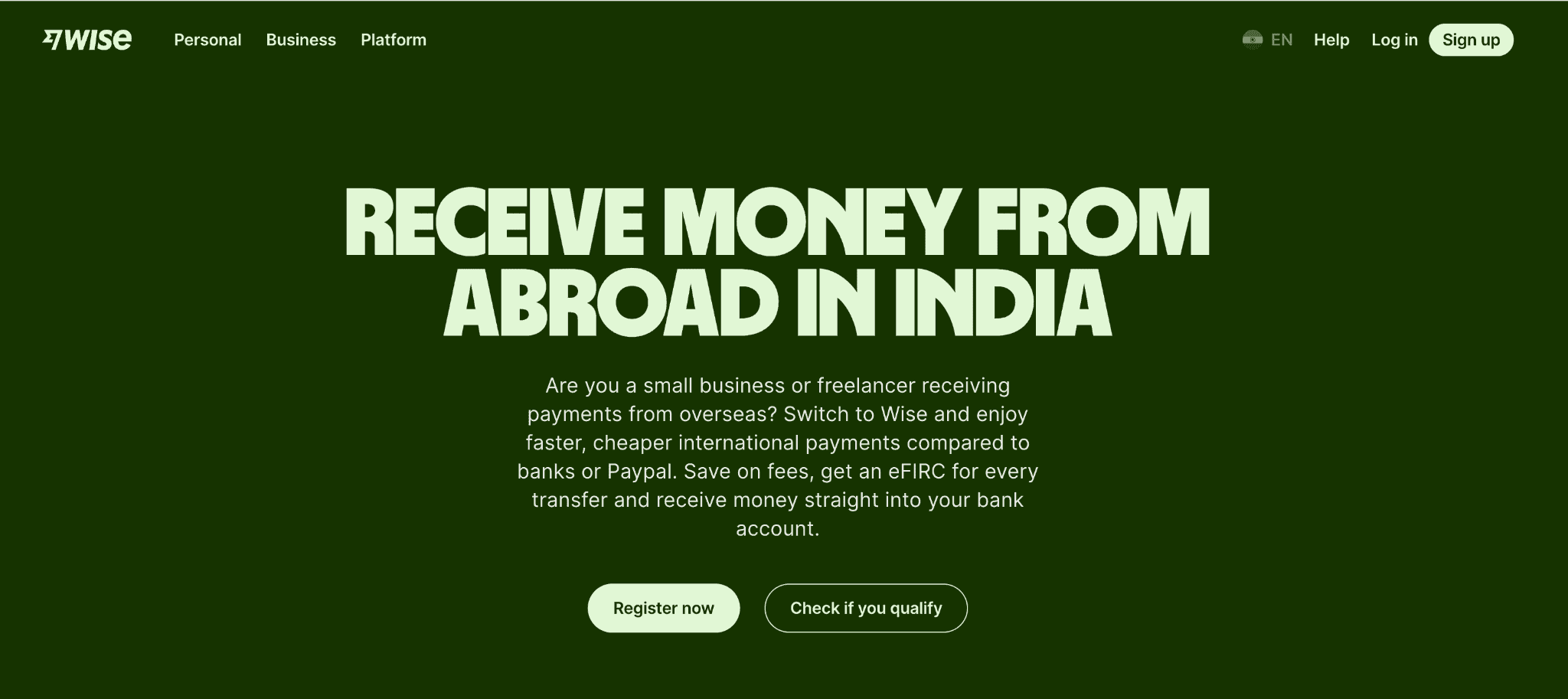
Wise (formerly TransferWise) is a global fintech international payment platform serving 16 million+ customers across 160+ countries. Wise has built its global reputation on transparent FX pricing that uses the real mid-market exchange rate with a clearly disclosed conversion fee.
In India, Wise Business supports freelancers and sole proprietors in receiving international payments in major currencies, including USD, GBP, EUR, AUD, and CAD.
Compared to PayPal, Wise is a meaningful improvement — zero FX markup versus PayPal's 3–4% markup, and a lower transaction fee (~1.65% versus PayPal's 4.4%).
However, Wise in India has its own set of significant limitations that prevent it from being the best solution for many Indian businesses.
Pricing and Fees
Fee Component | Wise | PayPal |
Transaction/conversion fee | ~1.65% | 4.4% + $0.30 |
FX markup | Zero | 3–4% |
FIRA | $2 per certificate | Monthly batch |
GST on the fee | 18% (on conversion fee) | N/A |
Total effective cost | ~2% all-in (incl. FIRA + GST) | 7–9% |
On a $5,000 invoice, Wise costs approximately $99–$102. PayPal costs $370–$420. Wise saves you roughly $270–$320 per transaction versus PayPal.
However, Wise charges $2 per FIRA and 18% GST on the conversion fee. On a $10,000 invoice, these add up to approximately $192 total. If you compare it with Infinity, then it is $50 (0.5% fees) on the same amount.
PayPal vs Wise
Parameter | Wise | PayPal |
Platform fee | ~1.65% | 4.4% + $0.30 |
FX markup | Zero | 3–4% |
Effective total cost | ~2% | 7–9% |
INR settlement | 1–2 days | 2–5 days |
FIRA | $2/certificate | Monthly batch |
Invoice cap | $10,000 | $10,000 |
Business entity support | Freelancers/sole props only | All types |
Foreign currency holding | No (India accounts) | No |
GST-compliant invoicing | No | No |
Domestic payments | No | No |
Account freezes | Not a widespread issue | Widely documented |
Summary
Wise is a clear improvement over PayPal. It has lower fees, zero FX markup, and no account freeze stories. But it is not the best option for Indian businesses.
The $2 FIRA charge, ~2% effective all-in cost with GST, $10,000 invoice cap, limits its usefulness. For individual freelancers who value multi-currency wallet features, Wise is a reasonable step up from PayPal.
3. Payoneer
Payoneer is one of the world's most established cross-border payment platforms. It serves over 5 million users across 190+ countries. Payoneer was founded in 2005, it has deep roots in the global freelancing and e-commerce ecosystem.
For Indian professionals, its primary value is its native integration with 500+ global platforms, including Upwork, Fiverr, Amazon, Airbnb, Walmart, Shopify, and more. If your income flows automatically from these marketplaces, Payoneer is often the only seamless payout option available.
Compared to PayPal, Payoneer is cheaper on receiving fees (1% versus 4.4%) but applies a significant FX markup on INR withdrawals.
Pricing and Fees
Fee Component | Payoneer | PayPal |
Receiving from marketplaces | 1% | 4.4% + $0.30 |
Receiving via credit card | 3% | 4.4% + $0.30 |
FX markup on INR withdrawal | Up to 3% | 3–4% |
Inactivity fee | $29.95/year | None |
FIRA | Free | Monthly batch |
Total effective cost | 4–7% | 7–9% |
On a $3,000 marketplace payment, Payoneer costs approximately $120–$210 (4–7%). PayPal costs $222–$252 (7–8%). Payoneer saves you $100–$40 per transaction versus PayPal.
PayPal vs Payoneer Comparison Table
Parameter | Payoneer | PayPal |
Receiving fee | 1–3% | 4.4% + $0.30 |
FX markup | Up to 3% | 3–4% |
Effective total cost | 4–7% | 7–9% |
INR settlement | 2–5 days | 2–5 days |
FIRA | Free | Monthly batch |
Inactivity fee | $29.95/year | None |
Marketplace integrations | 500+ | 100+ |
Country coverage | 190+ | 200+ |
Business entity support | All types | All types |
Account freezes | Documented in reviews | Widely documented |
Summary
Payoneer is a better alternative to PayPal when it comes to marketplace integration for freelancers. Payoneer also has cheaper transaction fees, conversion fees, and provides free FIRA, too.
However, Payoneer charges up to 3% FX markup on INR withdrawals. So, this makes it significantly costlier than other payment platforms. The $29.95 inactivity fee also traps low-volume users. Payoneer works well when you have to use marketplaces' payouts like Upwork, Fiverr, Amazon, etc.
4. Stripe
Stripe is one of the world's most powerful payment infrastructure platforms. It is used by over 1 million businesses globally, including some of the largest technology companies and fastest-growing startups.
Its API-first architecture makes it the gold standard for engineering teams building custom checkout flows, subscription billing systems, and global payment integrations.
In India, Stripe operates on an invite-only basis and is best suited for developer-driven SaaS companies and e-commerce businesses accepting international card payments.
Compared to PayPal, Stripe offers better developer tools and more customisable checkout experiences.
Although its effective fee for Indian users (4.3% transaction fee plus 2% FX conversion) is not significantly cheaper than PayPal for basic payment collection. It also provides no FIRA, making it unsuitable for export compliance requirements.
Pricing and Fees
Fee Component | Stripe | PayPal |
Transaction fee (intl. cards) | 4.3% | 4.4% + $0.30 |
FX conversion fee | 2% | 3–4% |
FIRA | Not provided | Monthly batch |
Total effective cost | ~6–7% | 7–9% |
On a $2,000 SaaS subscription invoice, Stripe costs approximately $120–$140 (6–7%). PayPal costs $148–$168 (7–8%). Stripe saves you $28–$28 per transaction versus PayPal.
PayPal vs Stripe
Parameter | Stripe | PayPal |
Transaction fee | 4.3% | 4.4% + $0.30 |
FX markup | 2% | 3–4% |
Effective total cost | ~6–7% | 7–9% |
India availability | Invite-only | Open |
FIRA | Not provided | Monthly batch |
Settlement speed | 7+ days (India) | 2–5 days |
Developer APIs | World-class | Limited |
Subscription billing | ✅ Advanced | Basic |
Marketplace integrations | Limited | 100+ |
Account freezes | Less common | Widely documented |
Summary
Stripe is slightly better than PayPal when it comes to total effective cost. But Stripe also lacks the ability to provide FIRA, which can be a major drawback for Indian professionals. Stripe outperforms PayPal in developer tooling, subscription management, and checkout customisation.
So, for simple invoice-based payment collection, Stripe may not be a great alternative. Although Infinity is cheaper and more compliant when compared to Stripe and PayPal for receiving international payments.
Read More - Best Stripe Alternatives
5. Xflow
Xflow is a Bengaluru-based cross-border payments platform founded in 2022. Its infrastructure runs on JP Morgan Chase rails, and it holds final RBI PA-CB authorisation. This makes Xflow India's most institutionally backed cross-border payment platform.
Compared to PayPal, Xflow is dramatically cheaper, significantly faster to settle, and fully FEMA-compliant for Indian inward remittances.
Pricing and Fees
Plan | Invoice Range | Fee | FX Markup |
Starter | Up to $2,000 | $12 flat | Zero |
Growth | $2,001–$5,000 | $20 flat | Zero |
Growth | Above $5,000 | 0.4% | Zero |
Scale | Above $10,000 | Custom | Zero |
On a $5,000 invoice, Xflow Growth charges $20 (0.4%). PayPal charges $370–$420 (7–8%). Xflow saves over $350 on a single $5,000 invoice.
PayPal vs Xflow
Parameter | Xflow | PayPal |
Transaction fee | $12/$20/0.4%/custom | 4.4% + $0.30 |
FX markup | Zero | 3–4% |
Effective total cost | 0.24–0.6% | 7–9% |
INR settlement | 1 business day | 2–5 days |
FIRA | Free, auto, 24hr | Monthly batch |
Invoice cap | None | $10,000 |
EEFC account support | ✅ Yes | ❌ No |
AI FX optimisation | ✅ Yes | ❌ No |
ISO 27001 / SOC 2 | ✅ Both | ❌ Neither |
Developer API / white-label | ✅ Yes | Limited |
Account freezes | Not a reported issue | Widely documented |
Summary
Xflow is a good PayPal alternative for enterprise-grade B2B exporters, IT service firms, and SaaS companies in India.
6. Dodo Payments
Dodo Payments is an India-based fintech international payment platform founded in 2023. Unlike every other platform in this comparison, Dodo Payments operates as a Merchant of Record (MoR).
This means that it acts as the legal seller of record in each market it operates in, handling not just payment processing but also tax compliance (VAT, GST, sales tax across 190+ countries), fraud protection, subscription management, and chargeback resolution on your behalf.
This MoR model makes Dodo Payments fundamentally different in purpose from platforms like Infinity, Skydo, or Wise. It is not primarily a tool for receiving client invoices or exporting collections.
Dodo Payments supports 220+ countries, 30+ payment methods (including UPI, Apple Pay, Klarna, Affirm, Cash App, and major card networks), and is available in 14 languages.
Pricing and Fees
Fee Component | Dodo Payments | PayPal |
Domestic transaction fee | 4% + $0.40 | 4.4% + $0.30 |
International surcharge | +1.5% | Included in 3–4% FX markup |
Tax handling | Included (automated) | Not provided |
Chargeback management | Included | Additional fees |
FIRA | Not applicable (MoR model) | Monthly batch |
Effective cost for digital products | ~5.5–6% international | 7–9% |
Enterprise | Custom pricing | — |
Important distinction: Dodo Payments' fees include automated tax compliance and MoR services.
When comparing costs to PayPal, it is important to compare the compliance value delivered and not just the percentage fee.
PayPal vs Dodo Payments
Parameter | Dodo Payments | PayPal |
Transaction fee | 4% + $0.40 | 4.4% + $0.30 |
International surcharge | +1.5% | Included (FX markup) |
Tax compliance | ✅ Fully automated (190+ countries) | ❌ Not provided |
Merchant of Record | ✅ Yes | ❌ No |
Subscription management | ✅ Advanced | Basic |
Chargeback handling | ✅ Included | ❌ Additional |
Digital product delivery | ✅ Automated | ❌ Not provided |
FIRA for Indian users | ❌ MoR model | ❌ Monthly batch |
Countries supported | 220+ | 200+ |
Best suited for | SaaS, digital products, creators | Occasional invoices |
India entity required | ✅ India-based founder support | ✅ |
Summary
Dodo Payments undoubtedly is a genuinely useful platform. But the use case of Dodo Payment is a bit different from PayPal. Dodo payment acts as a MoR and is useful for Indian SaaS founders who need automated compliance.
Dodo Payments is a compelling alternative to Paddle or Stripe. However, it is not a great alternative to PayPal when it comes to receiving international payments in India.
7. Razorpay
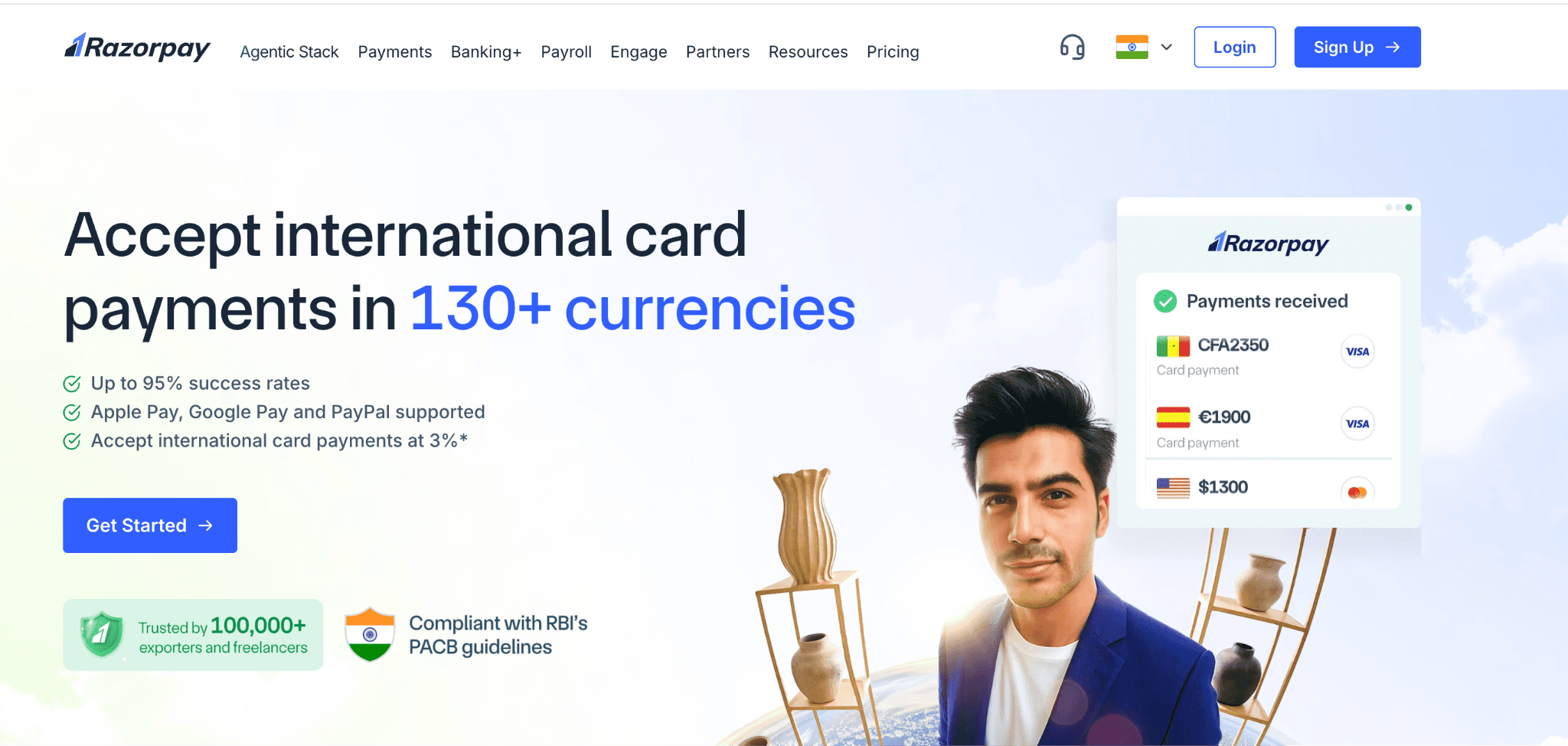
Razorpay is India's largest and most established payment gateway. It was founded in 2014 in Bangalore and is valued at over $7.5 billion. It serves more than 10 million Indian merchants and is the dominant platform for domestic Indian payments.
Razorpay expanded into international payments through its International Payment Gateway and the RazorpayX MoneySaver Export Account, which allows Indian businesses to receive cross-border bank transfers at competitive rates with zero FX markup.
Compared to PayPal, Razorpay's bank transfer route is significantly cheaper (1% + GST versus PayPal's 7–9%) and settles at mid-market rates. However, its T+7 international settlement timeline is the slowest in this comparison, a real limitation for cash flow management.
Pricing and Fees
Fee Component | Razorpay | PayPal |
International bank transfers | 1% + 18% GST = ~1.18% | 4.4% + $0.30 |
International card payments | 3% + 18% GST = ~3.54% | 4.4% + $0.30 |
FX markup | Zero (MoneySaver Export A/c) | 3–4% |
FIRA | Available | Monthly batch |
Effective total cost (bank) | ~1.18% | 7–9% |
Settlement time | T+7 days | 2–5 days |
On a $3,000 invoice via bank transfer, Razorpay costs approximately $35.40 (1.18%). PayPal costs $222–$252 (7–8%). Razorpay saves over $186–$216 on a single $3,000 invoice.
PayPal vs Razorpay
Parameter | Razorpay | PayPal |
Transaction fee (bank) | 1% + 18% GST | 4.4% + $0.30 |
FX markup | Zero (export a/c) | 3–4% |
Effective total cost | ~1.18–3.54% | 7–9% |
INR settlement | T+7 days | 2–5 days |
FIRA | Available | Monthly batch |
Domestic payments | ✅ Full India support | ❌ No |
UPI / net banking | ✅ Yes | ❌ No |
Invoice cap | None | $10,000 |
Business entity support | All types | All types |
RBI PA-CB approved | ✅ Yes | ✅ Yes |
Best for | Domestic + international | Occasional invoices |
Summary
Razorpay is definitely a better alternative to PayPal in India. It has cheaper transaction fees, no FX markup, and it is RBI- approved as well. Razorpay can be proven as a strong international payment platform if it is used for domestic payments as well. But the T+7 timeline is one of the key weaknesses of Razorpay. The slower settlement time can weaken the cash flow management for Indian professionals.
Conclusion
PayPal had its moment as the default international payment platform for Indian professionals. That moment has passed.
In 2026, the Indian cross-border payment platforms will offer a much better landscape compared to PayPal. The 7–9% effective cost that PayPal charges is not just high, it is indefensible when platforms like Infinity charge 0.5% all-in with zero FX markup, 24-hour settlement, and free automatic FIRA.
For instance, let's take an invoice amount of $5000/month. By using Infinity, you are approximately saving ₹3.5–₹4 lakh per year. And on a $10,000/month invoice, the annual savings exceed ₹7 lakh. These are not marginal gains but a transformative one.
Here is the clearest possible final guidance:
For the best all-round PayPal alternative: → Infinity (0.5%, zero FX, 24hr, free FIRA)
For marketplace payouts (Upwork/Fiverr/Amazon): → Payoneer
For SaaS card payments with developer APIs: → Stripe
For global digital product selling with tax automation: → Dodo Payments
For domestic + international on one platform: → Razorpay
For multi-currency global flexibility: → Wise and Infinity
FAQs
Q1. What is the best PayPal alternative in India for 2026?
The best PayPal alternative in India in 2026 is Infinity. It charges a flat 0.5% (all-inclusive) fee with zero FX markup, settles international payments within 24 hours, and automatically generates a free FIRA with every transaction.
Q2. Which PayPal alternative is cheapest for Indian freelancers?
Infinity is the cheapest option at 0.5% all-in with zero FX markup. It is significantly lower than Wise (~2% effective, including FIRA + GST), Payoneer (4–7%), Stripe (6–7%), and PayPal (7–9%).
Q3. Does Razorpay support international payments for Indian exporters?
Yes. Razorpay's MoneySaver Export Account (via RazorpayX) supports international bank transfer collections at 1% + 18% GST with zero FX markup.
Q4. Is Stripe a good PayPal alternative for Indian SaaS businesses?
Stripe is a better choice than PayPal for developer-driven SaaS companies that need powerful payment APIs, subscription billing infrastructure, and custom checkout flows. However, Stripe operates on an invite-only basis in India and charges ~6–7% effective on international transactions.
Q5. What is Dodo Payments, and how is it different from PayPal?
Dodo Payments is a Merchant of Record (MoR) platform. It acts as the legal seller in each market, handling automated tax compliance (VAT, GST, sales tax across 190+ countries), subscription billing, chargeback management, and digital product delivery on your behalf.
Q6. Does any PayPal alternative provide free FIRA automatically?
Yes, Infinity, Skydo, Xflow, and Payoneer all provide free FIRA automatically. Infinity and Skydo deliver FIRA instantly, issued by RBI-authorised banks.
Q7. Can I use Payoneer instead of PayPal for Upwork/Fiverr payouts?
Yes, and for marketplace-based freelancers, Payoneer is a strongly recommended alternative to PayPal for Upwork, Fiverr, and other platform payouts. Payoneer has native integration with 500+ global marketplaces, charges a 1% receiving fee (versus PayPal's 4.4%), and provides free FIRA.


