

Global payments


Subscribe to our newsletter
Get the latest updates, insights, and tips delivered straight to your inbox.
The first time I received an international payment from a US client, I kept checking my bank account for three days straight. The money left their account on a Tuesday and landed in mine the following Monday.
When it finally arrived, it was about 2.5% less than I had expected. No one had mentioned the exchange rate markup. No one had told me that I would need a certificate for my CA at tax time either.
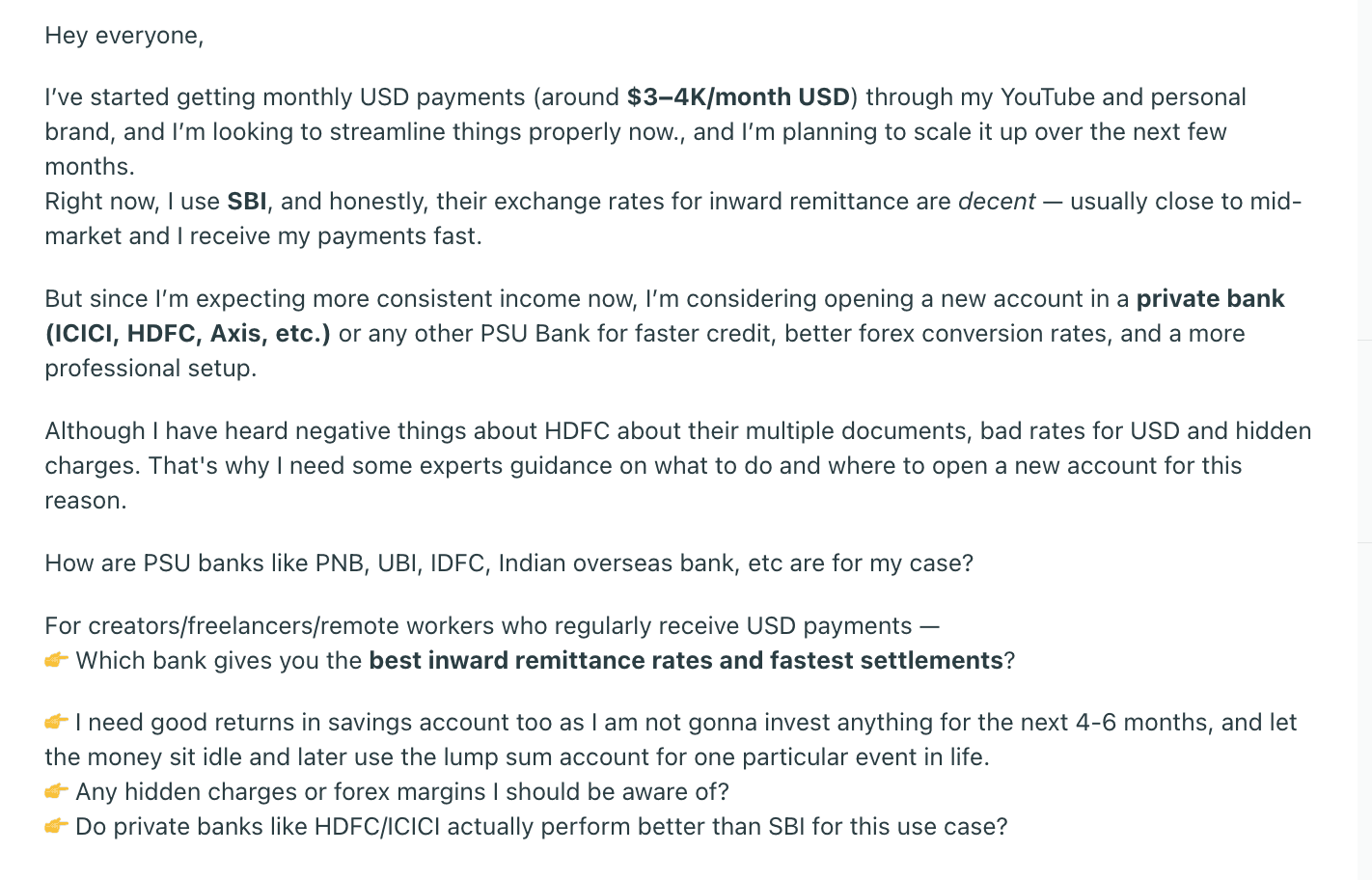
Reddit Thread Asking for Best Bank to Receive USD
I remember calling my bank's helpline, getting transferred twice, and still not getting a straight answer about why the amount did not match.
If you receive payments from abroad, whether as a freelancer, an exporter, an agency serving overseas clients, or a SaaS founder billing international customers, you have probably run into some version of this.
Which bank actually gets you the best rate? How long will the money take to land? What documents will you be asked for later? And is a bank even the right place to receive this money, or should you be looking at a payment platform instead?
This blog will walk you through the 5 most commonly used international payment platforms in India.
It explains what each bank is best at and what to look out for before you choose one. It also covers the paperwork side, including FIRC, FIRA, and purpose codes, as well as how banks compare with newer international payment platforms, so you can make an informed choice.
Best Banks To Receive International Payments in India
Here are 5 best and safe banks to receive international payments in India.
HDFC Bank: No inward transfer fee, but forex markup is roughly 1.5–3.5%. Best for familiar private banking and a strong digital experience.
ICICI Bank: No published inward remittance fee. Forex markup is around 1.5–3%, with good support for exporters and EEFC account holders.
Axis Bank: Charges roughly ₹100–₹300 plus GST, with competitive digital remittance tools.
Indian Overseas Bank: Charges ₹100–₹500, with a lower forex markup of roughly 1–2.5%. A practical option if cost matters most.
SBI: Charges ₹250 through Express Remit, while standard SWIFT charges may reach ₹1,500. Best for branch access and in-person support.
The exchange-rate markup usually costs more than the transfer fee, so compare the bank’s TT buying rate with the mid-market rate. Exporters may also need an FIRC, e-FIRC, or FIRA. For frequent payments, compare the total cost with RBI-authorised payment platforms.
Best Banks By Use Case
Not every bank is the right fit for every kind of inward payment. Here's a quick way to match your situation to a starting point:
HDFC or ICICI - if you're a freelancer receiving occasional small payments, these are good for digital convenience and a large support network
ICICI or SBI - if you're an exporter with regular invoice-based proceeds, these are good for established trade finance desks and EDPMS-linked FIRC handling
Indian Overseas Bank - if you're cost-sensitive and comfortable with slightly less digital polish, this is suitable for one of the lower forex markups among traditional banks
Axis Bank - if you're looking for transparent, published inward charges, its commission structure is publicly listed
SBI - if you're prioritising branch access and in-person query resolution, it has a strong branch footprint across India
This is a starting point, not a rule. Your actual cost also depends on your account type, relationship with the bank, and the corridor you're being paid from.
How Banks Process Foreign Inward Remittance in India
When your client abroad sends you money, it almost never comes to you directly. Here's roughly what happens:
Your client's bank sends the payment, usually over the SWIFT network, to your Indian bank.
The payment may pass through one or more intermediary or correspondent banks on the way, especially if your bank does not have a direct banking relationship with the sender's bank. Each intermediary can deduct its own handling fee, typically USD 10-30 per hop.
Your Indian bank receives the payment in foreign currency and converts it to rupees using its own TT (telegraphic transfer) buying rate for that day, not the mid-market rate you'd see on Google.
The bank credits your account in rupees, after deducting its own inward remittance fee, if any, and GST on that fee.
If the payment is for exports or business income, your bank may ask for supporting documents (invoice, contract, purpose code) before or after crediting the amount.
The 2 things that matter most for how much you actually receive are the exchange rate markup and whether any correspondent bank fees were deducted before the money reached India.
Asking your client to use the "OUR" charge code on their end (where they bear all transfer costs) can help you receive the full invoiced amount, though not every corridor supports this.
What to Look for in a Bank for Receiving International Payments?
Before you pick a bank to route your international payments through, it helps to look past the headline fee and check:
The exchange rate margin, not just the transaction fee. A ₹0 inward fee with a 3% forex markup usually costs you more than a ₹500 fee with a 1% markup on a mid-sized payment.
How the bank handles FIRC/e-FIRC/FIRA requests, since you'll need these for GST refunds, income tax filing, and RBI compliance if you're exporting goods or services.
Try Infinity's Free FIRA analyser tool and see the real cost of your international payment.
Processing time, especially if you rely on this income for regular cash flow.
Correspondent bank fees on your typical corridor (US, UK, EU, Middle East), since these vary by which banks are involved on the sending side.
Support for the purpose code and account type you actually need (savings, current, EEFC, or a dedicated export account).
Whether the bank's trade finance or forex desk is set up for your invoice pattern, especially if your billing is irregular or high-value, which is common for exporters and SaaS businesses.

5 Best Banks to Receive International Payments in India
Here's a detailed comparison of the five most efficient banks to receive money transfers from abroad:
Bank | Best For | FX Markup | Inward Fee | Processing Time | FIRC/e-FIRC | Online Tracking | Main Drawback |
HDFC Bank | Freelancers and SMBs | 2%-3.5% | Rs. 500-Rs. 750 | Up to 72 hours | Digital available | Yes | Limited negotiation for small accounts |
ICICI Bank | Exporters and high-volume businesses | Around 3.5% | Varies | 1-2 working days | Online downloadable | Yes | Hidden/intermediary charges possible |
Axis Bank | Startups needing tracking | Around 3.5% | Varies | 2-5 working days | Manual request | Yes | FIRC process may be slow |
Indian Overseas Bank | Users prioritising better FX rates | Often better than private banks | Rs. 500 + GST approx. | 24-48 hours after documentation | Available | Limited | Manual branch/documentation process |
SBI | Large, infrequent export payments | Often competitive | Rs. 500-Rs. 1,000 approx. | 3-5 business days | Manual | Limited | Slow support and manual follow-ups |
1. HDFC Bank
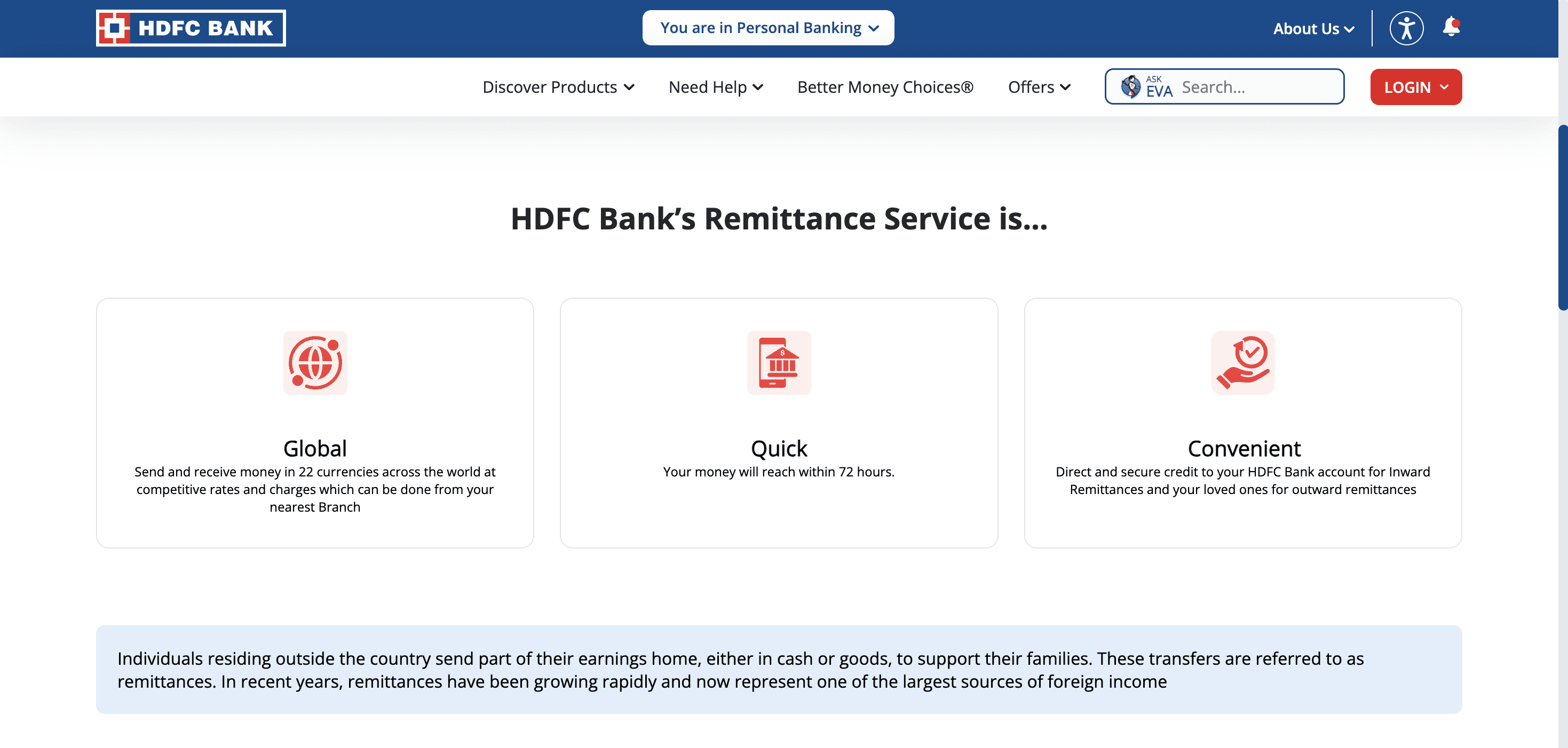
HDFC Bank allows foreign remittances in 19–22 major currencies, including USD, EUR, GBP, CAD, AUD, SGD, AED, etc. The bank processes international payments through SWIFT and correspondent bank tie-ups.
Key features:
Automatic currency conversion: The bank automatically converts foreign funds to INR at the bank’s telegraphic transfer (TT) selling rate once the amount is credited.
Charges & fees: HDFC charges a ₹500–750 inward remittance fee per transaction. Additional deductions may occur via intermediary (correspondent) banks.
Processing time: You get the payment in your bank account within 72 hours.
FX markup: Expect a forex markup of about 2-3.5% of the transaction amount.
Cheque collection: It accepts foreign currency cheques and demand drafts for 14 currencies in savings or current accounts.
Pros and cons
Pros | Cons |
Auto conversion at credit, no manual forex conversion needed | FIRC fee of ₹200 + GST per certificate, plus ACE and wire transfer charges |
Easy integration with global platforms | Additional wire transfer fees |
Clear fee structure; fixed markup and flat charges provide predictability | Customer support can be delayed at times |
FIRC can be accessed digitally | No negotiation flexibility for small accounts |
A Reddit user shared their experience with HDFC for foreign payments

Source: Reddit Post
Fees and Charges:
Assumptions: 2–3.5% forex markup and ₹500–₹750 transfer fee.
Payment | Mid-market value | Estimated amount received |
|---|---|---|
$1,000 | ₹95,000 | ₹90,925–₹92,600 |
$3,000 | ₹2,85,000 | ₹2,74,275–₹2,78,800 |
$5,000 | ₹4,75,000 | ₹4,57,625–₹4,65,000 |
$10,000 | ₹9,50,000 | ₹9,16,000–₹9,30,500 |
2. ICICI Bank
ICICI Bank is better suited for export firms and mid-sized agencies to receive international payments. If you’re an exporter, agency, or business with high international turnover and your monthly remittances are on the higher side, ICICI offers more personalised service and slightly better forex rates than most.
Key features:
Payment processing time: International wire transfers typically take 1–2 working days to process and for the funds to reflect in your account.
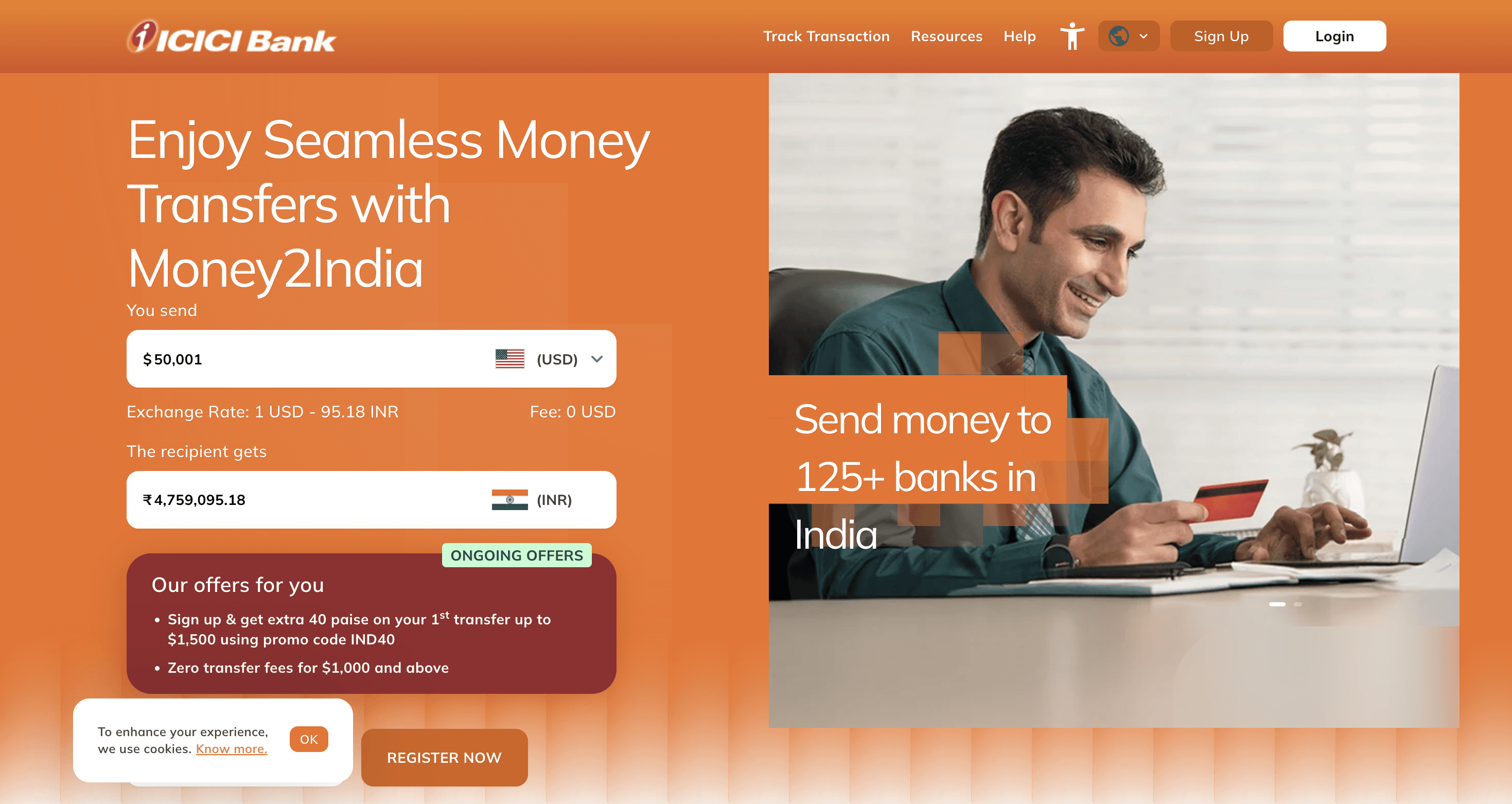
High-value transfers: ICICI’s Money2India app allows remittances up to $300,000 in a single transaction, ideal for large payments.
Personalised support: Offers dedicated relationship managers for high-volume clients, helping resolve forex and compliance issues faster.
FIRC availability: Foreign Inward Remittance Certificates (FIRCs) can be conveniently downloaded online.
Instant credit feature: ICICI is among the few banks in Asia‑Pacific offering SWIFT GPI Instant for inbound remittances up to ₹2 lakh, instantly credited via IMPS.
Pros and Cons
Pros | Cons |
No transfer fees for high-value remittances | Higher forex markup (3.5%) |
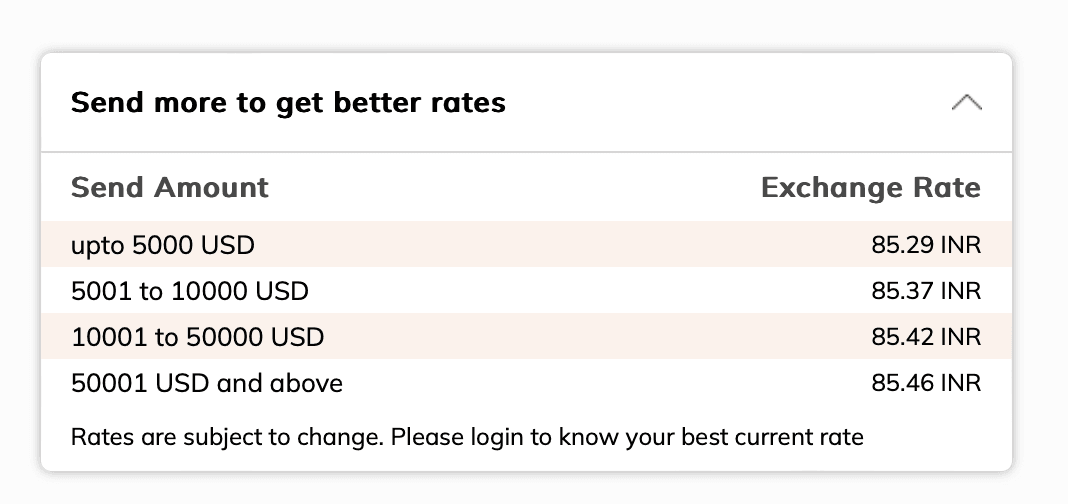
Exchange rates improve with higher transfer amounts—a tiered structure that rewards bulk remittance | Additional wire transfer fees, exchange rate markups, and fees from intermediary banks |
Solid online banking tools | Hidden fees may not always be disclosed upfront |
FIRC can be accessed digitally | Setup might take longer |
ICICI Bank’s conversion rate for converting USD to INR
Here’s what a Reddit user says about receiving foreign payments through ICICI Bank:
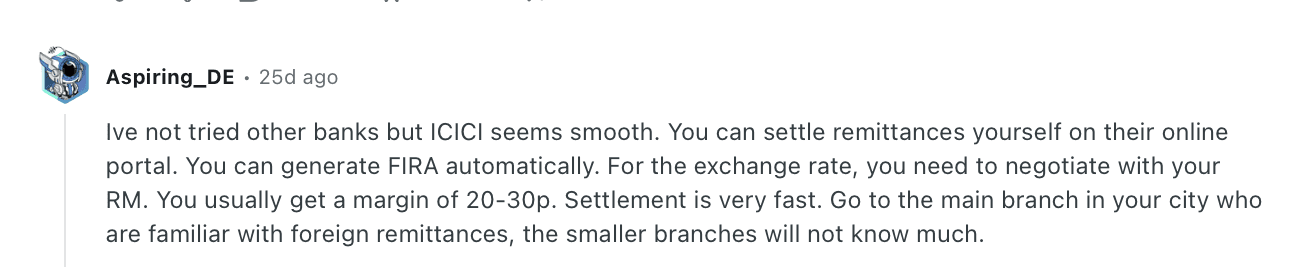
Source: Reddit Post
Fees and Charges:
Assumption: 3.5% forex markup and no inward transfer fee.
Payment | Mid-market value | Estimated amount received |
|---|---|---|
$1,000 | ₹95,000 | ₹91,675 |
$3,000 | ₹2,85,000 | ₹2,75,025 |
$5,000 | ₹4,75,000 | ₹4,58,375 |
$10,000 | ₹9,50,000 | ₹9,16,750 |
3. Axis Bank
Axis Bank has a startup-friendly approach. If you’re just setting up your global payment process, you can use this bank for better transparency.
Key features:
Processing time: Internet/mobile banking takes 2-5 working days and branch transfers take 3-5 working days.
Forex markup: FX markup is around 3.5%.
Tracking feature: The Axis mobile app lets you track inbound remittances in real time.
24/7 USD settlement: 24/7 real-time USD settlement in partnership with J.P. Morgan’s Kinexys platform, enabling commercial clients to send or receive USD payments at any hour, all year round.
FIRC availability: FIRCs are available, but you’ll need to request them manually (email or branch).
Pros and cons
Pros | Cons |
Transparent fee structure with no onboarding or processing charges via OIRM | Higher forex markup (3.5%) |
Real-time tracking of inbound funds with instant rate booking and split credit capabilities | FIRCs require manual requests, which can cause delays |
Reliable for regular, smaller payments | Some hidden charges may apply via intermediary banks for SWIFT transfers |
This is what a user says about using Axis Bank for international payments:

Source: Reddit Post
Fees and Charges:
Assumption: 3.5% forex markup and no separate processing fee.
Payment | Mid-market value | Estimated amount received |
|---|---|---|
$1,000 | ₹95,000 | ₹91,675 |
$3,000 | ₹2,85,000 | ₹2,75,025 |
$5,000 | ₹4,75,000 | ₹4,58,375 |
$10,000 | ₹9,50,000 | ₹9,16,750 |
4. Indian Overseas Bank (IOB)
Indian Overseas Bank offers a better foreign exchange rate compared to other Indian banks. This makes it attractive for exporters or freelancers receiving frequent foreign inward remittances.
Key features:
Top-tier exchange rates: It often offers ₹0.50–₹1 higher INR/USD TT buying rates in India than private banks on mid-market rates.
Automated inward remittances: Funds typically clear within 24–48 hours once FEMA declaration & purpose codes are submitted.
Low flat charges: Nominal service fees (₹500 + GST) and fixed SWIFT charges make costs predictable and transparent.
Convenient NRE/NRO/FCNR accounts: Offers full repatriability of foreign earnings with tax‑exempt status on NRE interest.
UPI-enabled inbound remittances: Supports IMPS/NEFT/RTGS and UPI cross-border transactions via NRE/NRO accounts.
Pros and cons:
Pros | Cons |
Excellent for regular forex clients— branches and managers often offer negotiation room | Inward remittances may take 2–3 days due to manual checks |
Sends FIRC/e‑FIRC post inward remittances as per RBI norms | Several users reported needing in‑branch visits for FEMA forms and documentation |
Here’s what a Reddit user says about receiving foreign payments through IOB Bank:
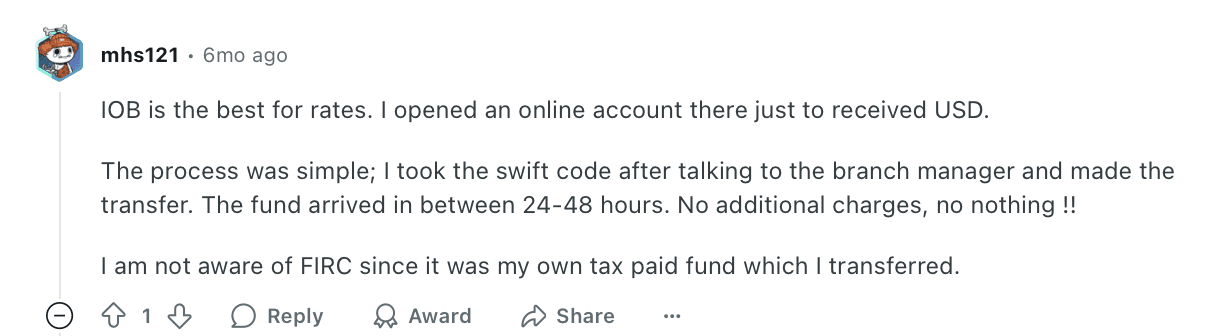
Source: Reddit Post
Fees and Charges:
Let's assume the bank’s USD buying rate is ₹0.50–₹1 below the mid-market rate, giving an estimated conversion rate of ₹94–₹94.50. A ₹500 fee plus 18% GST, or ₹590, is deducted.
Payment | Mid-market value | Estimated amount received |
|---|---|---|
$1,000 | ₹95,000 | ₹93,410–₹93,910 |
$3,000 | ₹2,85,000 | ₹2,81,410–₹2,82,910 |
$5,000 | ₹4,75,000 | ₹4,69,410–₹4,71,910 |
$10,000 | ₹9,50,000 | ₹9,39,410–₹9,44,410 |
5. State Bank of India (SBI)
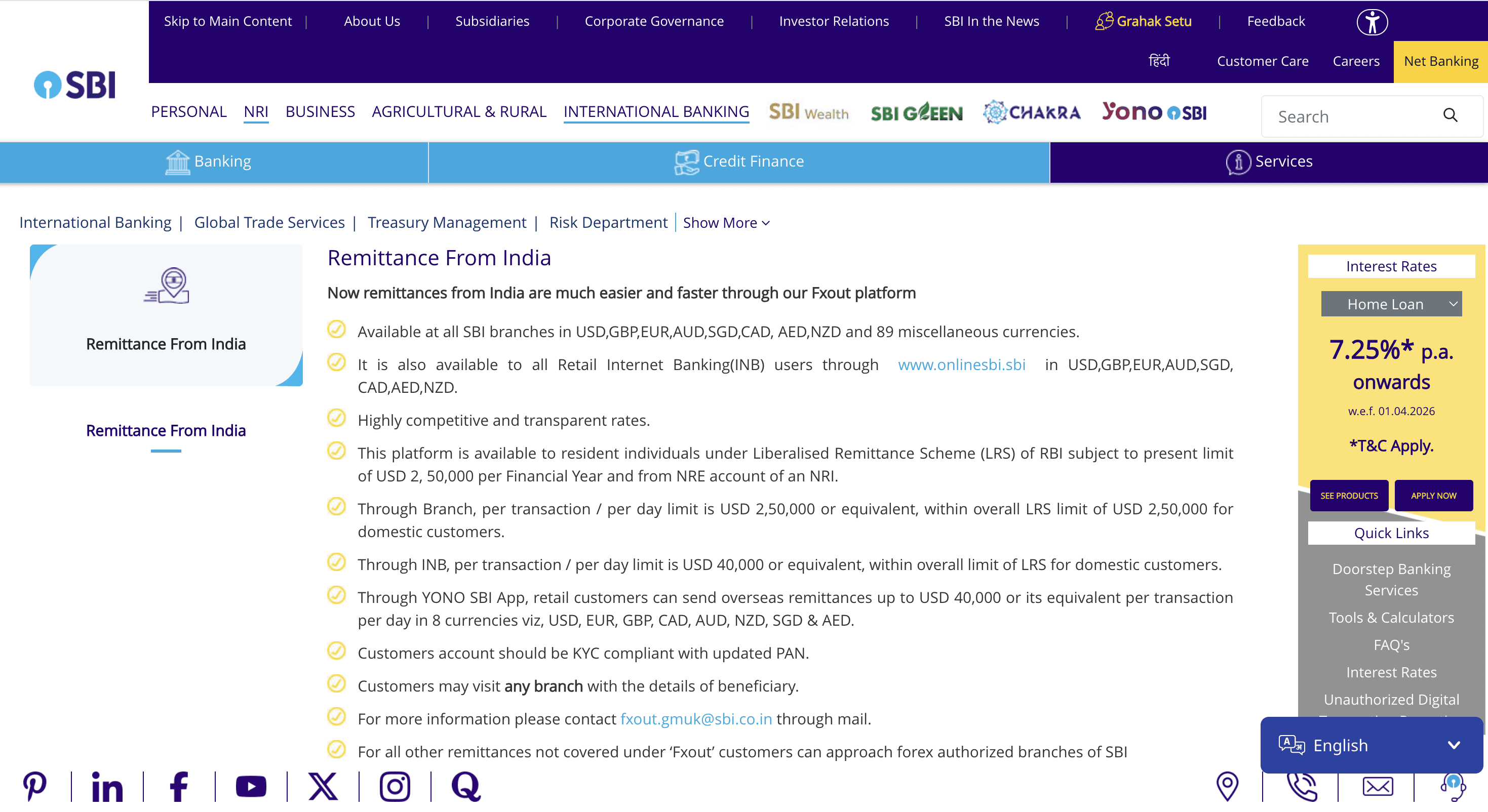
SBI Bank has a wide branch network and low service fees. It is suitable especially for exporters handling large, less frequent payments.
Key features:
Supported platforms: It supports SWIFT transfers and PayPal integration.
Service fees and FX rates: Service fees are low, and FX rates are close to the RBI’s reference rate.
Processing time: Processing time can be 3–5 business days, slower than private banks.
FIRC availability: FIRC is handled manually and may require multiple follow-ups.
Pros and cons
Pros | Cons |
Low service fees (often ₹500–₹1,000 per transaction) | Slower processing times |
Good for large, infrequent payments. | Some users say that the mobile banking app can be more intuitive |
Public sector trust and stability | FIRA process can be tedious |
Here’s what a Reddit user says about receiving international payments through SBI Bank:
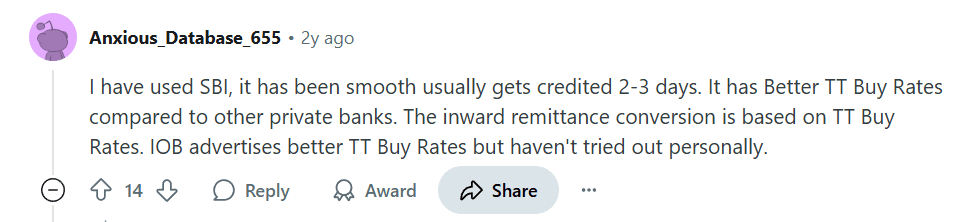
Source: Reddit Post
Fees and Charges
Your draft does not specify SBI’s forex markup. The estimates below only deduct its stated ₹500–₹1,000 service fee.
Payment | Mid-market value | Amount after service fee* |
|---|---|---|
$1,000 | ₹95,000 | ₹94,000–₹94,500 |
$3,000 | ₹2,85,000 | ₹2,84,000–₹2,84,500 |
$5,000 | ₹4,75,000 | ₹4,74,000–₹4,74,500 |
$10,000 | ₹9,50,000 | ₹9,49,000–₹9,49,500 |
*SBI’s exchange-rate deduction and any correspondent-bank charges still need to be subtracted.
Note: All figures are illustrative. Actual amounts depend on the bank’s TT buying rate on the payment date, GST, and intermediary-bank fees.
Pro Tips for Receiving International Payments via Banks
Now, let’s see some tips to receive international money transfers smoothly:
Receive payment in foreign currency: You’ll usually get a much better rate if you convert the amount from foreign currency to INR.
Always request a FIRC: Request a FIRC every single time, even if the amount seems small. It’s essential for tax filing, GST refunds, or showing proof of export income later.
Negotiate your forex rates: If you receive large or regular payments, talk to your Relationship Manager (RM). Even a 0.5% difference in rates can save you thousands over time.
Use a business account instead of a personal one: You’ll get higher transaction limits and smoother handling of international remittances in your current account.
Track exchange rates regularly: Check online platforms like Currency Converter for FX rates and request the payment from the client when the conversion rates are favourable.
Documents, FIRC/FIRA, purpose codes, and RBI compliance
If you're receiving money for freelance work, exports, or business income (as opposed to a personal gift or family support), you'll need to keep a few things straight for RBI and tax compliance.
FIRC (Foreign Inward Remittance Certificate): issued for remittances linked to FDI, ODI, FII, or realisation of export proceeds (including advance payments against exports).
e-FIRC: issued when the bank that receives your payment is different from the bank through which your export documents were filed, so the two banks can be linked within RBI's EDPMS.
FIRA (Foreign Inward Remittance Advice): generally covers other business inward remittances outside the FDI/export categories above.
FIRS (Foreign Inward Remittance Statement): issued for personal remittances such as gifts or family maintenance, where FIRC/FIRA don't apply.
Purpose code: every inward remittance needs to be tagged with an RBI purpose code (for example, software exports, consulting services, or export of goods) so the bank can report it correctly.
EDPMS: The Export Data Processing and Monitoring System is how RBI tracks whether export proceeds have actually been realised within the prescribed timeframe. If you export goods or services, your bank reports your shipping bills and the corresponding inward remittances here, and mismatches can cause delays or compliance flags later.
In practice, this means exporters and businesses should keep every invoice, contract, and shipping/export document on file, request the correct certificate (FIRC, e-FIRC, or FIRA) for each payment, and make sure the purpose code used matches the nature of the transaction. If you're unsure which certificate applies to you, your bank's trade finance or forex desk can usually confirm it based on your account type and the nature of the remittance.
Banks vs International Payment Platforms
The RBI has fully authorised numerous entities under the Reserve Bank's Payment Aggregator - Cross Border (PA-CB) framework introduced in 2023, to handle cross-border payments in India. This includes several dedicated cross-border payment platforms, as well as larger payment companies.
The practical differences between a traditional bank and one of these platforms usually come down to a few things:
Exchange rate: banks typically apply a TT buying rate that sits below the mid-market rate by a margin; several newer platforms advertise conversion closer to the live mid-market rate with a separate, visible fee instead.
Fee transparency: bank charges can be split across a flat fee, a GST component, and an embedded FX margin that isn't always obvious upfront; platforms built specifically for this often display a single, all-in fee before you accept a payment.
Documentation: both banks and RBI-authorised platforms can issue FIRC/e-FIRC or equivalent documents for export proceeds, though the process and turnaround can differ.
Settlement speed: this varies by provider and corridor on both sides, so it's worth checking current turnaround times rather than assuming one category is always faster.
Neither option is universally better. A traditional bank may suit you if you value an established relationship, branch access, or already hold accounts there for other purposes. A payment platform may suit you if your invoices are large, variable, and you want more visibility into the exact rate and fee applied before the money lands.
Alternative to Banks for Receiving International Payments: Infinity
Banks often have hidden charges, delayed payments, and slow customer support. Infinity takes a simpler and more transparent approach.
What is Infinity?
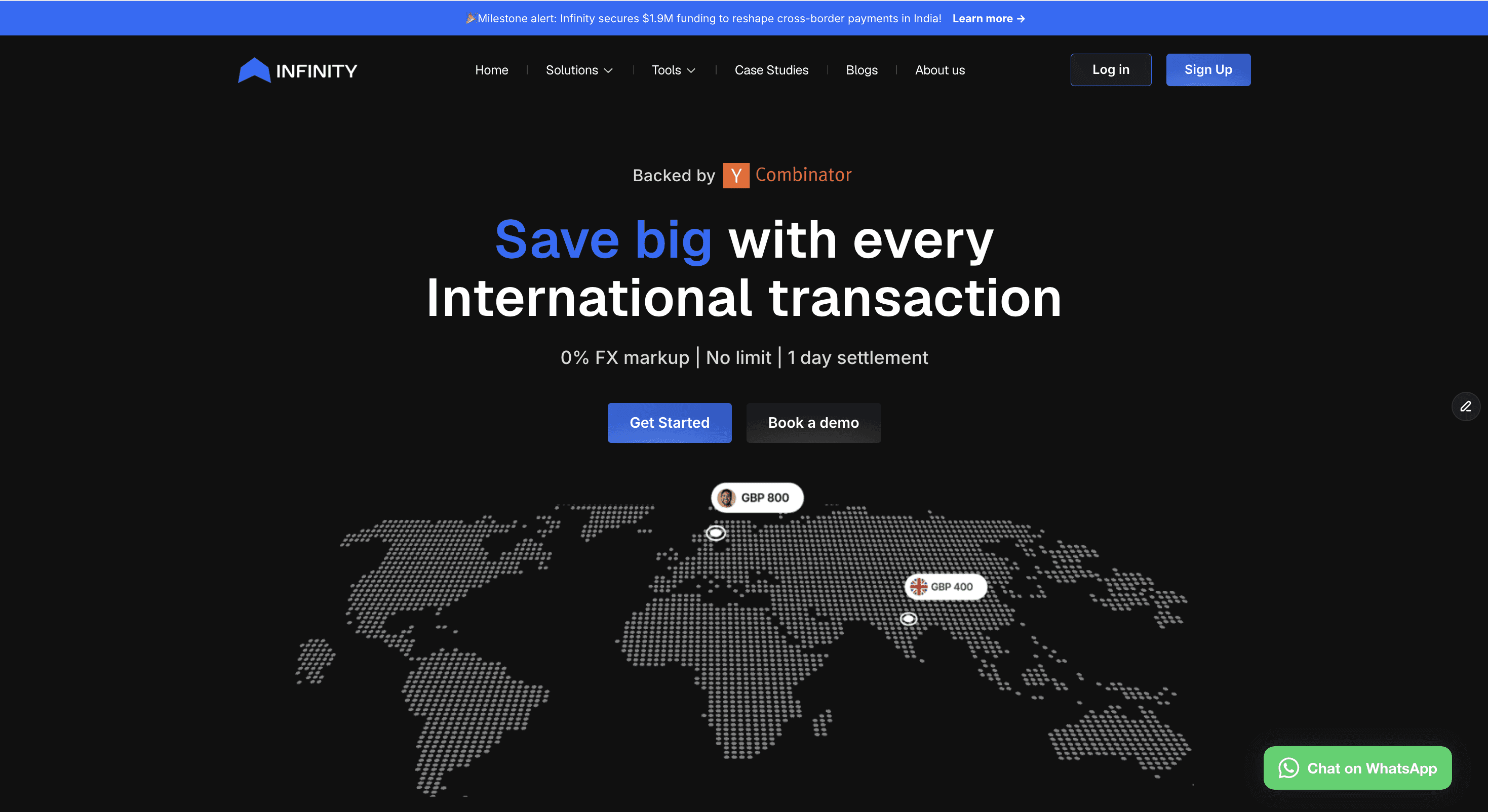
Infinity is a modern international payment platform designed specifically for freelancers, creators, and SMBs in India.
Here’s what makes Infinity better than banks for receiving international payments in India:
No/Minimal FX markup: Infinity offers live FX rates with zero markup, so you get more of your hard-earned money.
Transparent, flat fees: With Infinity, you don’t get any mystery charges. Just a simple, flat 0.5% transaction fee on all foreign payments.
Faster transfers: While banks can take 2–5 days, Infinity typically processes your payments in under 24 hours.
FIRC support: Do you need proof for tax or GST purposes? Infinity automatically provides FIRC documentation, saving you the follow-up emails and branch visits.
Multi-currency Support: Infinity offers multi-currency accounts so you can easily receive payments in USD, GBP, EUR, and AUD. This makes it easy to collect payments from clients anywhere in the world.
Platform integration: Infinity works smoothly with platforms like Upwork, Fiverr, Stripe, and more, making your global workflow even easier.
Feature | Infinity | Traditional Banks (ICICI, Axis, etc.) |
Processing Time | Within minutes to 1 working day | 1–5 working days, depending on the method |
FX Markup | Zero FX markup | Higher (typically 2.5–3.5% or more) |
FIRC Certificates | Auto-generated and downloadable | Available, but often need manual requests |
User Experience | Fully digital onboarding, intuitive UI | Traditional often requires branch visits for issues |
Remittance Tracking | Real-time updates on app/web | Some banks provide tracking via ma obile app |
Customer Support | Dedicated support via chat and email | Relationship managers for high-volume clients only |
Freelancer/SMB Friendliness | Designed for freelancers & SMBs | Primarily focused on exporters, corporates, and NRIs |
Ease of Setup | Fast online KYC and activation | May involve paperwork and in-person verification |
Choose Infinity over Traditional Banks
Banks often come with unexplained deductions, slow settlements, and unclear FX rates. And traditional banks just weren’t built with freelancers or small businesses in mind.
Infinity was built to fix exactly that problem.
It’s built for people like you. Freelancers, creators, consultants, and business owners who work globally need a payment system that actually works for them. With faster transfers, real-time tracking, clearer fees, and no hidden FX charges, Infinity removes the usual stress from international payments.
Sign up for Infinity today!
FAQs
1. Which bank has the lowest charges for receiving international payments in India?
Public sector banks like Indian Overseas Bank and SBI have generally shown lower forex markups than private banks in published fee trackers. But you must always check the current TT buying rate against the mid-market rate for your specific payment.
2. What is FIRC, and how can you get it?
FIRC (Foreign Inward Remittance Certificate) is an official document issued by banks to confirm that you've received a foreign payment in India. You have to request it manually. Platforms like Infinity provide automated FIRC support with every withdrawal at no extra cost.
3. Do I need a FIRC for every international payment I receive?
No. FIRC and its variants (e-FIRC, FIRA) generally apply to business income such as export proceeds, FDI, or ODI. Personal remittances like gifts or family maintenance typically only need a FIRS.
4. Which bank offers the best forex rates?
IOB offers the best forex rates. However, you should check the transaction charges.
5. Can I use a savings account for international payments?
Yes, you can receive payments into a regular savings account via SWIFT transfers. However, business accounts may offer higher limits and better support.
6. How long does it take to process international payments?
Indian banks usually process international payments within 2 to 5 business days. It depends on the sending country, bank holidays, and intermediary banks involved.
7. Can I receive international payments without a bank account, using a payment platform instead?
RBI-authorised PA-CB platforms can facilitate inward and outward cross-border payments for imports and exports. But the funds are usually still settled into your Indian bank account eventually. These platforms sit alongside banks rather than fully replacing the banking system.


