

Export essentials

Subscribe to our newsletter
Get the latest updates, insights, and tips delivered straight to your inbox.
A few months back, a friend who runs a small design export business called me in a bit of a panic. Her client in the US had paid her on time, the money had landed in her account weeks ago, and she assumed the transaction was done and dusted. Then her bank sent her a notice asking her to "close the shipping bill in EDPMS" or risk being flagged. She had no idea what EDPMS even stood for, let alone why a payment she had already received was somehow still "pending" in the RBI's eyes.
If you export goods or services from India, this is a story you will eventually run into, one way or another. Your payment can be sitting safely in your account, and your export can still be technically "open" and non-compliant, simply because of a data-matching step nobody explained to you.
This guide breaks down what EDPMS actually is, why it exists, how it works, where people commonly go wrong, and how you can stay on top of it without losing sleep.
TL;DR
EDPMS (Export Data Processing and Monitoring System) is the RBI's online system that tracks whether export payments have actually been received against the shipping bills or SOFTEX forms filed for those exports.
Every export needs to be "closed" in EDPMS once your bank matches the payment to the shipment, usually within 9 months.
If this matching does not happen, you can face RBI scrutiny, delays in future export benefits, or even land on a caution list.
Most of the confusion comes from exporters assuming payment received means compliance done, when the bank still needs to match and close the entry separately.
What is EDPMS?
EDPMS stands for Export Data Processing and Monitoring System. It is an online platform run by the Reserve Bank of India, launched in March 2014, that tracks every export made from India and checks whether the payment for it has been received (realised) within the allowed time.
In simple terms, EDPMS is the RBI's way of asking one question for every export you make: "Did the money actually come in, and does it match what was shipped or invoiced?" Your bank feeds data into this system, and until that match happens, your export is considered "open" or pending.
Why Was EDPMS Introduced?
Before 2014, this entire tracking process was manual. Banks and exporters relied on paper-based documents to prove that export proceeds had been received, and RBI had no real-time way of knowing which exports were paid for and which were not.
This created two problems. Exporters faced delays because paperwork moved slowly between banks, customs, and RBI. And RBI could not properly monitor foreign exchange coming into the country, which matters for the country's forex reserves and for catching cases where money never came back at all.
EDPMS solved this by putting everyone, customs, banks, and the RBI, on one shared digital system, so matching happens automatically instead of through paperwork.
How Does EDPMS Work?
Here is the process in a simple sequence:
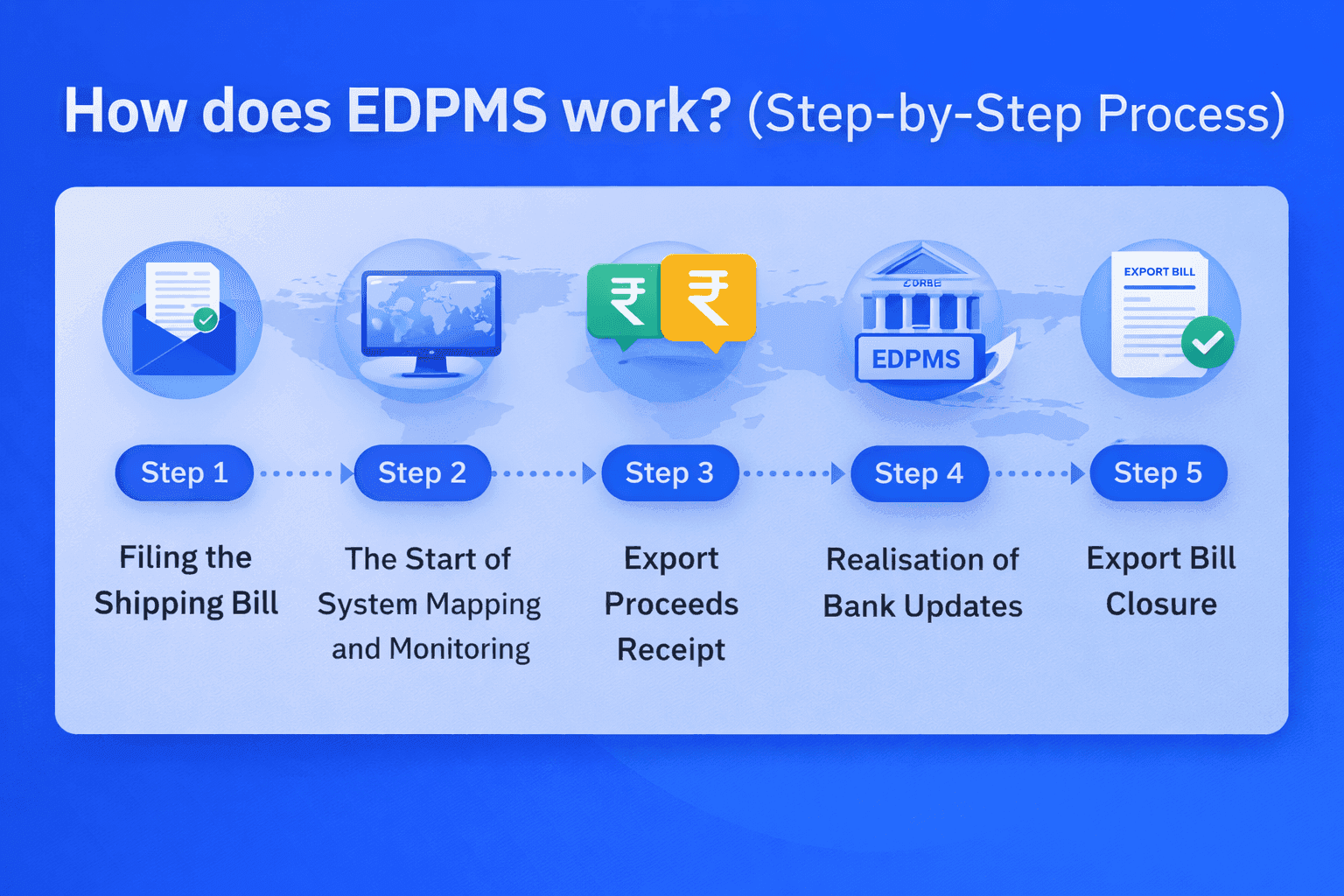
Shipping bill or SOFTEX form is generated. For goods, this comes from Customs. For services (including most freelancers, agencies, and SaaS businesses), this comes from SEZ or STPI authorities.
This data flows into EDPMS. Customs, SEZ, and STPI systems feed the shipment or invoice details into EDPMS automatically.
Your bank receives your payment. When your overseas client pays you, the payment comes through your bank as an authorised dealer (AD) bank.
The bank matches the payment to the shipping bill or SOFTEX entry. This is the critical step. The bank checks that the amount received corresponds to a specific export entry.
The transaction is marked "closed" in EDPMS. Once matched, an electronic Bank Realisation Certificate (eBRC) is generated, and your export is considered compliant.
The part most exporters miss is step 4. Money reaching your account is not the same as your bank matching it in EDPMS. That matching depends on your bank having the correct reference details, and delays or errors here are what leave transactions "open" even though you have already been paid.
EDPMS vs IDPMS: What's the Difference?
These two are often confused because they sound similar and are run by the same authorities. Here is a detailed difference between EDPMS and IDPMS:
EDPMS | IDPMS | |
Full form | Export Data Processing and Monitoring System | Import Data Processing and Monitoring System |
Tracks | Export shipments and proceeds received | Import shipments and payments sent out |
Applies to | Exporters (goods and services) | Importers |
Key documents | Shipping bill, SOFTEX, eBRC | Bill of Entry, outward remittance |
Launched | March 2014 | October 2016 |
If you are exporting from India, EDPMS is the one that applies to you. IDPMS is the mirror system for businesses bringing goods into India.

Common Mistakes Exporters Make with EDPMS
The following are the common mistakes exporters make with EDPMS:
Assuming payment received means compliance done. As covered above, the bank still needs to match and close the entry.
Wrong or missing reference numbers. If the invoice number, shipping bill number, or SOFTEX number given to the bank does not match RBI's records, the system cannot auto-match the payment.
Not following up with the bank. EDPMS closure is not always automatic on the exporter's end. If your bank has not closed an old entry, it can sit open for months without anyone flagging it to you.
Ignoring the 9-month realisation rule. RBI expects export proceeds to be realised within 9 months of the shipment or invoice date. Missing this window without informing your bank can lead to your export being marked overdue.
Not tracking service exports separately. Many freelancers and agencies assume EDPMS only applies to physical goods. It applies to service exports through SOFTEX as well, and the matching rules are the same.
Key Components of EDPMS
The following are the key components of EDPMS:
Shipping bill / SOFTEX form: The document that records what was exported and its value.
Authorised Dealer (AD) bank: Your bank, responsible for reporting your export payment and matching it in EDPMS.
Realisation period: The time limit (generally 9 months) within which payment must be received.
eBRC (electronic Bank Realisation Certificate): Generated automatically once your export is matched and closed, this is your proof of compliance.
XOS (Export Outstanding Statement): A report banks submit listing exports that are still open or overdue, used by RBI to monitor pending cases.
How Infinity Simplifies Export Compliance
A lot of the EDPMS confusion comes down to visibility. You know your client paid you, but you often have no easy way to see whether that payment has actually been matched and closed on the compliance side.
With Infinity, every payment you receive comes with a clean, ready FIRA (Foreign Inward Remittance Advice) at no extra cost, so you always have documented proof of the payment tied to the right transaction details. This makes it far easier for you or your CA to reconcile payments against your shipping bills or SOFTEX filings and follow up with your bank before anything turns into an overdue entry. Instead of discovering an EDPMS issue through a bank notice months later, you have the paperwork on hand from day one.
FAQs
What is the full form of EDPMS?
EDPMS stands for Export Data Processing and Monitoring System, an RBI platform that tracks export shipments and payment realisation.
Does EDPMS apply to service exporters and freelancers?
Yes. Service exports filed through SOFTEX forms are tracked in EDPMS the same way goods exports are.
What is the time limit to realise export proceeds under EDPMS?
Generally 9 months from the date of the shipping bill or invoice, though RBI circulars can revise this from time to time.
What happens if my EDPMS entry stays open too long?
Your export may show up as overdue in your bank's XOS report to the RBI, which can affect future export benefits and, in prolonged cases, lead to caution listing.
How do I check if my EDPMS entry is closed?
Your AD bank can confirm the status of a specific shipping bill or SOFTEX entry. Some banks also provide online tracking for this.


