

Export essentials

Subscribe to our newsletter
Get the latest updates, insights, and tips delivered straight to your inbox.
TL;DR
For software services that has to be exported from India, a SOFTEX form is a necessary declaration. Under Indian foreign exchange restrictions, SOFTEX form aids as a regulator in monitoring software exports and foreign exchange revenues.
For every export invoice, software exporters operating from Special Economic Zones or registered with organisations such as the Software Technology Parks of India (STPI) are required to submit SOFTEX forms. This certification enables licensed banks to record the foreign inward remittance and validates the value of exported software services from India.
Creating an export invoice, submitting the SOFTEX form via the STPI or SEZ portal, obtaining export value certification, and connecting it with the payment received from foreign clients are all steps in the filing procedure. As part of India's foreign exchange monitoring framework, the Reserve Bank of India (RBI) has published guidelines that govern how this system runs.
Managing SOFTEX compliance in addition to managing international payments can be challenging for exporters who deal with several foreign clients. By assisting companies in managing export documentation and payment reconciliation in one location, platforms such as Infinity streamline this procedure.
Why SOFTEX Compliance Matters for Indian Software Exporters
India is one of the biggest exporters of software services worldwide. Thousands of Indian experts provide software goods and services to clients throughout the world, from freelance developers and digital agency to IT outsourcing firms and SaaS startups.
The Indian government mandates that exporters accurately disclose software exports, which bring in billions of rupees annually. This keeps cross-border trade transparent and aids authorities in monitoring foreign exchange outflows.
The Foreign Exchange Management Act (FEMA), which controls the flow of foreign currency into and out of the nation, governs software exports. Exporters are required to file a declaration known as the SOFTEX form in order to guarantee compliance with these laws.
The value of software services exported by Indian businesses and freelancers is officially documented on this form. It enables banks and regulatory bodies to confirm revenue from exports and connect them to the foreign payments the exporter has received.
Therefore, any company that exports software services from India have to understand the SOFTEX filing procedure.
What is a SOFTEX Form?
Indian software exporters record the value of software services exported to foreign customers using a SOFTEX form. Its main purposes are to verify export invoices and make sure that the foreign exchange received from software exports is accurately documented.
In simple terms, the form serves as documentation that a specific export transaction has occurred and that the designated authority has confirmed the value of the exported software service.
Purpose of the SOFTEX Form
The SOFTEX forms primary function is to allow financial regulators and the government of India to keep an eye on software exports from India. There is no traditional shipping bill or customs paperwork because software services are delivered digitally rather than physically.
By offering an official record of the transaction, the SOFTEX form closes this gap. It verifies the type of software service that was exported, the amount of the invoice, and the information about the foreign client that was involved in the transaction.
This procedure guarantees that the international payment received from these services is appropriately recorded and connected to the exporter's bank account.
Who Issues the SOFTEX Certification?
The Software Technology Parks of India (STPI) or the appropriate Special Economic Zone authority, if the exporter operates from a SEZ, typically handle the certification of SOFTEX forms.
These authorities examine the company's export documents and confirm that the software service's disclosed value is accurate and reasonable. The validated SOFTEX form is sent to the exporter's authorised dealer bank after approval.
Which Transactions Require SOFTEX Filing?
The majority of software exports from India are subject to SOFTEX filing. This comprises a variety of digital services that are provided remotely to clients in other countries.
Custom software development projects, cloud-based software services, mobile app development, SaaS subscriptions, IT consulting services, and digital product development for foreign clients are typical examples.
The SOFTEX form functions as the formal export declaration needed by foreign exchange rules because these services are provided electronically.

Who Needs to File a SOFTEX Form in India?
Not all companies that handle foreign payments must submit a SOFTEX form. Exporters involved in software development and related IT-enabled services are particularly subject to this requirement of filing SOFTEX form.
STPI Registered Software Exporters
For software exports, companies enrolled under the Software Technology Parks of India must submit SOFTEX forms. These businesses usually function under export-oriented divisions that enjoy a number of tax and regulatory advantages.
SOFTEX filing is a regular compliance requirement associated with each export invoice for these organisations.
SEZ Units Exporting Software Services
Software firms based in Special Economic Zones are required to submit SOFTEX declarations as well. But rather than STPI, the SEZ authority manages the filing procedure.
Before sending the paperwork to the bank, these authorities examine the transaction and attest to the export value.
SaaS Companies and Digital Service Providers
Subscription-based software products are exported to customers worldwide by numerous contemporary SaaS companies established in India. The business must still adhere to export reporting regulations in such circumstances.
Documentation of certain software exports may require SOFTEX filing, depending on the registration status and firm structure.
Freelancers and Independent Developers
It might not always be necessary for independent developers and freelancers who export software services to submit SOFTEX forms. To verify the type of international payment received, banks may still ask for supporting paperwork.
Compliance standards may become more stringent for larger contracts or recurrent export revenue.
When Should a SOFTEX Form Be Filed?
A key factor in SOFTEX compliance is timing. Exporters are required to make sure the form is submitted within the time range that regulatory bodies provide.
Filing Timeline After Invoice Generation
The SOFTEX form usually needs to be filed soon after the export invoice is created. The deadline is usually within 30 days, but the precise date may vary depending on the regulations that apply.
Export transactions are accurately documented and connected to the foreign remittance that is subsequently received when they are submitted on time.
Filing for Each Export Invoice
Usually, SOFTEX forms are submitted invoice by invoice. To guarantee correct reporting, each export invoice created for a foreign client must be declared separately. Businesses that conduct a lot of foreign commerce may find this challenging.
Role of Authorised Dealer Banks
The SOFTEX form is sent to the exporter's designated dealer bank following certification by STPI or SEZ authorities. These banks are in charge of keeping an eye on foreign exchange transactions and are governed by the Reserve Bank of India.
To confirm that the money received relates to a valid export transaction, the bank employs the SOFTEX certification.
Step-by-Step Process to File a SOFTEX Form in India
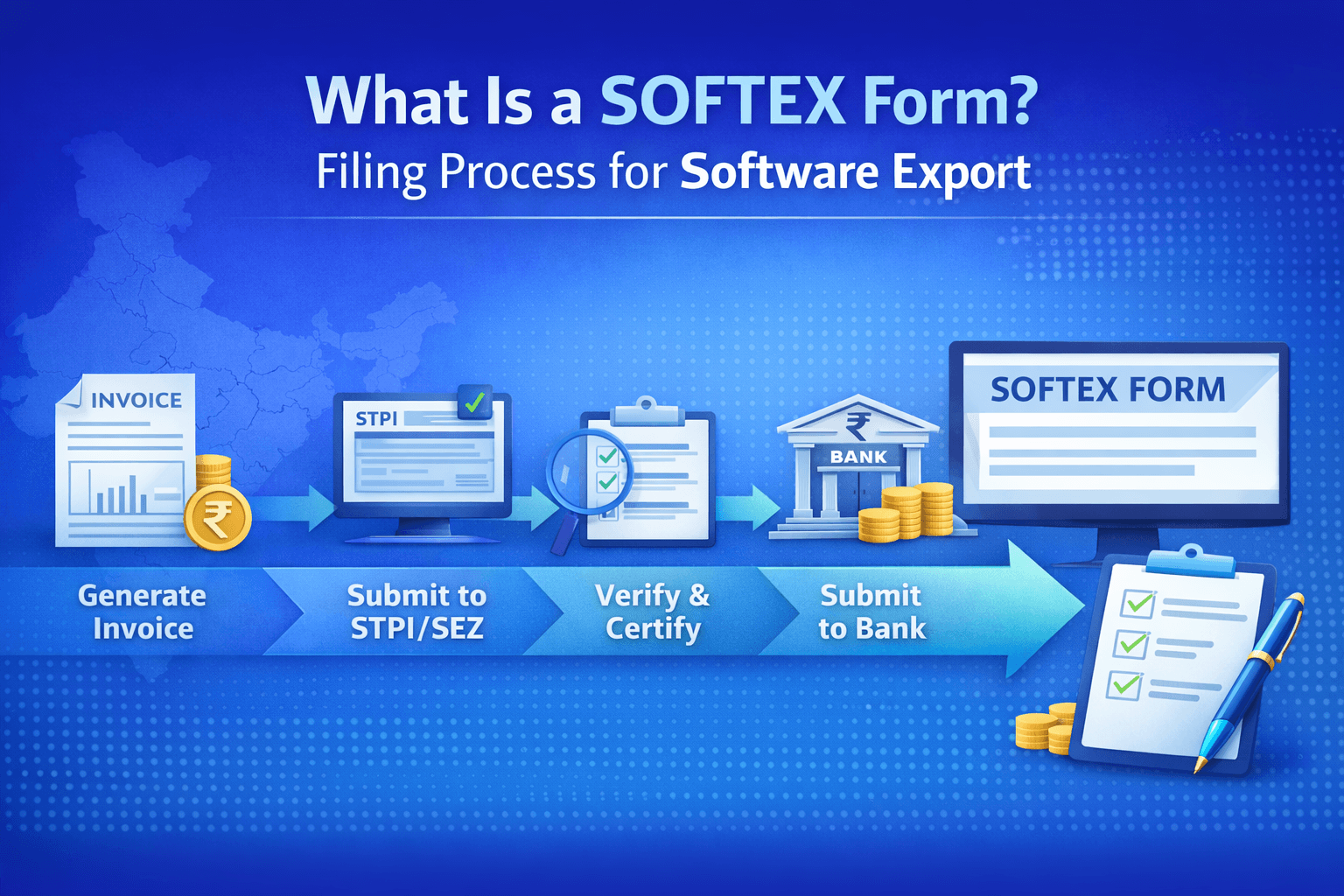
There are several processes involved in filing a SOFTEX form to guarantee correct paperwork and regulatory compliance.
Step 1: Generate Export Invoice
The creation of an export invoice for the software service rendered to the foreign client is the first step in the procedure. Details like the client's location, the service description, the contract value, and the currency in which payment will be made, all must be included on the invoice.
Step 2: Submit SOFTEX Details to STPI or SEZ Authority
The exporter next files the SOFTEX declaration using the SEZ authority's or STPI's designated website. The form contains information on the invoice, the type of software service, and the export's total value.
Step 3: Verification of Export Value
Following submission of the application, the authority examines the supporting documents to confirm that the indicated export value is appropriate and consistent with the type of service rendered.
This procedure guarantees openness and stops export values from being over-reported or under-reported.
Step 4: Certification by STPI or SEZ Authority
The authority certifies the SOFTEX form following verification. This certification attests to the legitimacy of the export transaction and the acceptance of the service's reported value.
Step 5: Submission to Authorised Dealer Bank
After that, the exporter's approved dealer bank receives the certified SOFTEX form. The foreign currency payment received in the exporter's account is linked to the export transaction by the bank.
Documents Required for SOFTEX Filing
When submitting a SOFTEX form, exporters are required to provide multiple supporting papers. Authorities can confirm the specifics of the export transaction with the use of these documents.
Export Invoice
The main document used to declare the value of the software service exported to the overseas client is the export invoice.
Client Contract or Agreement
To verify the extent of the work completed, a copy of the service agreement or project contract could be needed.
SOFTEX Application Form
Detailed information on the exporter, the overseas client, the invoice value, and the type of exported service is all included in the completed SOFTEX form.
Bank Realisation Details
To verify the export declaration with the received foreign remittance, proof of payment or bank realisation documentation may occasionally be needed.
Common Challenges in SOFTEX Filing
Even though handling SOFTEX files is a standard compliance obligation, many exporters encounter practical difficulties.
Delayed Filing Penalties
If the filing date is missed, compliance issues may arise, requiring further explanations or corrective filings.
Complex Documentation Requirements
Small exporters and startups frequently find it difficult to handle export paperwork in addition to their everyday business activities.
Difficulty in Tracking Multiple Invoices
Every month, SaaS firms and digital service providers could produce hundreds of invoices. Keeping track of SOFTEX filings for every transaction can get very taxing.
How SOFTEX Forms Impact International Payments
In order to connect export transactions with foreign currency inflows, SOFTEX forms are crucial.
The authorised dealer bank confirms that a payment made to an Indian exporter from a foreign client is associated with a certified export transaction. This aids in ensuring that export revenues are properly reported and that foreign exchange restrictions are followed.
Compliance is a crucial component of managing a worldwide software company since banks may postpone or question foreign payments in the absence of adequate documentation.
How Infinity Simplifies SOFTEX Form Filing for Exporters
For companies that frequently deal with foreign clients, handling export documents, foreign payments, and regulatory compliance can easily become challenging.
By assisting exporters in streamlining their international payment procedures and keeping well-organised records for their cross-border transactions, Infinity streamlines this whole process. Exporters can focus on expanding their international business while managing compliance and international payments more effectively with Infinity.
FAQ
What is an Indian SOFTEX form?
Software exporters use a SOFTEX form to record the value of software services they export to clients abroad.
Who is required to submit a SOFTEX form?
Software exporters operating out of SEZ facilities or registered with STPI are required to submit SOFTEX forms for export invoices.
Do SaaS companies need to file SOFTEX?
SaaS enterprises exporting software services could have to submit SOFTEX forms, depending on their export registration and business structure.
What body authorises SOFTEX forms?
The Software Technology Parks of India or the appropriate SEZ government usually certifies SOFTEX forms.
What paperwork is needed to file for SOFTEX?
Export invoices, service contracts, the SOFTEX application form, and bank remittance information are examples of common papers.


