


Discover infinity


Subscribe to our newsletter
Get the latest updates, insights, and tips delivered straight to your inbox.
Most people don't start looking for a BriskPe alternative because BriskPe stopped working.
They start looking after receiving a few international payments.
The first invoice goes through without any issues. The client pays, the money arrives, and everything seems straightforward.
A few months later, your priorities begin to change.
Maybe your invoices have grown from $500 to $8,000, and you're wondering whether you're paying more than necessary in fees.
Maybe your accountant keeps asking for FIRA documents, and downloading or organising them has become another monthly task.
Or maybe you've realised that most of your clients simply pay through bank transfers, so features like PayPal payment links or Amazon marketplace support aren't adding much value to your workflow.
At that point, the question is no longer "Is BriskPe good?"
It's "Is there something that fits my business better?"
The answer depends on how you receive international payments.
I compared the most popular international payment platforms used by Indian businesses, including their pricing, settlement timelines, compliance support, payment methods, and where each one makes the most sense.
Some are built for freelancers.
Some are designed around marketplace payouts.
Others focus on high-value B2B exports.
This guide explains where each platform fits best, where it falls short, and when switching from BriskPe actually makes sense.
TL;DR - Best BriskPe Alternatives
Platform | Best for |
Freelancers, agencies, SaaS, and exporters wanting the lowest flat fee with zero FX markup and free FIRA | |
Skydo | Larger invoices ($2,000+) where flat-fee pricing beats percentage-based models |
Xflow | High-value B2B exporters, IT firms, and SaaS companies needing FX rate locking and compliance desk support |
Wise Business | Simple multi-currency holding, low-cost transfers, global reach |
Payoneer | Marketplace sellers on Upwork, Fiverr, Amazon, and 2,000+ platforms |
PayPal | Clients who specifically request PayPal wallet or card payments |
Stripe | SaaS and developer-led checkout with global card acceptance |
Winvesta | USD, GBP, EUR, CAD collections with multi-currency holding and FX timing control |
Karbon | B2B bank-transfer collections, payment links, exporters who need outward remittance too |
Fees Comparison
Freelancer receives $1,000 from a US client.
Platform | Platform fee | FX markup | FIRA | Estimated total cost |
$5 (0.5%, GST included) | Nil | Free | ~$5 | |
Skydo | $19 + 18% GST = ~$22.42 | Nil | Free | ~$22.42 |
Xflow (Starter) | $12 | Nil | Free | ~$12 |
Karbon | $10 (1%) + GST | Nil | Free | ~$11.80 |
PayPal | ~$44 (4.4%) + $30–40 FX | — | Monthly only | ~$74–84 |
Wise | ~$17 (1.7%) | Nil | $2 | ~$19 |
BriskPe | ~$7.50 (0.75% legacy) or tiered new pricing | Verify | Included | Verify current |
Winner for $1,000: Infinity at approximately $5 all-in.
Why Look Beyond BriskPe?
BriskPe isn't a bad product. In fact, for many businesses it's a perfectly reasonable choice.
It supports Amazon Global Selling payouts, offers PayPal payment links, provides virtual collection accounts, and focuses specifically on Indian businesses receiving money from overseas. If that's exactly how you work today, there may be little reason to switch.
The problem is that no payment platform is the best choice for every business.
As your clients, invoice sizes, and payment methods change, the things that mattered when you opened the account may stop being the things that matter now.
For example, pricing can change significantly depending on how much you invoice.
BriskPe's newer pricing follows a tiered structure, where larger transactions benefit from lower percentage fees. That's perfectly reasonable, but it also means another platform with a flat fee or a lower fixed percentage could end up costing less if your invoice sizes follow a different pattern.
Compliance is another reason people compare providers.
If your accountant regularly needs FIRA certificates, purpose codes, or export documentation, the process of obtaining those documents matters almost as much as the transaction itself. Some platforms generate them automatically for every payment, while others require additional steps or provide them on a different schedule.
Payment methods also influence the decision.
If every client pays by bank transfer, features designed around wallets or payment links may never be used. On the other hand, agencies working with smaller international clients often find card payments or PayPal links useful because they reduce payment friction.
The goal isn't to find the platform with the lowest advertised fee.
It's to find the one that matches how your business actually gets paid.
How I Compared These Alternatives
Instead of comparing marketing pages, I focused on the questions most Indian businesses ask before switching payment providers.
Total cost
The advertised platform fee rarely tells the full story.
I looked at transaction charges, FX markups where applicable, GST treatment, FIRA costs, and any other charges that affect what you actually receive in your bank account.
Day-to-day operations
Receiving the money is only part of the workflow.
Settlement speed, onboarding, export documentation, reconciliation, and compliance all affect how easy the platform is to use once payments become a regular part of your business.
Business fit
A freelancer, SaaS company, Amazon seller, and manufacturing exporter don't have the same requirements.
Rather than trying to crown one universal winner, I looked at which platform fits each type of business best based on its payment methods, supported currencies, integrations, and compliance features.
9 Best BriskPe Alternatives For International Payments
Platform | Best for | Collection methods | Fee model | e-FIRA / compliance | Key limitation |
Infinity | Freelancers, agencies, SaaS, exporters | Virtual accounts, bank-transfer led | 0.5% flat, zero FX markup, GST included | Free FIRA per transaction, RBI-compliant | No PayPal/PayU wallet links |
Skydo | Larger invoices ($2,000+) | Virtual accounts, InstaLinks, Amazon PSP | $19/$29 flat + 0.3% above $10,000, zero FX markup (Plus 18% GST) | Instant FIRA, eBRC for Amazon sellers | Flat fee expensive |
Xflow | High-value B2B, SaaS, IT exporters | Virtual accounts, payment links, APIs | $12 Starter / $20 Growth flat + variable, zero FX markup | e-FIRA in 24 hrs, Compliance Desk for EDPMS | Not cheapest for invoices under $2,000 |
Wise Business | Multi-currency users, low-cost transfers | Virtual accounts, SWIFT | ~1.65% conversion fee, mid-market rate, $2 per FIRA | FIRA available at cost | Not designed for India export compliance workflows |
Payoneer | Marketplace and platform payouts | Marketplace payouts, global accounts | 1% ACH / 3.2%+$0.49 card, 2-3% FX withdrawal | FIRA varies by corridor | FX markup on INR withdrawal, $29.95 annual fee if under $6,000/year |
PayPal | Clients requesting wallet/card payments | Wallet, card, payment links | ~4.4% transaction + 3-4% FX markup | Monthly FIRA, not per-transaction | High cost, dispute risk, payment holds |
Stripe | SaaS/developer checkout | Cards, subscriptions, checkout | Processing fee + FX (varies) | India-specific export documentation limited | Onboarding constraints for Indian merchants |
Winvesta | USD/GBP/EUR/CAD focus, multi-currency holding | Virtual accounts in 4 currencies, SWIFT in 37+ | 0% FX markup, competitive fees (verify current pricing) | FIRA support, auto purpose codes | Currency coverage narrower than Xflow or Payoneer |
Karbon | B2B bank transfers, exporters needing outward remittance too | Virtual accounts (USD), payment links, cards | 1% flat, 0% FX markup, GST not included in listed fee | Auto-FIRA in 24 hrs, GST-ready records | Currently USD-primary for virtual accounts; card fees higher |
Quick verdict: For India-first transparent bank-transfer collections, choose Infinity. For marketplace payouts, Payoneer or BriskPe. For compliance-heavy exports, Xflow. For card and wallet payment link workflows, Karbon, PayPal, Infinity, or Stripe.

1. Infinity- Best Overall BriskPe Alternative
If your clients usually pay invoices through bank transfers instead of cards or digital wallets, Infinity is probably the closest alternative to BriskPe.
The biggest difference isn't the interface or onboarding process. It's how the platform approaches international collections.
BriskPe tries to support several different payment workflows, including Amazon Global Selling, PayPal payment links, and virtual collection accounts. Infinity takes a narrower approach. It focuses almost entirely on helping Indian businesses receive international bank transfers at the lowest possible cost.
For many freelancers and agencies, that's exactly what they need.

Fees:
Pricing is where the platform stands out.
Infinity charges a flat 0.5% fee on incoming payments. The company says there are no FX markups, no monthly subscription, and GST is already included in that fee. That makes estimating your payment surprisingly simple because the percentage doesn't change depending on invoice size.
For example:
A $1,000 payment costs $5
A $5,000 payment costs $25
A $25,000 payment costs $125
There aren't additional platform charges hidden behind different pricing tiers.
Documentation is another area where Infinity keeps things simple.
Every withdrawal includes a FIRA issued through an RBI-authorised banking partner, and the company states that transactions are processed through AD-1 banks within a FEMA-compliant framework.
That won't matter much if you only receive a few payments every year.
It becomes much more valuable when you're reconciling dozens of invoices every month, and your accountant asks for export documentation regularly.
That said, Infinity isn't trying to replace every international payment workflow.
If your clients insist on paying through PayPal, want to use credit cards, or you're heavily dependent on Amazon marketplace payouts, you'll probably find BriskPe or another provider better suited to those situations.
BriskPe vs Infinity - Direct Comparison
Comparison point | BriskPe | Infinity |
Best for | Amazon sellers, PayPal/PayU link workflows, marketplace exporters | Freelancers, agencies, SaaS, and service exporters billing via bank transfers |
Fee structure | Tiered: higher rates on smaller amounts, 0.25% above $10,000 (new PA-CB pricing); 0.75%+ for existing customers | Flat 0.5% all-inclusive (GST absorbed, no FIRA charge) |
FX markup | Live FX positioning (verify actual rate vs mid-market before transacting) | Zero FX markup- mid-market rate confirmed |
e-FIRA | Available; user reports of delays in downloading | Free, auto-generated per transaction via AD-1 bank partner |
Amazon PSP | Yes, recognised Amazon PSP | Not a current focus |
PayPal/card links | Yes, core feature | No wallet payment links currently |
Settlement | Typically next business day | T+1, 24 hours |
Best use case | Mixed payment method workflow — PayPal links + virtual accounts + Amazon seller payouts | Clean bank-transfer-led collections with lowest effective fee and compliance documentation |
Compliance and documentation:
The process is straightforward.
You create virtual collection accounts in supported currencies, share the relevant bank details with your client, and they pay using a local bank transfer. Once the payment reaches Infinity, it's converted into INR using the live mid-market exchange rate before being settled into your Indian bank account.
Settlement: Infinity settles funds to your INR bank account within 24 hours of receiving the international payment.
What I like
Predictable pricing regardless of invoice size
No published FX markup
Free FIRA for every eligible withdrawal
One-day settlement for most payments
No monthly subscription
Where it isn't the best fit
No native PayPal wallet payments
No marketplace-focused features like Amazon PSP
Businesses needing card-based checkout will need another solution
Bottom line
If most of your international payments already arrive through bank transfers, Infinity removes a lot of unnecessary complexity. You aren't paying for wallet infrastructure, marketplace integrations, or features you'll rarely touch. That's why it makes the most sense for freelancers, agencies, consultants, and service businesses billing overseas clients directly.
2. Skydo
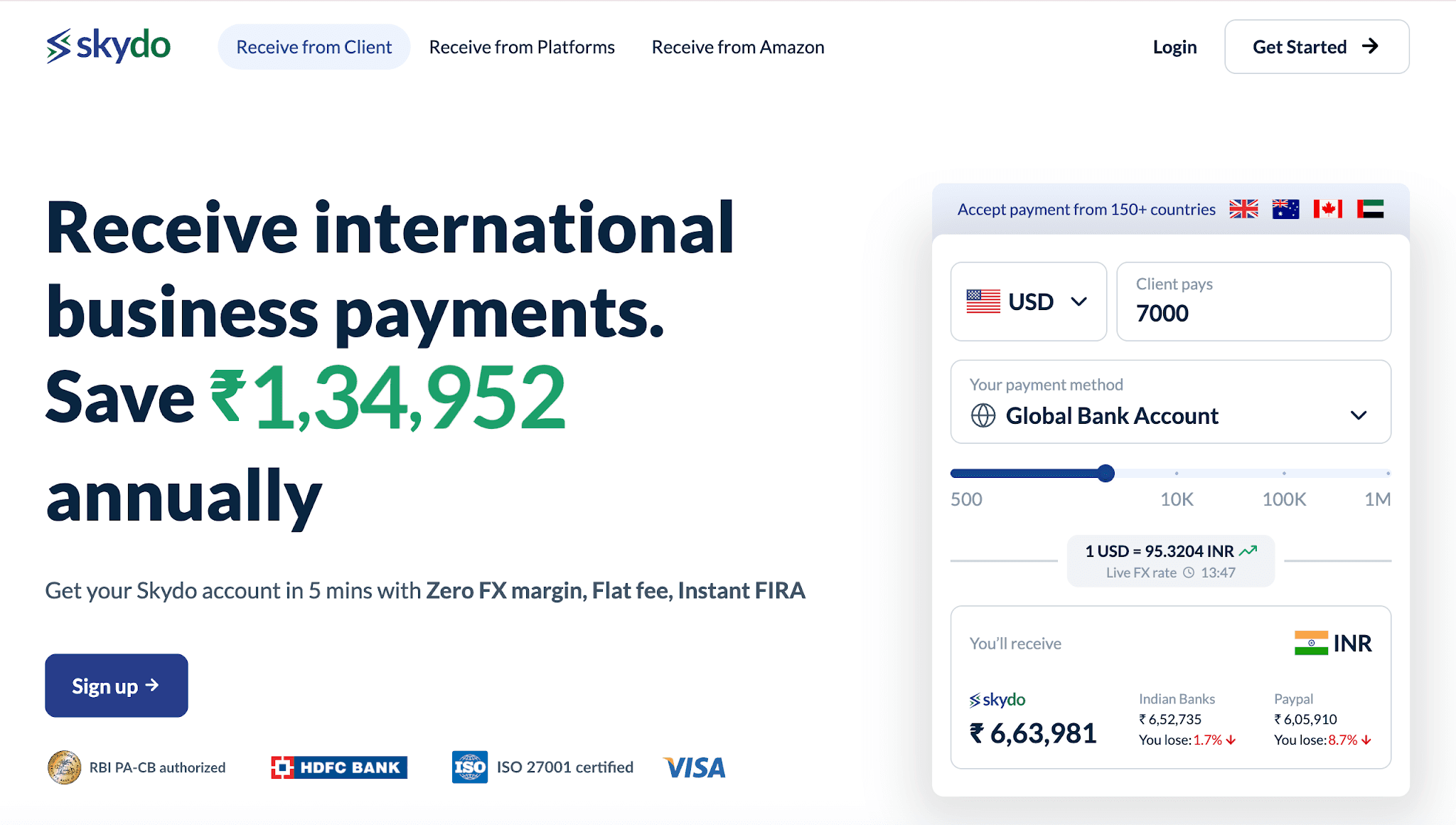
Skydo solves a slightly different problem.
Instead of trying to be the cheapest option for every payment, it becomes more attractive as invoice values increase.
If you're regularly sending invoices worth several thousand dollars, a flat-fee pricing model can work out better than percentage-based pricing. That's exactly where Skydo has built its positioning.
Fees:
For payments up to $2,000, Skydo charges $19.
Between $2,001 and $10,000, the fee increases to $29.
Above $10,000, pricing shifts to 0.3%, with GST charged separately on the platform fee.
That means the economics look very different depending on the size of your invoices.
A freelancer receiving $500 every few weeks may find the flat fee difficult to justify.
An IT services company invoicing $30,000 every month may reach the opposite conclusion.
Skydo also has one advantage that matters to a specific group of users: Amazon Global Selling.
Compliance and documentation:
Skydo gives you local bank account details in the US, UK, Canada, Australia, and 10+ other countries. For every eligible transfer, a FIRA certificate is auto-generated once the payment is settled. It is downloadable from the dashboard at any time. Skydo also generates eBRC for Amazon Global Selling sellers, which BriskPe's alternatives do not all offer.
Settlement: 24–48 hours to INR bank account.
What I like
Flat pricing becomes attractive on larger invoices
Amazon PSP approval
Automatic FIRA generation
eBRC support for Amazon exporters
Uses mid-market exchange rates without a published FX markup
Where it falls short
Small invoices become relatively expensive
GST is added separately to platform fees
Outward international payments aren't currently available
Bottom line
Skydo isn't trying to beat every competitor on every invoice.
It's built for businesses that receive fewer but larger international payments, especially exporters already working inside the Amazon ecosystem.
Also Read - In-depth Skydo Review: Is It Worth It For Cross-Border Payments?
3. Xflow
Xflow feels less like a freelancer payment platform and more like software designed for finance teams.
You notice that almost immediately.
Instead of talking primarily about fees, Xflow spends much more time discussing compliance, APIs, FX management, and RBI documentation.
That makes sense because it's aimed at businesses dealing with larger transaction volumes and more complicated payment operations.
Fees:
Its pricing depends on which plan you choose.
The Starter plan charges $12 for invoices up to $2,000, followed by 0.6% above that amount.
The Growth plan charges $20 up to $5,000, then 0.4% for larger invoices. According to Xflow, GST isn't charged directly because collections are handled through its US entity, although businesses may still need to account for GST under the Reverse Charge Mechanism.
Compliance and documentation:
Where Xflow separates itself from most competitors is compliance.
Its Compliance Desk is designed to help exporters dealing with EDPMS issues and more complex RBI documentation. The platform also offers FX rate locking, API access, and tools that help businesses manage larger international payment operations.
Those features won't matter if you're sending one invoice every month.
They become much more valuable when multiple people inside the business are managing collections, finance, and reporting.
Settlement: T+1 (next business day) to INR or EEFC account.
What I like
Strong compliance tooling
Useful APIs for platforms and SaaS companies
FX rate locking
No transaction size limit
One-day settlement
Where it isn't ideal
The minimum fee makes small invoices expensive
No marketplace payout integrations
Doesn't currently support outward remittances
Bottom line
If compliance has become a bigger headache than receiving the payment itself, Xflow deserves serious consideration. It isn't the simplest platform in this list, but it offers capabilities that smaller payment providers simply don't target.
Also Read - Xflow Review: Is It Worth It For Accepting International Payments in India?
4. Wise Business
Wise has built a strong reputation over the years for one simple reason: it makes moving money between countries easier than traditional banks.
If you've ever sent money internationally, you've probably come across it.
That's also why many overseas clients are already comfortable paying into a Wise account. There's no explanation needed. They recognise the name, they know how it works, and the payment experience feels familiar.
But that's also where many Indian businesses stop comparing.
Wise and platforms like Infinity, Skydo or Xflow solve slightly different problems.
Wise is designed for businesses operating across multiple currencies. You can receive payments, hold balances in foreign currencies, convert them later, and even pay suppliers overseas without moving everything back into INR immediately. If that's part of your workflow, it's difficult to find another platform with the same flexibility.
Where the comparison changes is export compliance.
Wise isn't built specifically around India's export documentation requirements. It can provide FIRA for eligible payments, but certificates are charged separately, and the platform doesn't revolve around Indian compliance in the same way as some India-first providers.
Fees and compliance:
Rather than adding an FX markup, Wise converts using the mid-market exchange rate and charges a separate conversion fee. For many major currencies, that works out to roughly 1.6–1.8%, depending on the transfer.
That pricing is perfectly reasonable if you're regularly moving money between currencies.
It becomes less attractive if your workflow is simply:
Client pays → convert to INR → withdraw.
In that situation you're paying for flexibility you may never use.
Settlement: For INR settlement, funds typically arrive within 1–3 business days.
What I like
One of the easiest platforms for managing multiple currencies
Excellent international reputation
Outward payments are built in
Mid-market exchange rates without hidden FX spreads
Things to keep in mind
Conversion fees are higher than several India-first alternatives
FIRA isn't free
Export documentation isn't the platform's primary focus
Bottom line
If your business regularly holds foreign currency or pays overseas contractors, Wise is an excellent fit.
If every payment ends up in your Indian bank account within a day or two, you may find a platform designed specifically for Indian exports simpler and less expensive.
5. Payoneer
If your income comes from Upwork, Fiverr, Amazon, Airbnb or hundreds of other marketplaces, chances are you've already used Payoneer.
That's where it has an advantage almost nobody else can match.
Most payment platforms focus on direct client invoices.
Payoneer spent years integrating with marketplaces.
For many sellers, there isn't even a decision to make because Payoneer is already offered as one of the default payout methods.
According to the company, it supports payouts from more than 2,000 platforms across over 190 countries.
Fees:
Payoneer's costs come in layers. There's a 1% fee when your client pays via ACH, or 3.2% + $0.49 if they pay by card. On top of that, withdrawing to your Indian bank account adds another 2-3% in currency conversion fees. If you receive less than $6,000 in a year, there is a $29.95 annual fee.
When you withdraw USD to your Indian bank account in INR, Payoneer applies a conversion rate typically 1.5% to 2% below the mid-market rate. On a $5,000 payment, that FX gap alone equals approximately ₹6,500–₹8,500 lost purely in the exchange rate.
The tradeoff is clear: Payoneer's FX and total cost is higher than India-first alternatives, but its marketplace payout integrations cannot be replicated by Infinity, Skydo, or Xflow. If your income flows through Upwork or Fiverr, Payoneer is often a practical necessity.
Settlement: 2–3 business days to an INR bank account.
What I like
Massive marketplace network
Well-established international brand
Supports dozens of currencies
Reliable for freelancers working across multiple platforms
Things to keep in mind
Overall receiving cost can become expensive after FX conversion
Annual inactivity fee applies below certain thresholds
FIRA availability varies depending on payment corridor
Bottom line
For marketplace payouts, Payoneer remains one of the easiest options available.
For businesses sending invoices directly to overseas clients, it's worth comparing the total cost before automatically choosing it.
6. PayPal

There are two reasons businesses continue using PayPal.
The first is simple: the client already has a PayPal account and wants to pay that way.
The second is trust.
If you're working with a new overseas client, asking them to send money to a payment platform they've never heard of can sometimes create friction. PayPal has spent more than two decades building consumer trust, so many businesses default to it without asking whether it's the cheapest option.
That's where the trade-off begins.
For Indian businesses receiving international payments, PayPal is one of the most expensive options in this comparison.
Fees
PayPal's costs don't come from a single fee.
They're spread across the transaction itself and the exchange rate used when your payment is converted into INR.
For most cross-border business payments, you can expect to pay around 4.4% as the transaction fee. On top of that, PayPal typically applies an additional 3–4% currency conversion markup before the funds reach your Indian bank account.
That difference becomes much more noticeable as invoice values increase.
A $500 invoice might lose around $35–40 once fees and FX are combined.
A $5,000 invoice can easily cost $300–400 in total deductions, depending on the currency corridor and exchange rate at the time of conversion.
Compared with bank-transfer-first platforms that charge a flat fee or lower FX costs, the gap adds up surprisingly quickly if you invoice international clients every month.
Additional risks for Indian accounts: Payment holds are a known issue, particularly for new accounts or accounts receiving larger-than-usual transactions. Dispute resolution can go against the seller in cross-border transactions. Indian PayPal accounts face restrictions: no domestic INR-to-INR payments, no holding foreign-currency balances, and no outbound international transfers.
What PayPal still does better
Despite the higher cost, PayPal solves a problem that many cheaper alternatives don't.
Almost everyone already knows how to use it.
If your client wants to pay with a card, prefers PayPal Wallet, or doesn't want to arrange an international bank transfer, sending a PayPal payment link is often the quickest way to get paid.
That convenience is exactly why many freelancers continue accepting PayPal even though it costs more.
What I like
Widely recognised and trusted by international clients
Supports wallet payments, cards, and payment links
Easy for first-time international clients
Good buyer and seller protection for eligible transactions
Things to keep in mind
One of the highest overall receiving costs in this comparison
Monthly FIRA instead of per-transaction documentation
Payment holds can still happen on newer or higher-risk accounts
Indian accounts have more restrictions than accounts in several other countries
Bottom line
If a client specifically asks to pay through PayPal, there's usually little point arguing over the payment method.
But if you're choosing a platform for regular international invoices, it's worth calculating what those fees actually cost over a year. A few percentage points may not seem significant on one invoice, but over dozens of payments they can become one of your highest operating costs.
7. Stripe
Stripe isn't really a direct competitor to BriskPe.
If you're comparing the two, you're probably trying to solve two different problems.
BriskPe is built around receiving international payments into India.
Stripe is built around accepting online payments globally.
That difference matters because it changes almost everything else.
Imagine you run a SaaS product.
Customers subscribe through your website using Visa, Mastercard, Apple Pay or Google Pay. You need recurring billing, invoices, failed payment recovery, webhooks, tax calculation and APIs that plug into your application.
That's exactly the kind of business Stripe was designed for.
Now imagine you're a freelance designer who sends one invoice every month to a client in New York.
Using Stripe for that workflow is usually unnecessary.
You're paying for an entire payments infrastructure when all you really need is somewhere for your client to send a bank transfer.
Pricing
Unlike several India-first payment platforms, Stripe doesn't have a single pricing model for international collections.
Your total cost depends on:
where your customer is located
how they pay
whether currency conversion is involved
whether international cards are used
For Indian businesses, card processing fees and foreign exchange charges are applied separately where applicable. Since pricing varies across payment methods and countries, Stripe recommends checking its latest India pricing before calculating costs.
The important point isn't the exact percentage.
It's understanding what you're paying for.
With Stripe, you're paying for payment acceptance, fraud protection, subscription billing, APIs, dispute handling, reporting, and checkout infrastructure—not simply receiving money from overseas.
Where Stripe stands out
This is probably the strongest developer platform in this comparison.
Its APIs are mature, documentation is excellent, and almost every SaaS tool integrates with Stripe out of the box.
If you're building software, chances are you'll eventually integrate with Stripe whether you use it for payments or not.
Features like:
recurring subscriptions
usage-based billing
hosted checkout
customer portals
webhooks
payment retries
are things BriskPe was never designed to solve.
That's why comparing them purely on transaction fees misses the point.
Where it falls short for Indian exporters
For businesses that mainly send invoices and receive international bank transfers, Stripe introduces complexity that may not provide much value.
India-specific export documentation, such as FIRA and purpose code handling, isn't the platform's focus. Depending on your business model, settlement and compliance workflows can require additional configuration compared with platforms built specifically around Indian exporters.
If your accountant regularly asks for export paperwork, you'll probably spend more time managing those processes than you would on a platform designed specifically for inward remittances.
What I like
Excellent APIs and developer experience
Industry-leading subscription billing
Supports cards, wallets and global checkout
Strong fraud prevention and dispute management
Integrates with almost every SaaS stack
Things to keep in mind
Not built primarily for bank-transfer-led international collections
Export compliance isn't its strongest area
Card processing costs are usually higher than receiving a bank transfer directly
Many features will never be used if you only invoice overseas clients
Bottom line
Choose Stripe if your product collects payments through a website or app.
Choose an India-first collection platform if your clients simply send invoices by bank transfer.
They're solving different problems, and comparing them only on transaction fees usually leads to the wrong decision.
8. Winvesta
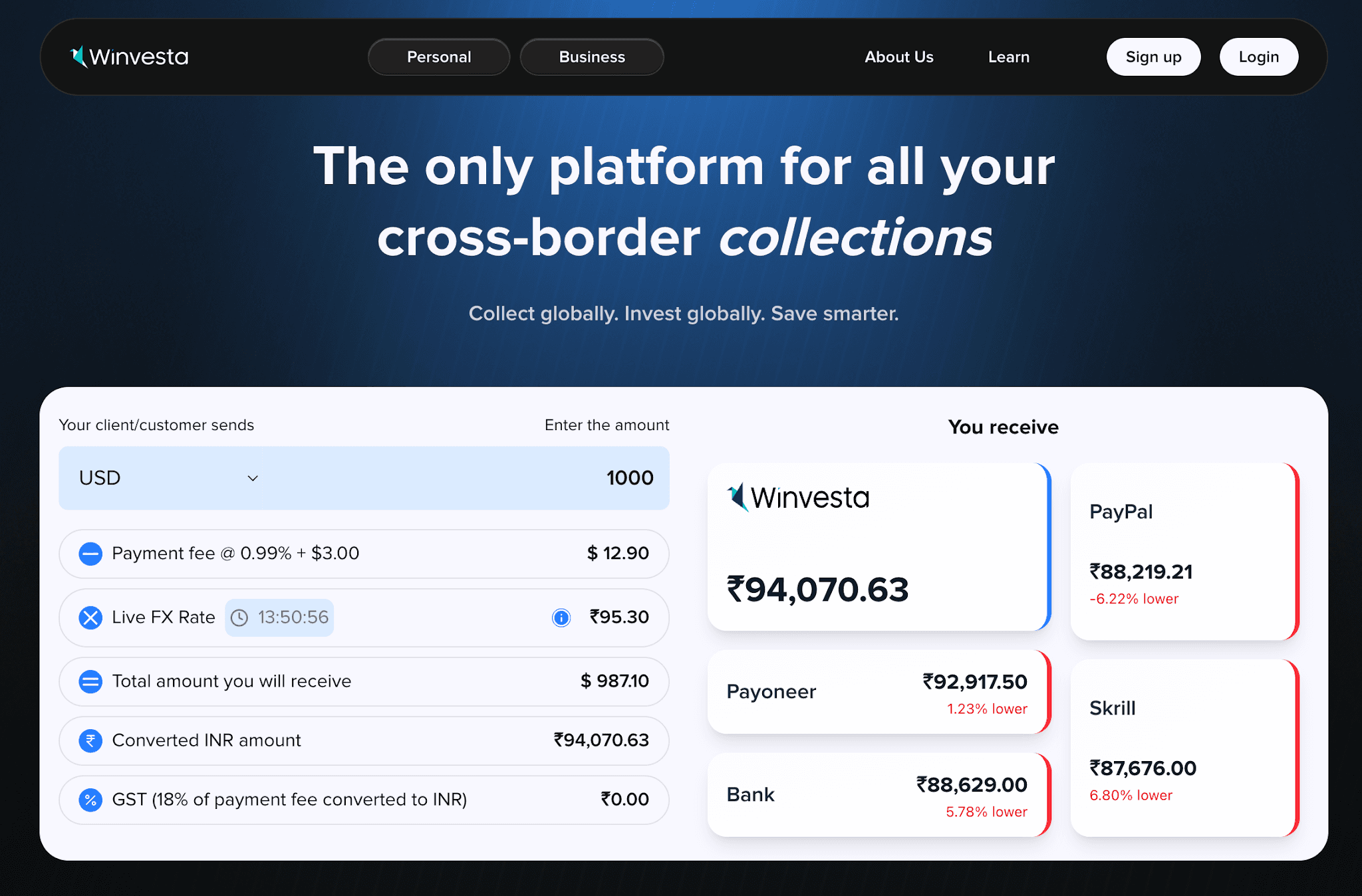
Most payment platforms ask you to convert incoming payments into INR almost immediately.
Winvesta gives you another option.
You can receive money in foreign currencies, hold those balances for a while, and decide later when you want to convert them.
That sounds like a small feature until exchange rates start moving.
Imagine you're expecting several USD payments over the next two weeks.
Instead of converting each one as it arrives, you can wait until you've received everything and convert once, when the exchange rate is more favourable.
For businesses with predictable international revenue, that flexibility can make more difference than saving a few basis points on transaction fees.
Winvesta doesn't charge a setup fee or monthly subscription for opening an account.
The company positions itself around 0% FX markup, while transaction pricing varies depending on the payment corridor and service being used. Rather than publishing a single fee that applies to every payment, Winvesta recommends checking its latest pricing before transacting.
That's worth knowing because your total cost depends on more than just the advertised exchange rate.
What makes Winvesta different
The platform currently provides local collection accounts in USD, GBP, EUR and CAD, while also supporting SWIFT payments across many additional currencies.
For many freelancers, that's enough.
For businesses invoicing clients across a wider mix of currencies, another provider may offer broader local collection coverage.
Winvesta also automatically generates FIRA and maps purpose codes during the payment process, reducing the manual work involved in export compliance.
One feature I particularly like is the ability to hold foreign currency balances before converting them.
Not every business needs it.
But if exchange rates materially affect your revenue, having control over conversion timing is genuinely useful rather than just another marketing bullet point.
What I like
Hold foreign currency before converting to INR
Free FIRA generation
Automatic purpose code mapping
Local collection accounts in major business currencies
No monthly subscription
Things to keep in mind
Local collection accounts are available in fewer currencies than some competitors
Not designed for businesses needing card payments or payment links
Current transaction pricing should be verified before making large transfers
Bottom line
Winvesta makes the most sense if your revenue comes primarily in USD, GBP, EUR or CAD and you want more control over when those funds are converted into INR.
If you need wider currency coverage or payment methods beyond bank transfers, you'll probably find a better fit elsewhere.
9. Karbon
Karbon is one of the few platforms in this comparison that isn't focused only on receiving money.
It's built for businesses that move money in both directions.
That's an important distinction.
Most freelancers have a fairly simple workflow.
A client pays an invoice.
The money reaches their Indian bank account.
End of process.
Many growing businesses don't work like that anymore.
You might receive a payment from a client in the US on Monday, pay a designer in Europe on Wednesday, and send money to a software vendor in Singapore before the end of the week.
Using separate platforms for incoming and outgoing payments quickly becomes frustrating.
That's the gap Karbon is trying to fill.
Instead of treating inward remittances and outward remittances as two different products, it lets businesses manage both from the same account.
Pricing
Karbon charges a 1% fee for receiving international payments.
According to the company, currency conversion uses the live mid-market exchange rate without an additional FX markup, although GST isn't included in the published fee.
Outgoing international payments are priced separately depending on the transaction.
For a freelancer sending one invoice each month, that pricing probably isn't the deciding factor.
For a business moving money in both directions every week, consolidating everything into one platform can reduce operational complexity even if the transaction fee itself is slightly higher.
Where Karbon stands out
Most of the products in this comparison assume your clients already know how to pay you.
Karbon gives you more options.
Clients can pay through virtual accounts, bank transfers or payment links depending on what works best for them.
That flexibility becomes useful when you're working with smaller businesses overseas.
Not every client wants to initiate an international bank transfer.
Some simply ask:
"Can you send me a payment link?"
Karbon supports that workflow without requiring another payment provider.
The platform also generates FIRA automatically, maps Shipping Bills for goods exporters and keeps GST-ready transaction records, which reduces manual work when reconciling export payments.
If you're exporting physical goods rather than services, those features become considerably more valuable than they would for a freelancer.
Another feature worth mentioning is currency holding.
Karbon allows businesses to hold USD, GBP, EUR and CAD balances for up to 60 days before converting them into INR. That gives finance teams more control over conversion timing when exchange rates fluctuate.
Where Karbon isn't the strongest option
The platform isn't trying to compete on the lowest receiving fee.
If your workflow is simply:
Client pays → convert to INR → withdraw
there are cheaper options available.
Virtual collection accounts also remain centred around USD, while other currencies rely more heavily on SWIFT transfers.
Card payments also cost more than bank transfers, which is true across almost every payment provider rather than something unique to Karbon.
What I like
Receive and send international payments from the same platform
Automatic FIRA generation and Shipping Bill mapping
Payment links alongside traditional bank transfers
Foreign currency holding for up to 60 days
Good fit for businesses managing both customers and overseas vendors
Things to keep in mind
Higher receiving fee than several India-first competitors
USD remains the primary virtual account currency
Card payments are naturally more expensive than bank transfers
Bottom line
Karbon isn't trying to be the cheapest platform in this comparison.
It's trying to replace two or three different tools with one.
If your business regularly receives money from international clients and sends payments overseas, that convenience may outweigh the additional transaction cost.
If you only receive international invoices and never make overseas payments, you probably won't benefit from everything Karbon offers.
Which BriskPe Alternative Should You Choose?
If you've read this far, you've probably realised there isn't one platform that's objectively better than BriskPe.
Each solves a slightly different problem.
Here's the shortlist I'd use.
If your priority is... | I'd look at... | Why |
|---|---|---|
Lowest receiving cost for direct client invoices | Predictable flat pricing, bank-transfer-first workflow, free FIRA | |
Large invoices | Skydo | Flat-fee pricing becomes more attractive as invoice values increase |
Export compliance | Xflow | Compliance Desk, EDPMS support and finance-focused workflows |
Multi-currency balances | Wise | Hold foreign currencies and make international payouts |
Marketplace income | Payoneer | Deep integrations with Upwork, Fiverr, Amazon and other platforms |
Clients insist on PayPal | PayPal | Familiar payment experience despite higher costs |
SaaS subscriptions | Stripe | Billing infrastructure, APIs and recurring payments |
Foreign currency flexibility | Winvesta | Hold balances before converting to INR |
Receive and send international payments | Karbon | Inward and outward remittances from one platform |
Final Verdict
BriskPe is still a solid option.
If you're already using Amazon Global Selling, rely on PayPal payment links, or your current pricing works well for the size of your invoices, there may not be a compelling reason to move.
The reason most businesses switch isn't that BriskPe is broken.
It's because their business changes.
Freelancers become agencies.
Agencies become SaaS companies.
Invoice values grow.
Clients start paying in different ways.
Compliance becomes more important than onboarding.
The payment platform that made sense when you received your first international invoice isn't always the one that makes sense after your five hundredth.
Before switching, I'd compare four things:
Your actual cost per invoice, not just the advertised fee.
How your clients prefer to pay, whether that's bank transfer, cards or wallets.
How export documentation is handled, especially if you regularly need FIRA or purpose codes.
Whether you'll need more than collections, such as subscriptions, marketplace payouts or international vendor payments.
The cheapest platform on paper isn't always the one that leaves you with the least work every month.


