

Global payments


Subscribe to our newsletter
Get the latest updates, insights, and tips delivered straight to your inbox.
I still remember the email. A client based in Berlin had agreed to pay my startup 2,000 EUR for a project. I closed my laptop that evening, feeling like we had finally made it. Then reality hit the next morning: how was I actually supposed to receive my payment?
I called my bank. They asked for a purpose code. I did not know what that was. They mentioned FIRA. I had never heard of this term. My co-founder suggested PayPal, but the fees looked steep for a first invoice. Three days and several confused calls later, the payment finally landed in our account, minus fees we had not accounted for.
If you are a first-time founder or a startup founder receiving your first payment from an international client, this guide is meant to save you those three days for you.
Who this guide is for
This guide is for Indian startup founders receiving their global payment from an international client, whether you are pre-registration, bootstrapped, or already funded. The core process stays the same for all kinds of startups.
Quick Answer
As a startup founder in India, in order to receive international payments, you need a business bank account (or current account), the correct purpose code for the transaction, and a way to route the payment. These routes can be bank wire, PayPal, Wise, or a platform like Infinity. Once you have received your payment, your bank or payment partner should issue a Foreign Inward Remittance Advice (FIRA). FIRA is important because it acts as your proof of the transaction for compliance and tax purposes.
Out of all the options in India mentioned above, Infinity tends to be the a good choice for Indian startup founders.
TL;DR
You do not need to be fully registered as a company to receive your first payment, but a business current account makes the process smoother.
IEC (Import Export Code) and GST registration matter more as you scale, not necessarily on day one.
Bank wire transfers, PayPal, Wise, and Infinity are the most common ways Indian founders receive international payments, each with different speed and fee trade-offs.
FIRA is your official proof of receiving foreign payment. Infinity auto-generates FIRA for its users, which saves a step most founders do not know to expect.
Purpose codes are non-negotiable. Getting them wrong is one of the most common reasons payments get delayed or flagged.
Most international payments take anywhere from a few hours to 3-5 working days to reflect, depending on the method used.
Infinity is a very good choice to receive international payments as a startup founder.
What founders need in place before the first international payment
You do not need everything sorted before your first invoice goes out, but a few basics make the process far less stressful.
Requirement | Why it matters | Who really needs it |
Business current account | Most banks and payment platforms require a current account, not a savings account, for receiving business payments | Any founder receiving payment in a company’s name |
IEC (Import Export Code) | Technically required for exporting services or goods beyond a certain threshold; some banks ask for it even earlier | Founders scaling past their first few payments, though it is worth applying early |
GST registration | Not always mandatory for the very first payment, but needed once your export turnover crosses the threshold, and often expected by banks for documentation | Founders expecting recurring international clients |
Purpose code | Every inward remittance needs to be tagged with the correct RBI purpose code (for example, software services, consulting, exports) | Every founder, on every transaction |
If you are still pre-registration or working through a proprietorship setup, you can often receive your first payment and sort the rest out in parallel. Infinity’s purpose code finder tool is useful here, since picking the wrong code is one of the most common first-timer mistakes.
Comparing your options at a glance
Method | Speed | Typical fees | Best for |
Bank wire (SWIFT) | 2-5 working days | Roughly 3-5% all-in (flat fees plus 2-4% FX markup) | Larger, one-off payments where speed is not urgent |
PayPal | Same day to 1-2 days | Roughly 7-8% all-in (4.4% + fixed fee + 3-4% conversion) | Small, quick payments from individual clients |
Wise | 1-2 days | Roughly 2% all-in (1.6-1.8% conversion + FIRA fee + GST) | Founders who want mid-market exchange rates and clarity on costs |
Infinity | Same day to 1-2 days | Flat 0.5%, inclusive of GST, no FX markup | Founders who want low, predictable fees with compliance handled alongside the payment |
4 different ways to receive international payment, in detail
Bank Wire Transfer (SWIFT)
Summary: The traditional route. Your client’s bank sends funds directly to your Indian bank account using the SWIFT network, using your account’s SWIFT/IBAN details.
Pros: Widely trusted, works for any amount, no third-party platform needed.
Cons: Can take 2-5 working days, involves multiple intermediary banks that each deduct a fee, exchange rates are often less favourable than market rate.
Fees: A bank wire typically stacks up a number of fees. A sending bank can charge around $25-50, an intermediary bank can deduct $15-30 per correspondent bank in the chain, and a receiving bank can charge ₹200-1,000. Then comes the currency conversion markup, which can be around 2-4%. Overall, this usually works out to 3-5% of the payment value once everything is added up.
Is bank wire good for a first-time startup founder?
Bank wire is workable, but it is not ideal for a small first invoice. This is because fees can eat a meaningful chunk of a modest payment.
PayPal
Summary: PayPal is a global name; hence, it becomes a familiar option for first-time founders working with international clients who prefer PayPal invoicing.
Pros: Easy to set up, client-friendly, fast for smaller amounts.
Cons: High percentage fees, poor currency conversion rates, and withdrawals to your Indian bank account can add another layer of cost and delay. Also, you cannot hold funds in your PayPal wallet.
Fees: PayPal charges a transaction fee of 4.4% plus a small fixed fee (which varies by currency), plus a currency conversion fee of 3-4% when converting to INR. This adds up the total cost to around 7-8%.
Is PayPal good for a first-time startup founder?
PayPal is only useful if your client specifically asks for PayPal, but it is not the most cost-efficient choice if you have a say in the payment method.

Wise

Summary: Wise is built specifically for cross-border transfers. Wise is known for its transparency as it uses the mid-market rate for converting your international payments to INR.
Pros: Transparent pricing, competitive exchange rates, reasonably fast.
Cons: Still requires you to manage compliance documentation like FIRA separately (as FIRA is chargeable), and business account verification can take some back-and-forth.
Fees: Wise charges a conversion fee of roughly 1.6-1.8% of the transfer value, plus a flat FIRA charge of around $2 per certificate. Wise also charges 18% GST on the fee component. Overall, this usually comes to about 2% of the payment value, which is lower than both bank wires and PayPal.
Is Wise good for a first-time startup founder?
Wise is a solid choice if you want a cost-efficient option. However, as it is not an India-based company, there might be issues with customer support and compliance issues.
Infinity
Summary: Infinity is an RBI-regulated, AD-1 certified platform built specifically for Indian freelancers, exporters, and startup founders for receiving international payments in India.
Pros: Auto-generates FIRA for every transaction, charges just 0.5% (inclusive of all), does not charge any FX markup and gives you a dedicated personal account manager rather than a support queue.
Cons: As with any newer platform, some founders prefer to first check it fits their specific client geography and currency needs before switching entirely.
Fees: Infinity charges a flat 0.5% transaction fee, inclusive of GST, with zero FX markup and free automatic FIRA generation. On a $1,000 payment, that works out to roughly $5 in total fees, noticeably lower than bank wires, PayPal, or Wise.
Is Infinity good for a first-time startup founder?
Infinity is particularly a very good choice for founders who do not want to learn compliance paperwork on their first transaction and want to minimise the transaction cost. The account manager support tends to matter most when something about your first international payment does not go as expected.
Compliance side: FIRA, purpose codes, and tax basics
This is the part that catches most first-time founders off guard, not because it is complicated, but because nobody tells you about it in advance.
FIRA (Foreign Inward Remittance Advice)
FIRA is the document your bank or payment platform issues confirming that you received a specific foreign payment. It is different from FIRC, an older certificate that has largely been replaced by FIRA for most banks. You will need this document for tax filing, for claiming export benefits, and often when investors or auditors review your financials later. Infinity auto-generates FIRA for every transaction on the platform, which removes a step founders often forget to chase until they need it urgently.
Purpose codes
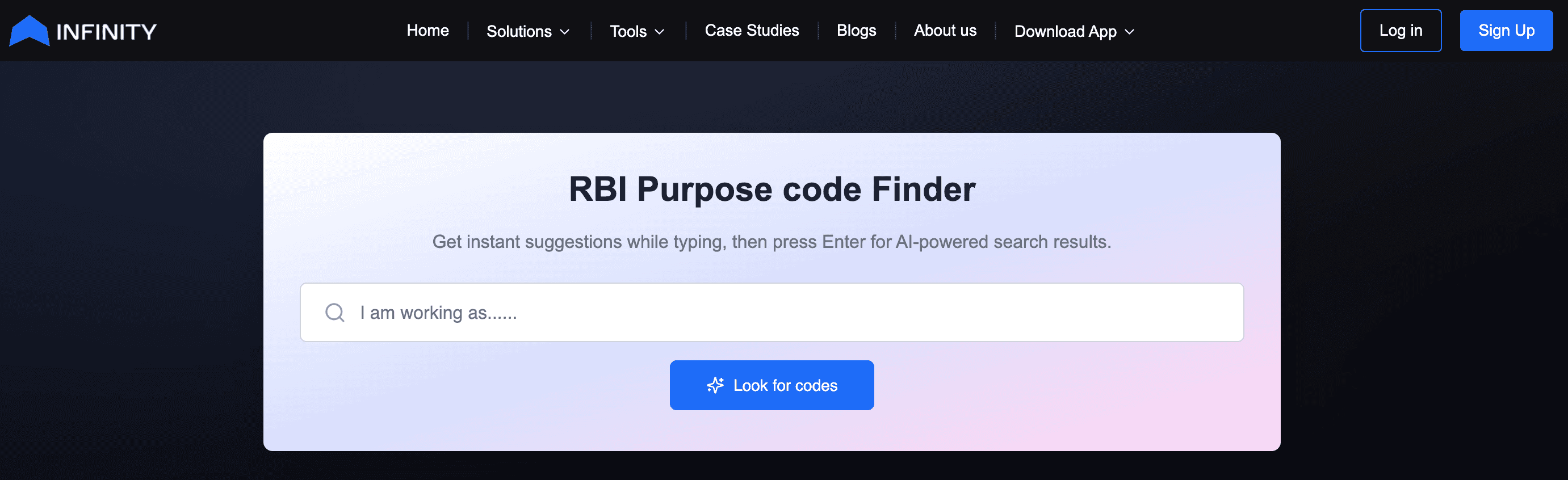
Purpose codes are short codes that tell the RBI why money is entering India. Software exports, consulting services, and product sales each have different codes. Using the wrong one can delay your payment or trigger additional bank queries. If you are unsure, tools like Infinity’s purpose code finder help you identify the right one before you run into an issue.
GST and export benefits
GST and export benefits come into play once your international revenue crosses certain thresholds, or if you want to claim your services as a zero-rated export. This is worth discussing with a CA once you have a few payments under your belt, rather than something to solve before your very first invoice.
FEMA compliance
FEMA essentially means following the Reserve Bank of India’s rules around foreign exchange transactions. As a founder, you mostly interact with this indirectly, through your bank or payment platform correctly tagging and reporting your transactions. Choosing a platform that is properly regulated for this, like an AD-1 certified provider, takes most of this burden off your plate.
Key terms, quickly explained for first-time founders
IEC (Import Export Code): A code issued by the DGFT that allows a business to legally import or export goods and services, including receiving payment for exported services beyond a certain volume.
FIRA: A document confirming you received a specific foreign inward remittance, used for compliance, tax filing, and audits.
Purpose code: An RBI-mandated code that classifies why a foreign payment is entering India, such as software services or consulting.
SWIFT: The global messaging network banks use to send and confirm international wire transfers.
FEMA: The Foreign Exchange Management Act, India’s primary law governing foreign exchange transactions, including how businesses receive and report international payments.
Common mistakes first-time founders make
The following are the common mistakes that can be made by first-time founders:
Not confirming SWIFT or IBAN details in advance, which leads to bounced or delayed transfers.
Using the wrong purpose code, one of the most frequent reasons a first payment gets flagged by the bank.
Ignoring FIRA until it is needed, usually months later during tax filing or an investor’s due diligence, by which point tracking it down becomes a hassle.
Choosing the cheapest-looking option without checking hidden conversion fees, which often ends up costing more than a transparent platform would have.
Waiting too long to open a proper business current account, and trying to route business payments through a personal savings account instead.
So, what is the best way to receive international payments as a startup founder?
Weighing all four options on speed, cost, and how much compliance work lands on you, Infinity comes out as the most founder-friendly choice for a first international payment, and for the ones that follow.
Here is what stands out:
Flat 0.5% fee, all-inclusive. No separate conversion charge, no GST added on top, no surprise deductions. Compare that to PayPal's 7-8% or even Wise's roughly 2%, and the difference on a $1,000 payment alone is several thousand rupees.
Zero FX markup. Infinity converts at the live, mid-market rate, the same one you would see on Google. Banks and PayPal typically build in a 2-4% markup that quietly eats into your payout before you even notice.
24-hour settlement. Once a payment is received, it reflects in your account within a day, instead of the 2-5 working days a traditional bank wire can take.
Free, automatic FIRA. As covered earlier, FIRA is something most founders do not think about until they urgently need it. Infinity generates it automatically for every transaction, at no extra charge, so it is already sitting in your dashboard when your CA or an investor asks for it.
Dedicated personal account manager. Instead of a generic support ticket queue, you get a specific point of contact who understands your account, which matters most when your very first international payment does not go exactly as expected.
Mobile app access. You can track incoming payments, check your FX rate, and manage your account from your phone, useful when you are juggling founder duties and do not want to be tied to a desktop.
India-based, RBI-regulated compliance. As an AD-1 certified platform, Infinity operates within RBI's framework for cross-border payments, so purpose codes, FIRA, and FEMA-related reporting are handled correctly from the Indian regulatory side, not bolted on afterwards.
For a founder receiving their first payment, the combination of low, predictable cost and compliance being handled automatically tends to matter more than shaving off a small amount on a single transaction with a cheaper-looking option.
Steps to receive your first international payment with Infinity
You can refer to the following video to learn how to receive international payments with Infinity:
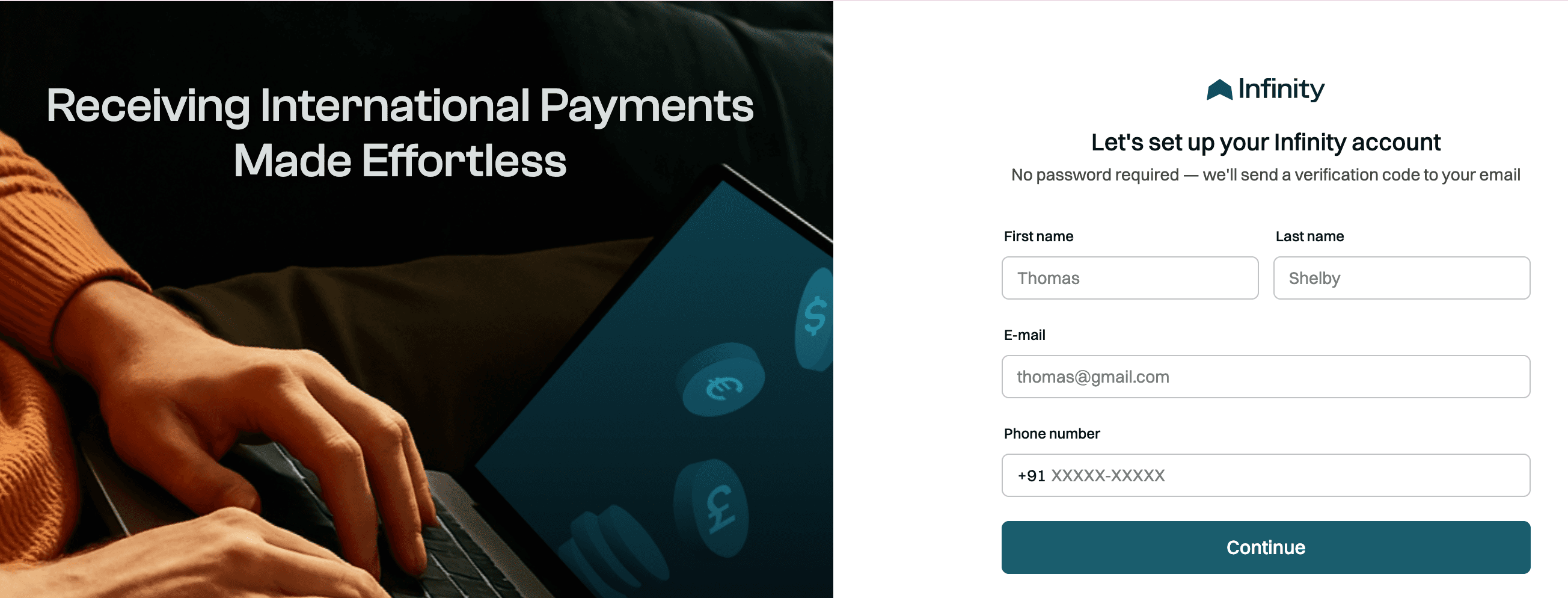
Sign up and complete verification. Create your Infinity account and complete the business verification process. Outcome: your account is ready to generate receiving details.
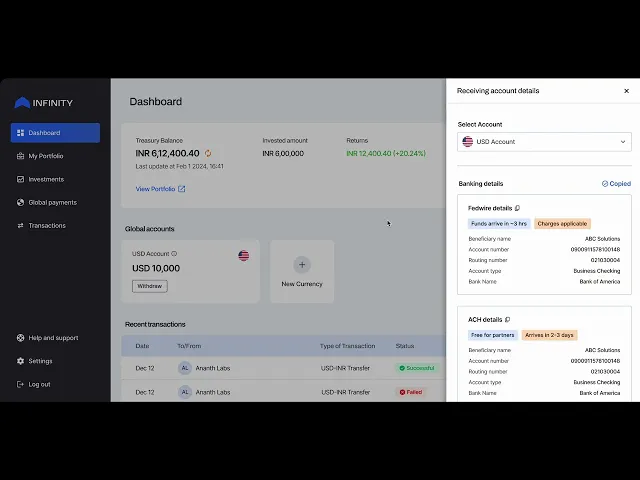
Get your virtual account details. Infinity provides you with local receiving account details in 50+ currencies. You can share this with your international client, similar to how a domestic account works. Outcome: your client has what they need to send the payment without dealing with SWIFT codes themselves.
Share the details and raise your invoice. Send your client the receiving details along with your invoice. Outcome: the client can initiate payment through a familiar, straightforward process.
Client sends the payment. Your client transfers the amount from their end. Outcome: the payment is on its way to your Infinity account.
Payment reflects with live FX rate applied. Infinity converts the amount at the live, mid-market rate, with the 0.5% fee shown upfront before you confirm anything. Outcome: you know exactly what you will receive by using Infinity's currency converter, with no hidden deductions.
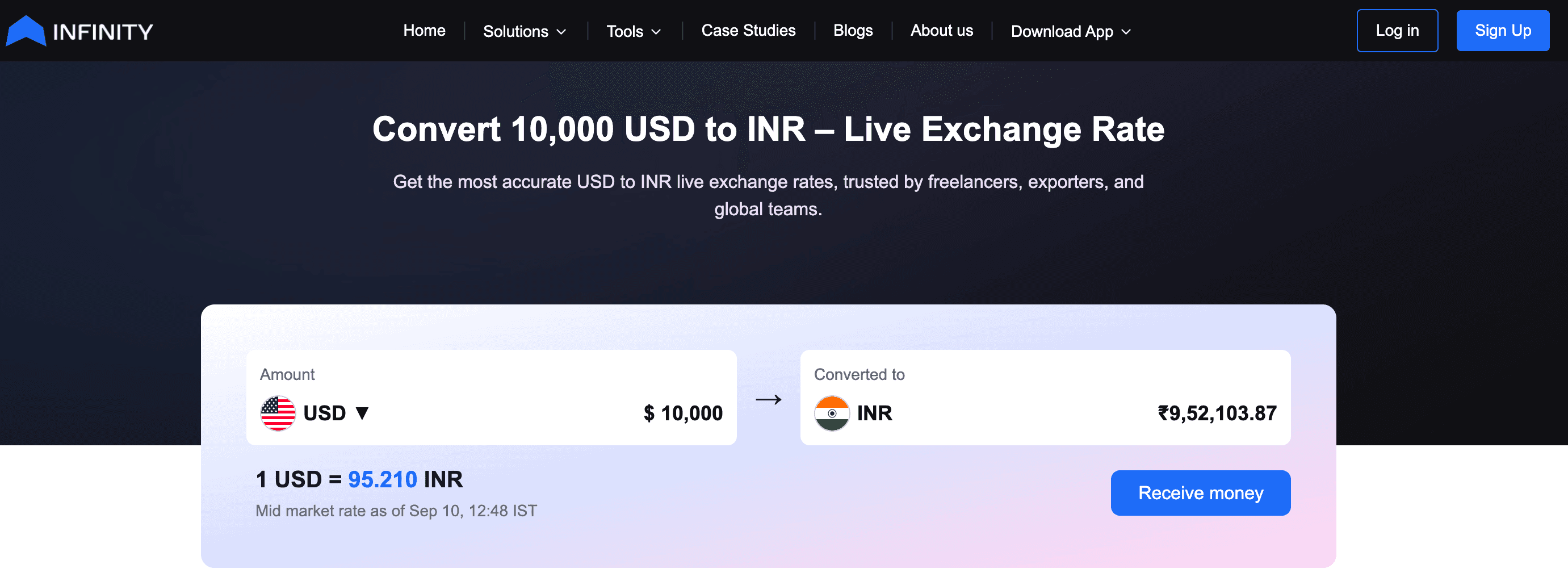
Purpose code gets handled. Use Infinity's purpose code finder if you are unsure which code applies, or confirm the one already suggested. Outcome: the transaction is correctly classified for RBI reporting.
Funds settle within 24 hours. Once approved, the converted amount reflects in your linked bank account. Outcome: your first international payment is in hand, usually well before a bank wire would have arrived.
FIRA is generated automatically. No separate request or additional fee needed. Outcome: your compliance document is ready and waiting in your dashboard for tax filing or due diligence.
Reach out to your account manager if anything looks off. Rather than a generic support queue, you have a dedicated point of contact for your account. Outcome: any first-time confusion gets resolved quickly, without you having to figure it out alone.
Frequently Asked Questions
How can a startup founder in India receive their first international client payment?
You can receive your first international payment in India as a startup founder by setting up a business current account, sharing your receiving bank details with the client, choosing a payment method such as bank wire, PayPal, Wise, or Infinity, and ensuring the transaction is tagged with the correct purpose code so your bank can process it smoothly.
Do I need an IEC code to receive international payments in India?
Not always for your very first international payment, but an IEC is generally required once you are consistently exporting services or goods, and some banks ask for it earlier. It is worth applying for one early to avoid delays later.
Is GST registration mandatory to receive foreign client payments?
Not for a single early payment, but it becomes necessary once your export turnover crosses the applicable threshold, and it is required if you want to claim your services as a zero-rated export.
What type of bank account do I need to receive international payments?
A business current account is strongly recommended, since most banks and payment platforms require one for processing foreign inward remittances in a company’s name.
What is the best way to receive international payments in India?
It depends on your priorities. Bank wires suit larger one-off payments, PayPal suits quick smaller payments, Wise offers transparent low fees, and platforms like Infinity provide an all-in-one service. This includes low cost, 0% FX markup, automatic FIRA, and the fastest settlement.
How does a SWIFT wire transfer work for Indian startups?
Your client’s bank sends the payment through the SWIFT network to your Indian bank using your account’s SWIFT code and IBAN details, typically taking 2-5 working days and passing through intermediary banks along the way.
Is PayPal a good option for Indian startups receiving client payments?
It works well if your client specifically prefers PayPal, but the fees and conversion rates tend to be higher than dedicated cross-border payment platforms. That is why it is not always the most cost-efficient choice.
Wise vs Infinity: which is better for Indian startup founders?
Wise offers transparent, low-cost transfers at the mid-market rate but leaves compliance documentation like FIRA up to you. Infinity handles international payments at a low cost, along with auto-generating FIRA and offering a dedicated account manager, which tends to help founders unfamiliar with compliance requirements.
What is FIRA and do startups need it?
FIRA (Foreign Inward Remittance Advice) is a document confirming a specific foreign payment was received. Startups need it for tax filing, claiming export benefits, and for due diligence during audits or fundraising.
What is a purpose code and why does my startup need one?
A purpose code is an RBI-mandated classification explaining why a foreign payment is entering India, such as for software services or consulting. Every inward remittance needs one, and an incorrect code is a common reason payments get delayed.
What FEMA rules should startups know before receiving foreign payments?
FEMA governs how foreign exchange transactions are conducted and reported in India. As a founder, you largely interact with this through your bank or payment platform correctly classifying and reporting your transactions, which is easier when working with an AD-1 certified provider.
How long does it take to receive an international payment in India?
This ranges from same-day for platforms like Infinity to 3-5 working days for traditional bank wires. The timeline depends on the method chosen and the banks involved.
Can a startup receive its first foreign payment before registering a company?
In many cases, yes, particularly if you are operating as a proprietorship. However, a formal business structure and a current account are needed to receive your first international payments seamlessly.
What documents are needed to receive a startup’s first international payment?
At a minimum, you need your business bank account details, the correct purpose code for the transaction, and eventually a FIRA once you have received your international payment.


