

Global payments

Subscribe to our newsletter
Get the latest updates, insights, and tips delivered straight to your inbox.
Running a business in India today goes far beyond just selling products or services. It requires managing finances efficiently, maintaining regulatory compliance, and ensuring smooth cash flow across operations.
One of the first and most important steps in building a strong financial foundation is opening a business bank account in India.
A well-structured business bank account not only helps you in managing daily transactions. Rather, it also plays a crucial role in tracking income, handling expenses, receiving payments, and maintaining financial transparency.
Whether you're a startup founder, freelancer, agency owner, or exporter, choosing the right business bank account in India can significantly impact how you:
Receive domestic and international payments in India.
Manage vendor payouts and salaries.
Maintain compliance and tax records.
Scale your operations efficiently.
In this blog, we’ll break down everything you need to know about business bank accounts in India. This includes types, features, benefits, documentation, and the best options available in 2026 for a business bank account.
What is a Business Bank Account?
A business bank account is a financial account specifically designed for businesses to manage their transactions, payments, and financial operations. This account handles finances separately from personal finances.
Unlike a regular savings account, a business bank account in India is structured to handle higher transaction volumes. It supports business payments and meets compliance requirements set by financial authorities.
These accounts are essential for maintaining financial clarity. Business bank accounts are widely used by startups, SMEs, freelancers, and large businesses.
What are the key components of a business banking account?
A business banking account comprises the following key components:
Dedicated financial identity for your business- A business bank account creates a clear separation between personal and business finances. This distinction is important for accurate bookkeeping, auditing, and tax filing.
Built for frequent and high-value transactions- Businesses typically deal with multiple inflows and outflows daily. A current account for business is optimised to handle such high-frequency transactions without limitations.
Supports multiple payment methods- A business account enables businesses to accept and send payments seamlessly, be it UPI, NEFT/RTGS transfers, card payments and international remittances
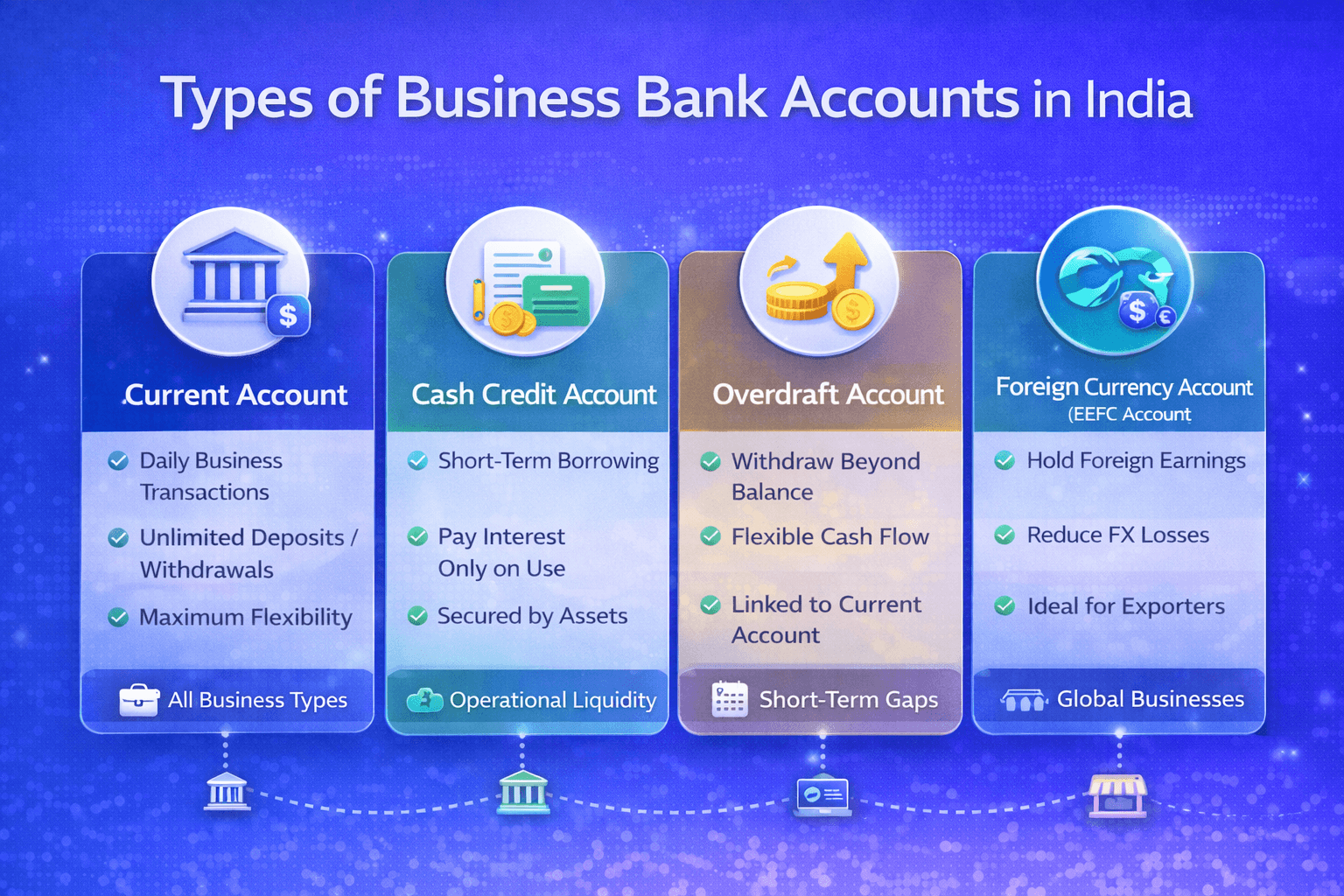
Types of Business Bank Accounts in India
In India, business bank accounts are categorised based on their purpose, usage, and financial requirements. While banks may offer different variants, the core account types remain consistent.
Current Account (Primary Business Account)
Designed for daily business transactions- A current account is the most widely used business bank account in India. It allows unlimited deposits and withdrawals.
No interest, but maximum flexibility- These accounts typically do not earn interest but offer complete flexibility in managing operational transactions.
Ideal for all business types- Startups, SMEs, agencies, and enterprises rely on current accounts as their primary banking solution.
Cash Credit Account
Short-term borrowing facility for businesses- A cash credit account allows businesses to borrow funds against assets. This includes inventory, stock, or receivables.
Interest charged only on utilised amount- Businesses pay interest only on the amount they use. This makes it cost-efficient for working capital needs.
Useful for managing operational liquidity- This type of account is ideal for businesses that require funds to manage everyday expenses.
Overdraft Account
Withdraw beyond your available balance- An overdraft facility allows businesses to access additional funds up to a pre-approved limit.
Flexible cash flow management- It helps businesses manage short-term financial gaps without applying for a formal loan.
Commonly linked to current accounts- Many banks offer overdraft as an extension of a current account for business.
Foreign Currency Account (EEFC Account)
Hold earnings in foreign currency- EEFC accounts allow businesses to receive payments in foreign currencies.
Reduce forex conversion losses- EEFC account avoids repeated INR conversions and associated FX markups.
Best suited for exporters and global businesses- It is ideal for businesses dealing with international clients regularly.

Key Features of a Business Bank Account
When selecting the best business bank account in India, it is important to understand its features.
High transaction limits- Unlike savings accounts in India, business accounts are built to handle large volumes of transactions without restrictions. This makes them ideal for growing businesses.
Multi-user access and role-based controls- Modern business banking allows multiple users (founders, finance teams, accountants) to access the account with defined permissions. It helps in improving operational efficiency.
Integrations & APIs for automation- Today’s business bank accounts in India integrate with accounting tools, payment gateways, and ERP systems. This enables a business bank account for the automation of financial workflows.
Online banking and mobile access- Digital dashboards and mobile apps allow businesses to track transactions, monitor cash flow, and manage finances in real time.
International payment capabilities- While most banks support cross-border payments, the experience can often be slow and expensive. Due to this, it is important for global businesses to evaluate the alternatives.
Benefits of Opening a Business Bank Account
Opening a business bank account in India is not just a compliance requirement. It is also a strategic decision that supports long-term growth.
Separation of personal and business finances- A dedicated business account ensures accurate financial tracking and eliminates confusion during audits and tax filing.
Enhanced business credibility- Clients and vendors are more likely to trust businesses that operate through an official business bank account.
Simplified tax filing and compliance- Organised financial records make it easier to manage GST filings, income tax returns, and audits.
Access to credit and financial products- Maintaining a business account helps in building financial history, enabling access to loans, overdraft facilities, and a credit line.
Documents Required to Open a Business Bank Account in India
The documents required to open a business bank account in India depend on your business structure.
For a Sole Proprietorship, the following documents are needed:
PAN card (individual)
Aadhaar card
Business registration proof (GST, Shop Act, etc.)
For Partnership Firms, the following documents are needed:
Partnership deed
PAN card of the firm
Address proof
For LLP / Private Limited Companies, the following documents are needed:
Certificate of Incorporation
PAN card of the company
MOA & AOA
Board resolution
How to Open a Business Bank Account in India
Opening a business bank account in India has become faster and more streamlined due to digital banking infrastructure. The following is the step-by-step process of opening a business bank account in India:
Choose the right bank or platform- Evaluate features, fees, integrations, and suitability for your business model.
Submit required documents- Upload KYC and business-related documents online or at a branch.
Complete verification- Banks may conduct video KYC or in-person verification.
Account activation- Once approved, your account becomes active and ready for transactions.
Online vs Offline Account Opening
Online process- The online process is much faster and more convenient. It is especially convenient for startups and digital businesses looking to open a business bank account in India online.
Offline process- Traditional approach involves branch visits and longer processing timelines.
Best Business Bank Accounts in India (2026)
Choosing the best business bank account in India depends on your transaction needs, business size, and whether you operate domestically or globally.
HDFC Bank – Current Account- A reliable choice with a strong branch network and multiple account variants. HDFC current accounts are suitable for established businesses, though it often requires a higher minimum balance.
ICICI Bank – Business Banking- It offers strong digital banking features and integrations. This makes it suitable for businesses looking for a balance between traditional and digital banking.
Axis Bank – Current Account- It provides flexible options for SMEs with decent digital capabilities, though certain transaction charges may apply.
Kotak Mahindra Bank – Neo Current Account- It is known for its digital-first approach and relatively lower balance requirements. This makes Kotak Bank Neo Current account popular among startups.
RazorpayX (Neobank)- It offers API-driven banking with seamless integrations, which is ideal for tech startups and online businesses.
Open (Neobank)- They provide automation tools, expense tracking, and integrations for growing businesses.
Infinity (Modern Alternative for Global Businesses)- Unlike traditional business bank accounts in India, Infinity is designed for businesses that deal with international clients. It helps in reducing FX losses, improving settlement speed, and offers better transparency for cross-border payments.
Challenges with Traditional Business Bank Accounts
Traditional business bank accounts in India come with limitations, especially in a digital and global economy like India.
High minimum balance requirements- Many banks require a minimum balance amount. This can be a challenging feature for startups in India.
Slow onboarding and processes- Despite digital improvements, traditional banking may still involve paperwork and delays in processing.
Limited integrations with modern tools- Not all business banks support seamless integrations required by digital businesses.
Inefficient international payments- Cross-border transactions are often slow, expensive, and lack transparency in FX rates.
Is There a Better Alternative to Traditional Business Banking Accounts?
Traditional business bank accounts in India have long been the foundation of financial operations. They work well for domestic transactions, vendor payments, and basic banking needs.
However, the moment a business starts operating globally, these systems begin to show clear limitations.
Today, a growing number of Indian businesses, especially startups, freelancers, agencies, and exporters, all work with international clients. And this is where traditional banking starts to feel outdated.
Some of the most common challenges faced by them include:
High FX markups that reduce your actual earnings- When you receive international payments through traditional banks, currency is often converted at marked-up rates. These hidden margins can significantly reduce the final amount you receive, without any clear visibility.
Delayed international settlements- Cross-border payments processed via traditional banking channels can take several days to settle. This delay directly impacts cash flow, especially for businesses that rely on frequent international payments.
Lack of transparency in charges- It’s often difficult to understand the exact cost of receiving international payments. This is due to a lack of transparency in charges, be it intermediary bank fees or currency conversion charges.
Fragmented experience across tools- Businesses often need multiple platforms like bank accounts, payment aggregators, and an invoicing tool. This helps them to manage global transactions efficiently. Lack of these tools in one place leads to inefficiency.
Limited flexibility for global operations- Traditional systems are not built with global-first businesses in mind, which makes it harder for businesses to scale internationally.
As a result, many businesses start looking beyond traditional business bank accounts in India for solutions that are faster, more transparent, and better suited for cross-border transactions.
Introducing Infinity: Built for Global Business Payments
This is where Infinity comes in. Infinity is not a traditional business bank account. Instead, it is a modern financial platform built specifically to solve the challenges that Indian businesses face when receiving international payments. While traditional banking systems treat cross-border payments as an add-on, Infinity is designed for international payments at its core.
How Infinity Solves Key Business Banking Challenges
Infinity focuses on making international payments simpler, faster, and more cost-efficient.
Transparent and competitive FX rates- One of the biggest pain points in international banking is hidden FX markup. Infinity offers more transparent rates (0.5% inclusive of all) and live exchange rates, ensuring businesses retain more of their earnings.
Faster settlement cycles for better cash flow- Instead of waiting several days for funds to arrive, businesses can receive payments faster, that is, within 24 hours. It helps them manage working capital more efficiently.
Multi-currency support for global clients- Infinity enables businesses to receive payments in 50+ currencies. This makes it easier to work with clients across different countries without any friction.
Streamlined payment experience- Instead of juggling multiple tools like making an invoice, converting currency, and many more, businesses get a more unified and simplified experience for managing international collections.
Compliance—friendly- Whether you're a freelancer invoicing clients in the US, an agency working with European companies, or an exporter receiving global payments, Infinity helps in providing instant and free FIRA.
The Bottom Line
Traditional business bank accounts in India are essential for managing domestic operations. But as businesses expand globally, relying solely on them may not be the most efficient approach.
Modern financial solutions like Infinity complement traditional banking by solving one of the biggest gaps in the financial service- international payments.
For businesses looking to scale globally, the future of banking lies in combining the stability of traditional systems with the efficiency of modern platforms.
FAQs on Business Bank Accounts in India
What is a business bank account?
A business bank account is used to manage financial transactions related to a business separately from personal finances.
Is a current account necessary for businesses in India?
No, it’s not legally mandatory for all businesses. But most businesses require a current account for smooth operations.
Which bank is best for business accounts in India?
It depends on your needs. HDFC, ICICI, Axis, and neobanks like RazorpayX are popular choices.
Can freelancers open a business bank account?
Yes, freelancers can open accounts as sole proprietors with basic documentation.
What is the minimum balance for a business account?
It varies by bank and account type, typically ranging from ₹10,000 to ₹1,00,000.


