


Global payments


Subscribe to our newsletter
Get the latest updates, insights, and tips delivered straight to your inbox.
If you have ever sent a clean invoice to a US, UK, or EU client and still felt unsure about how much INR will finally land in your bank, I know the exact problem you are trying to solve.
The client may pay on time, but then the real stress starts: FX spread, bank deductions, settlement delay, FIRA follow-up, purpose codes, and that annoying gap between the invoice amount and the money you actually receive.
That is why people search for Xflow reviews. You are not looking for another generic "international payments are growing" article. You want to know whether Xflow will help you get paid from abroad faster, more cheaply, and with fewer compliance headaches.
TL;DR: Should You Use Xflow?
Xflow is worth considering if you are an Indian exporter, agency, SaaS company, or B2B service business receiving larger international invoices and you want zero FX markup positioning, eFIRA support, virtual accounts, and a more structured cross-border collection workflow.
But Xflow is not automatically the best choice for everyone. If you are a freelancer, consultant, small agency, or SMB receiving frequent small and mid-sized invoices, I would compare it with Infinity first. Infinity's 0.5% flat all-inclusive fee positioning, zero FX markup, instant FIRA, and 24-hour settlement are easier to understand and can be a better fit for straightforward client payments.
What is Xflow?
Xflow is a cross-border payments platform built to help Indian businesses receive money from international clients. Instead of using a traditional SWIFT wire, chasing bank updates, and manually handling export payment documentation, Xflow gives businesses a more modern way to collect foreign payments and settle them into India.
Xflow helps with four things:
Receiving international payments from overseas clients and businesses.
Converting and settling money into INR so the payment reaches your Indian bank account.
Reducing FX confusion with zero FX markup positioning and more transparent conversion.
Handling export documentation through eFIRA/FIRA support, which matters for compliance, accounting, GST, and CA workflows.
The reason Xflow gets attention is simple: Indian businesses are tired of old cross-border payment rails. A client may send $5,000, but by the time the payment moves through banks, intermediary deductions, conversion spreads, and documentation follow-ups, the recipient is left asking, "Why did I receive less, and where is my FIRA?"
Xflow tries to fix that by making international collections more transparent and business-friendly. It is not the same as PayPal, Wise, Payoneer, Razorpay, or a domestic payment gateway. It is more focused on international B2B collections and export payment workflows.
2. Who Xflow Is Best For
If you and I were choosing a payment platform today, I would not start with "features." I would start with your payment pattern.
How often do you get paid? What is your average invoice size? Does your client want to pay by local bank transfer, wire, card, or platform? Do you need FIRA immediately? Do you care more about cost or infrastructure?
User type | Xflow fit | My honest take |
|---|---|---|
Exporters and B2B service companies | Strong fit | Xflow makes the most sense when you receive serious cross-border invoices and need compliant INR settlement with export documentation. If your monthly volume is meaningful, the structure can be useful. |
Agencies with recurring foreign clients | Good, but compare | If your invoices are large enough, Xflow can work well. If you send many smaller invoices, compare the effective cost against Infinity before committing. |
Freelancers and consultants | Depends on invoice size | Xflow may feel more powerful than necessary for occasional small payments. Cost, settlement speed, and simplicity matter more here. |
SaaS companies | Useful for some flows | Xflow can help with international collections, but SaaS checkout, taxes, subscriptions, and merchant-of-record needs may require another stack. |
Marketplace sellers | Not always | If your payout is locked into Upwork, Fiverr, Amazon, Payoneer, or PayPal, Xflow may not replace the marketplace rail. |
Use Xflow if...
You receive larger international B2B invoices.
You want a more organized alternative to SWIFT wires.
You need eFIRA/FIRA support for export compliance.
Your clients are businesses, not just individuals making one-off payments.
You care about transparent FX and structured collection workflows.

Xflow Fees: Calculate What Actually Reaches Your Bank Account
Looking only at the platform fee is a poor way to compare international payment tools.
The number that matters is the final INR credited to your Indian bank account after the platform fee, GST, currency conversion, FX spread, intermediary bank deductions, and any other charges.
Xflow uses flat-fee tiers for incoming payments. Its pricing starts at around $12 for invoices up to $2,000 and $20 for invoices up to $5,000, while positioning the service as having zero FX markup.
Xflow also offers pricing designed for businesses processing larger payment volumes, where the effective percentage cost can become more attractive as invoice values increase.
However, the final cost can still vary based on your plan, invoice value, payment method, currency, and account profile. It is worth confirming the exact pricing that applies to your business before signing up.
How Xflow’s Flat Fees Affect Different Invoice Sizes
Flat fees are easy to understand, but they do not affect every invoice equally.
For example:
A $12 fee on a $1,000 invoice equals 1.2%
A $12 fee on a $2,000 invoice equals 0.6%
This means Xflow’s effective cost becomes more competitive as invoice values increase. For smaller or recurring invoices, Infinity’s 0.5% all-inclusive pricing may result in a lower overall cost.
Invoice size | What to check with Xflow |
|---|---|
$500–$1,000 | Minimum flat fees may represent a relatively high percentage of the payment. |
$2,000–$5,000 | Check the applicable fee tier, GST, settlement time, FX rate, and eFIRA delivery. |
$5,000+ | Xflow may become more attractive if its pricing plan suits larger B2B invoices. |
The Best Way to Compare Xflow
Run a real or representative invoice through both platforms and compare:
The final INR credited
The total fee deducted
The exchange rate used
The settlement timeline
The time taken to receive eFIRA or FIRA
The client’s payment experience
The quality of support when something goes wrong
This gives you a far more accurate comparison than looking at headline pricing alone.
Xflow Fee Checklist
Before signing up, ask Xflow:
What is the exact fee for my typical invoice value?
Is GST charged on top of the stated platform fee?
Is there any FX markup or spread during conversion?
Can intermediary or correspondent banks deduct additional charges?
How long does INR settlement take?
When will I receive the eFIRA or FIRA?
Which payment methods are available to my overseas clients?
What happens if a payment is delayed, rejected, or held for review?
Are there separate fees for refunds, failed payments, or account maintenance?
Does the pricing change when my monthly payment volume increases?
If you're a serious buyer, this is one of the most important parts of the evaluation. A payment platform can have a clean dashboard and attractive headline pricing, but it is still expensive if less INR reaches your account than expected.
How Does Xflow Work?
Understanding Xflow's mechanics helps in understanding why it's faster and cheaper than traditional banking methods.
Understanding Xflow's mechanics helps in understanding why it's faster and cheaper than traditional banking methods.
Step 1: Sign up and complete KYC.
Indian businesses sign up on Xflow's platform and complete a digital KYC and onboarding process. The setup is designed to be quick and fully online.
Step 2: Receive virtual multi-currency accounts.
Once onboarded, you receive virtual local bank account details in major currencies like USD, EUR, GBP, AUD, CAD, SGD, AED, and more. These aren't generic SWIFT accounts. They're genuine local account numbers with routing details (for USD), IBANs (for EUR/GBP), and sort codes, depending on the currency.
Step 3: Your client pays like a local.
Instead of initiating an expensive international wire, your overseas client pays into your Xflow virtual account using their local payment rail. This could be ACH, Fedwire, or RTP for US clients; SEPA for European clients; Faster Payments for UK clients. To them, it looks and feels like a domestic transfer. This dramatically improves payment success rates and eliminates the sender's international wire fees.
Step 4: Xflow receives and processes the funds.
The funds arrive in your virtual account. Xflow uses live mid-market FX rates with zero markup. This helps you in understanding exactly how much INR you will receive before you initiate a withdrawal. You can also use the FX AI Analyst to set a target conversion rate and wait for the market to hit it.
Step 5: INR lands in your Indian bank account.
After you initiate a withdrawal, funds settle into your Indian bank account or EEFC (Exchange Earners' Foreign Currency) account within 1 business day. An eFIRA (electronic Foreign Inward Remittance Advice) is automatically generated within 24 hours, with no manual follow-up required.
This end-to-end flow replaces the old 5-step SWIFT process that involved multiple intermediary banks, opaque fees, and days of waiting.
Xflow Features - A Deep Dive
Xflow is not a minimalist payment tool. It is a comprehensive cross-border payment infrastructure with a feature set built for businesses that take international payments seriously. Here's a detailed look at everything it offers.
Multi-Currency Virtual Receiving Accounts
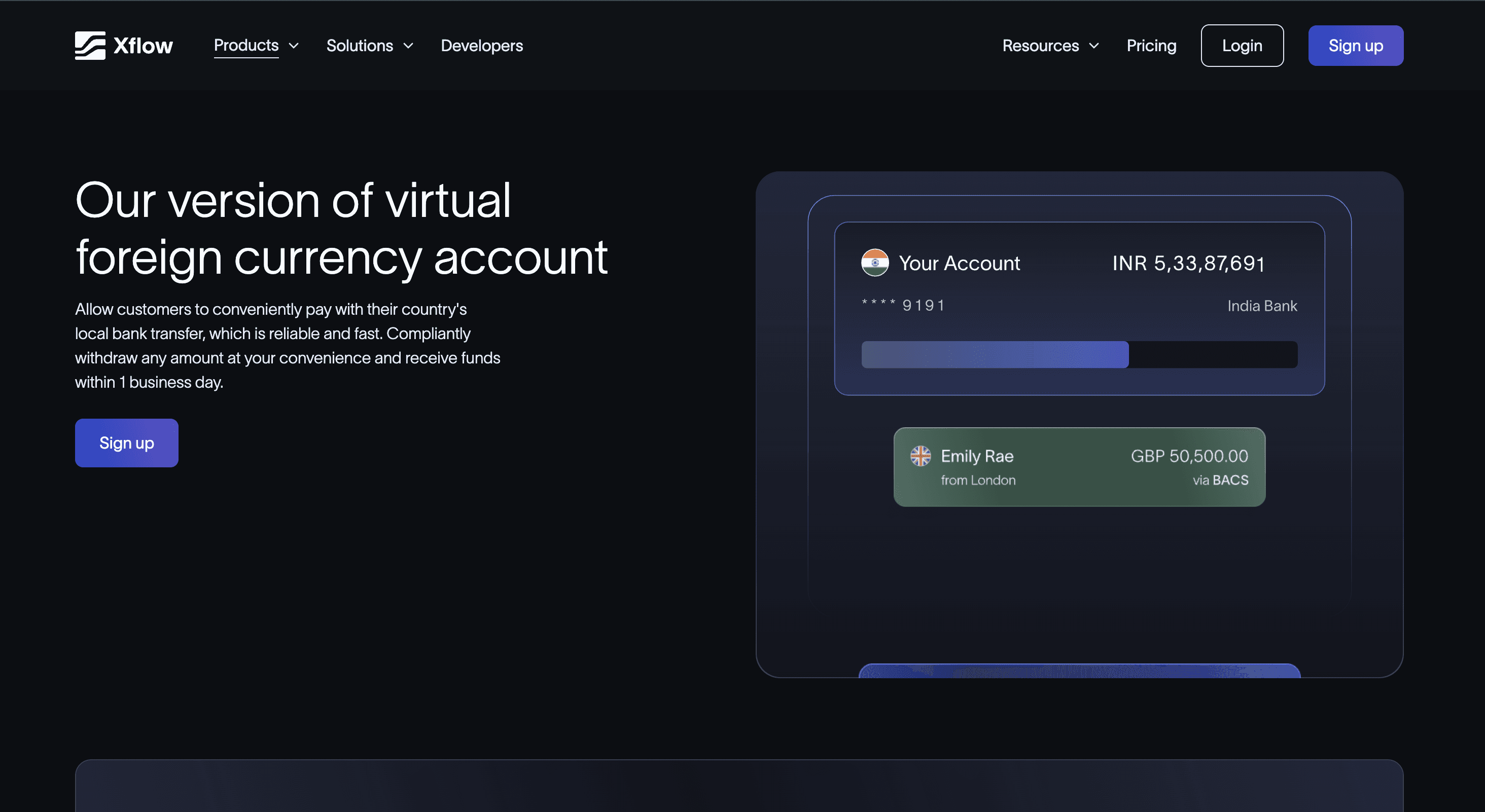
Xflow provides virtual local receiving accounts in 25+ currencies across 140+ countries. Your international clients pay using their own domestic payment methods, which means no SWIFT required. This improves payment completion rates and eliminates the unpredictability of intermediary bank deductions.
Local Payment Rails
One of Xflow's most technically significant advantages is its support for local payment rails. This includes payment methods like ACH, Fedwire, RTP (Real-Time Payments) for USD; SEPA for EUR; Faster Payments for GBP; and more.
These rails are faster, cheaper, and more reliable than international SWIFT wires. RTP, for instance, is near-instantaneous, which accelerates the entire collection timeline.
Zero FX Markup with Live Mid-Market Rates
Xflow converts foreign currency at the live mid-market rate with zero FX markup. Before you initiate a withdrawal, the platform shows you the exact INR amount you will receive. This helps you with complete transparency and no surprises. This is a significant departure from traditional banks that routinely apply 1.5–3% hidden FX margins.
AI-Powered FX Analyst
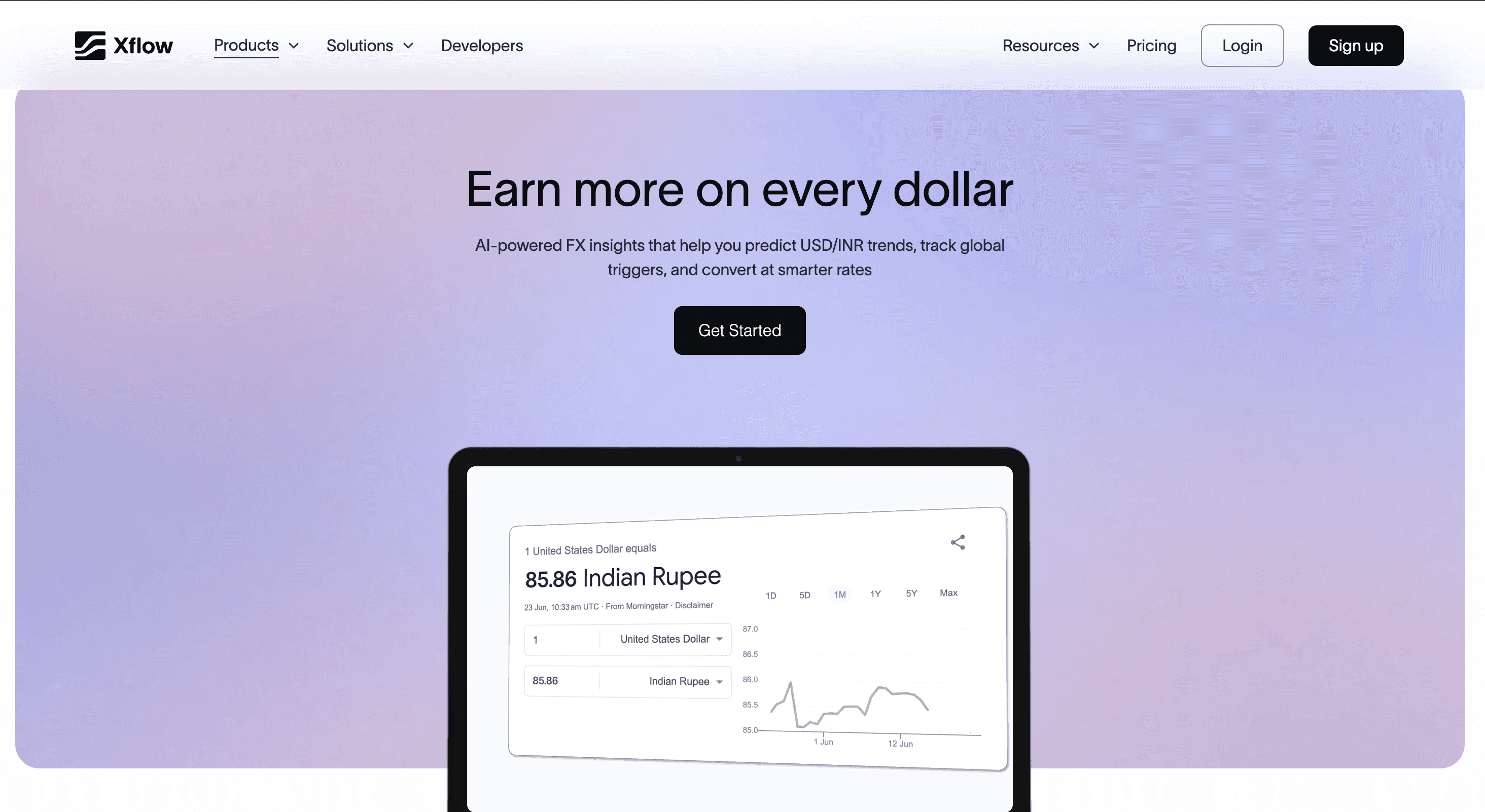
This is one of Xflow's most differentiated features and a genuine innovation in the Indian payments space. The FX AI Analyst uses machine learning to analyse millions of data points and monitor real-time USD/INR (and other currency pair) trends. It allows finance teams to:
Set target conversion rates (similar to placing a limit order in financial markets)
Receive smart alerts when the market hits favourable rates
Earn an additional 8–10 paise per dollar on average compared to converting at spot rates
For a business receiving $50,000 per month, earning even 8 paise extra per dollar translates to approximately ₹4,000 in additional income every month.
1-Business-Day INR Settlement
Funds settle into your Indian bank account within 1 business day of initiating a withdrawal. Xflow also supports EEFC accounts, allowing businesses to hold foreign currency in India before converting. This is useful for companies that want to manage FX exposure over time.
Automated eFIRA Generation
Every transaction on Xflow automatically generates a digital eFIRA (electronic Foreign Inward Remittance Advice) within 24 hours. FIRA is generated from an RBI-approved bank, with no manual follow-up or paperwork. This is essential for GST return filing, income tax documentation, and FEMA compliance.
Built-In Invoicing and Payment Links
Xflow includes a built-in invoicing tool that lets you create branded professional invoices with embedded global payment instructions. You can also generate shareable payment links.
This means that you can send a link to your client, and they can click and pay directly. The platform tracks when the link was viewed and when payment was made, eliminating the need for awkward "just following up on payment" emails.
No Transaction Limits
Unlike some platforms that cap single invoices at $10,000 (Wise, for instance), Xflow imposes no transaction limits on individual invoices. This makes it particularly well-suited for high-value B2B payments, large project settlements, or intercompany transfers.
Xflow Ratings:
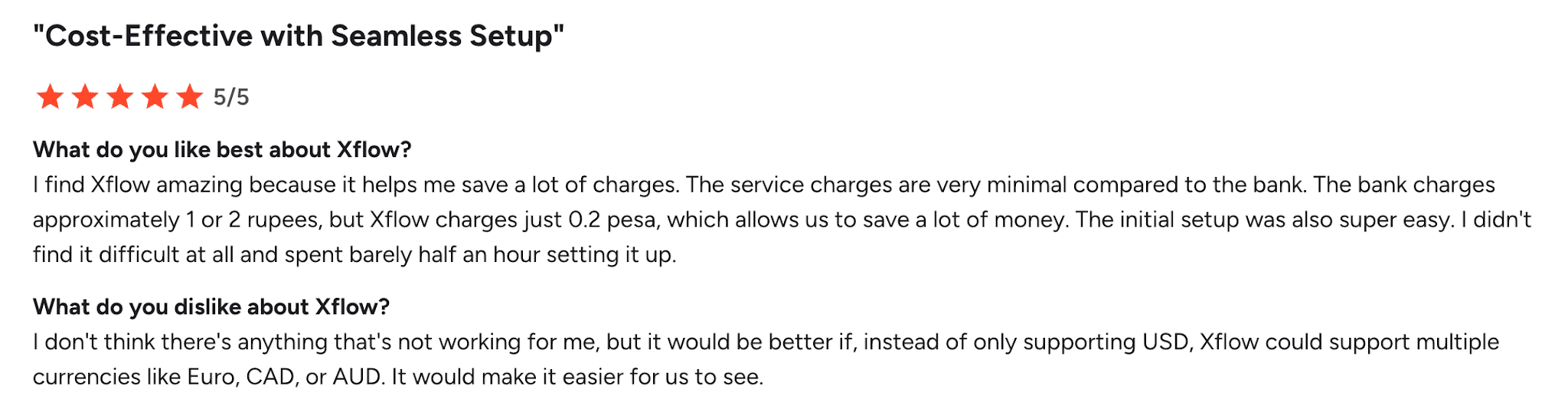
Xflow has a rating of 4.8/5 on G2 and 4.5/5 on Trustpilot. This is what a customer has to say about XflowPay on G2:
Xflow Pricing
Xflow's pricing is structured around three tiered plans, designed to accommodate different invoice sizes and business volumes. All plans include zero FX markup.
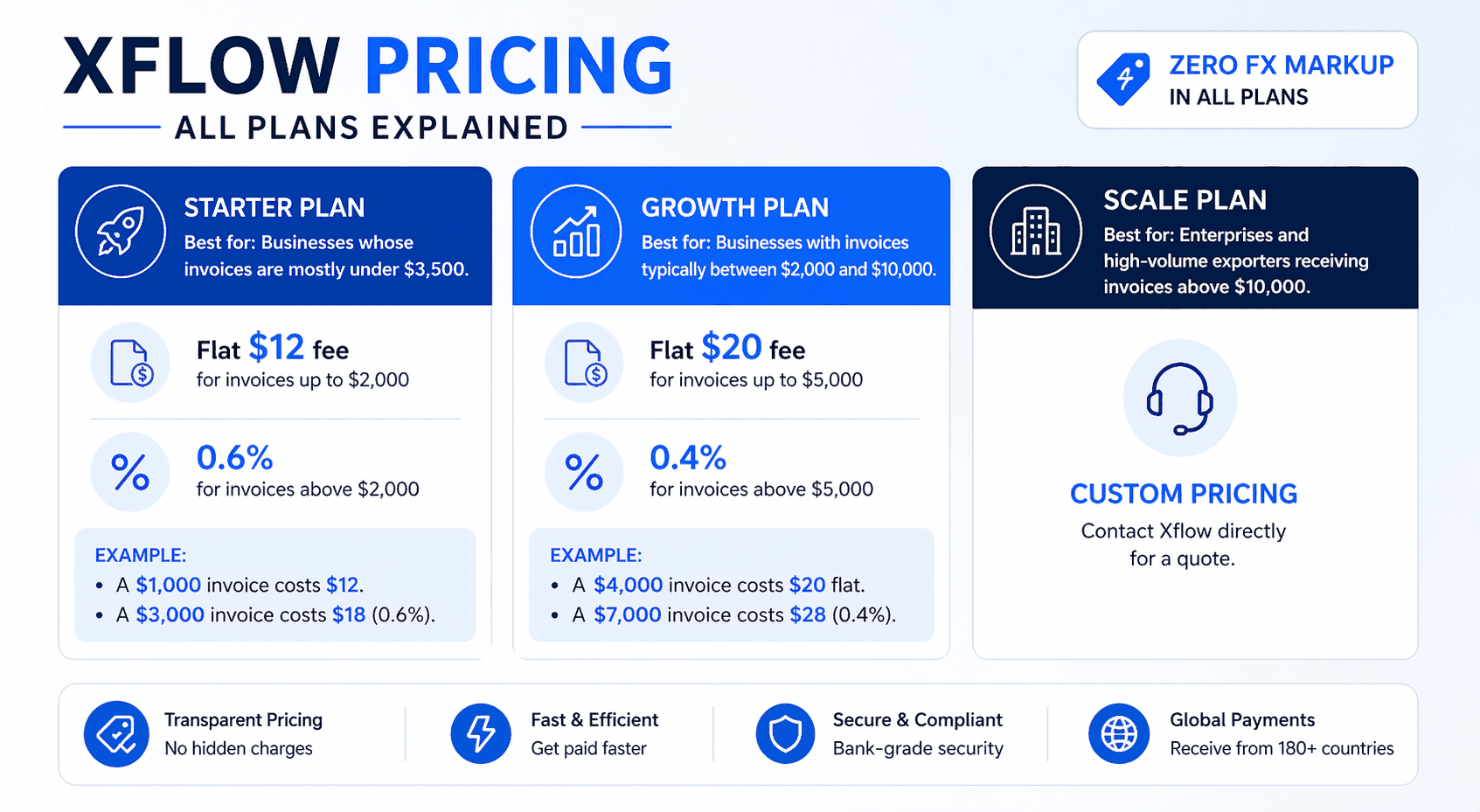
Starter Plan
Best for: Businesses whose invoices are mostly under $3,500.
Flat $12 fee for invoices up to $2,000
0.6% for invoices above $2,000
Example: A $1,000 invoice costs $12. A $3,000 invoice costs $18 (0.6%).
Growth Plan
Best for: Businesses with invoices typically between $2,000 and $10,000.
Flat $20 fee for invoices up to $5,000
0.4% for invoices above $5,000
Example: A $4,000 invoice costs $20 flat. A $7,000 invoice costs $28 (0.4%).
Scale Plan
Best for: Enterprises and high-volume exporters receiving invoices above $10,000.
Custom pricing: contact Xflow directly for a quote.
FX Rate Locking
Xflow offers an FX rate locking feature. This allows you to lock in a specific conversion rate at the time of withdrawal for predictable INR settlement. This feature has been offered free of cost for early sign-ups and is particularly useful for businesses managing cash flow forecasting.
Invoice Amount | Starter Plan | Growth Plan |
$500 | $12 (2.4%) | $20 (4%) |
$1,000 | $12 (1.2%) | $20 (2%) |
$2,000 | $12 (0.6%) | $20 (1%) |
$4,000 | $24 (0.6%) | $20 (0.5%) |
$7,000 | $42 (0.6%) | $28 (0.4%) |
$10,000 | $60 (0.6%) | $40 (0.4%) |
The Growth plan becomes more cost-effective from around the $3,500 invoice mark. For smaller invoices under $2,000, the Starter plan is more economical.
Xflow Pros
Enterprise-grade infrastructure: Flow is powered by JPMorgan Chase and backed by Stripe and PayPal Ventures. Xflow offers a level of institutional credibility that few Indian fintech platforms can match.
Genuinely zero FX markup: The live mid-market rate with no hidden spread means what you see is what you get, every time.
AI-powered FX optimisation: The FX AI Analyst is a genuinely useful tool for finance-savvy businesses.
No transaction limits: Receiving a ₹50 lakh B2B payment on a single invoice? Not a problem. Xflow's no-limit policy makes it reliable for high-value collections.
Strong compliance automation: Automated eFIRA and the Compliance Desk make the regulatory burden nearly zero for most users.
Xflow Cons
Flat fee disadvantage on small invoices: For invoices under $1,000, the $12 minimum fee on the Starter plan translates to 1.2–2.4% effective cost. This is higher than Infinity's 0.5% flat fee on the same amount.
Collections-only focus (primarily): Xflow is designed around inward remittances. If you need domestic payment processing, expense management, payroll, corporate cards, or an all-in-one financial platform, you'll need additional tools.
No prepaid card for India: Unlike some global platforms, Xflow does not currently offer a prepaid card for Indian users to spend their balance internationally.
Limited marketplace integrations: Xflow doesn't have the same depth of native marketplace integrations (Fiverr, Upwork, Amazon) that Payoneer offers. Freelancers dependent on these platforms may find Payoneer more convenient.
Pricing complexity for mixed invoice sizes: If your invoices vary significantly in size, choosing between the Starter and Growth plans and calculating which delivers the lower cost per transaction adds a layer of decision-making that simpler flat-percentage platforms avoid.
Who Is Xflow Best Suited For?
Xflow is purpose-built for specific types of Indian businesses. If you fit one of these profiles, it is worth a serious look.
B2B exporters receiving large, irregular invoices from overseas buyers. These are especially those exporters managing EDPMS compliance and large-value settlements will find Xflow's no-limit policy and compliance desk support highly valuable.
SaaS companies and tech startups collecting USD or EUR subscriptions or one-time payments from global customers benefit from Xflow's clean invoicing tools, payment links, and fast settlement.
Freelancers receive large direct invoices. Those who bill above $2,000 regularly will find the Growth plan's flat-fee model more predictable than percentage-based alternatives at higher invoice values.
Xflow Best Alternative - Infinity
Now let me be direct. If you are reading this review because you want to accept international payments in India without losing money to FX spread and paperwork, Infinity should be the comparison tool.
Infinity's message is simpler for many Indian businesses: receive global payments at lower cost, avoid FX markup, get FIRA quickly, and settle faster.
Comparison point | Xflow | Infinity |
|---|---|---|
Best fit | Exporters, B2B companies, and businesses needing a structured cross-border collection setup. | Freelancers, agencies, consultants, exporters, startups, and SMBs receiving direct international client payments. |
Pricing clarity | Flat fee tiers and plan-based pricing can work well, especially as invoice values grow. | 0.5% flat all-inclusive fee positioning is simpler and often easier to explain. |
FX promise | Zero FX markup positioning. | Zero FX markup positioning with a more direct low-cost message for small and mid-sized businesses. |
Documentation | eFIRA/FIRA support is a major reason to consider it. | Instant FIRA is a strong, easy-to-understand promise for busy operators. |
Settlement | Built for faster global payment settlement. | 24-hour settlement positioning is clearer for users who hate cash-flow uncertainty. |
Buyer simplicity | Can feel more infrastructure-led. | Feels more direct if your need is: "I invoice foreign clients and want more INR to land quickly." |
I would position Infinity as the better choice for readers who want a simple, low-cost, India-first way to receive international payments. Xflow may still win for larger or more infrastructure-heavy payment operations, but Infinity is easier to recommend for freelancers, agencies, consultants, and SMBs that care about predictable cost and less admin.
Also Read - 5 Best Xflow Alternatives for Cross-Border Payments in 2026
Conclusion: Is Xflow Worth It in 2026?
Xflow is, without question, one of the most technically impressive and well-capitalised cross-border payment platforms in India in 2026.
For B2B exporters, IT service firms, SaaS companies, and GCCs dealing with high-value invoices, the Growth or Scale plan offers competitive pricing. The FX AI Analyst alone can generate meaningful additional income for finance-savvy teams. The Compliance Desk is a genuine differentiator for exporters struggling with EDPMS and RBI documentation requirements. And the no-transaction-limit policy makes Xflow the right infrastructure for large, irregular invoices.
However, Xflow is not the lowest-cost option for every user. For freelancers and small businesses receiving invoices under $2,000, Infinity's 0.5% flat fee is consistently cheaper than Xflow's $12 Starter minimum. On a $500 invoice, Infinity charges $2.50; Xflow charges $12. That difference compounds significantly for high-frequency, smaller-invoice businesses.
The smartest approach in 2026 is to match your platform to your invoice profile:
Large B2B invoices, enterprise compliance needs, API integration → Xflow
Small to mid invoices, direct client billing, lowest cost → Infinity
Mid to large flat-fee invoices → Infinity
Marketplace freelancing (Upwork/Fiverr/Amazon) → Payoneer
Global multi-currency flexibility → Wise Business and Infinity


