


Discover infinity


Subscribe to our newsletter
Get the latest updates, insights, and tips delivered straight to your inbox.
Stripe is one of the most trusted payment platforms globally. But for Indian users, the story is more complicated. Indian SaaS companies that need international card payments, subscription billing, and developer-friendly APIs can work well with Stripe.
But for freelancers, agencies, exporters, and service businesses, Stripe may not be the easiest or cheapest option. This is mainly because Stripe does not offer low-cost foreign payments into India with clean documentation.
This review breaks down Stripe's availability, fees, FX charges, settlement timelines, export documentation, pros, cons, and alternatives. This will help you decide whether Stripe is the right payment solution for your business.
TL;DR: Is Stripe good for Indian businesses?
Best for: Stripe is best for Indian SaaS companies, startups, developer-led platforms, and subscription businesses that need global card payments.
Not ideal for: Freelancers, agencies, exporters, consultants, and service businesses that mainly receive foreign invoice payments into India.
Fees: 4.3% on international card transactions + 2% currency conversion + 18% GST on service fees. Effective cost typically lands at 6% or more.
Access: Invite-only since May 2024. You cannot sign up directly. You must request access through Stripe's sales team.
Documentation: Stripe does not automatically issue FIRA, FIRC, or eBRC. Exporters need to coordinate documentation separately.
Alternatives - Infinity, Dodo Payments, and Razorpay International Payment
Stripe is an excellent payment infrastructure. But for Indian businesses that receive international payments, there are better India-first payment platforms, which we will find later in this blog.

What is Stripe?
Stripe is a global payment infrastructure platform. It helps businesses to accept online payments, create checkout flows, manage subscriptions, send invoices, handle refunds, detect fraud, and build custom payment experiences through APIs.
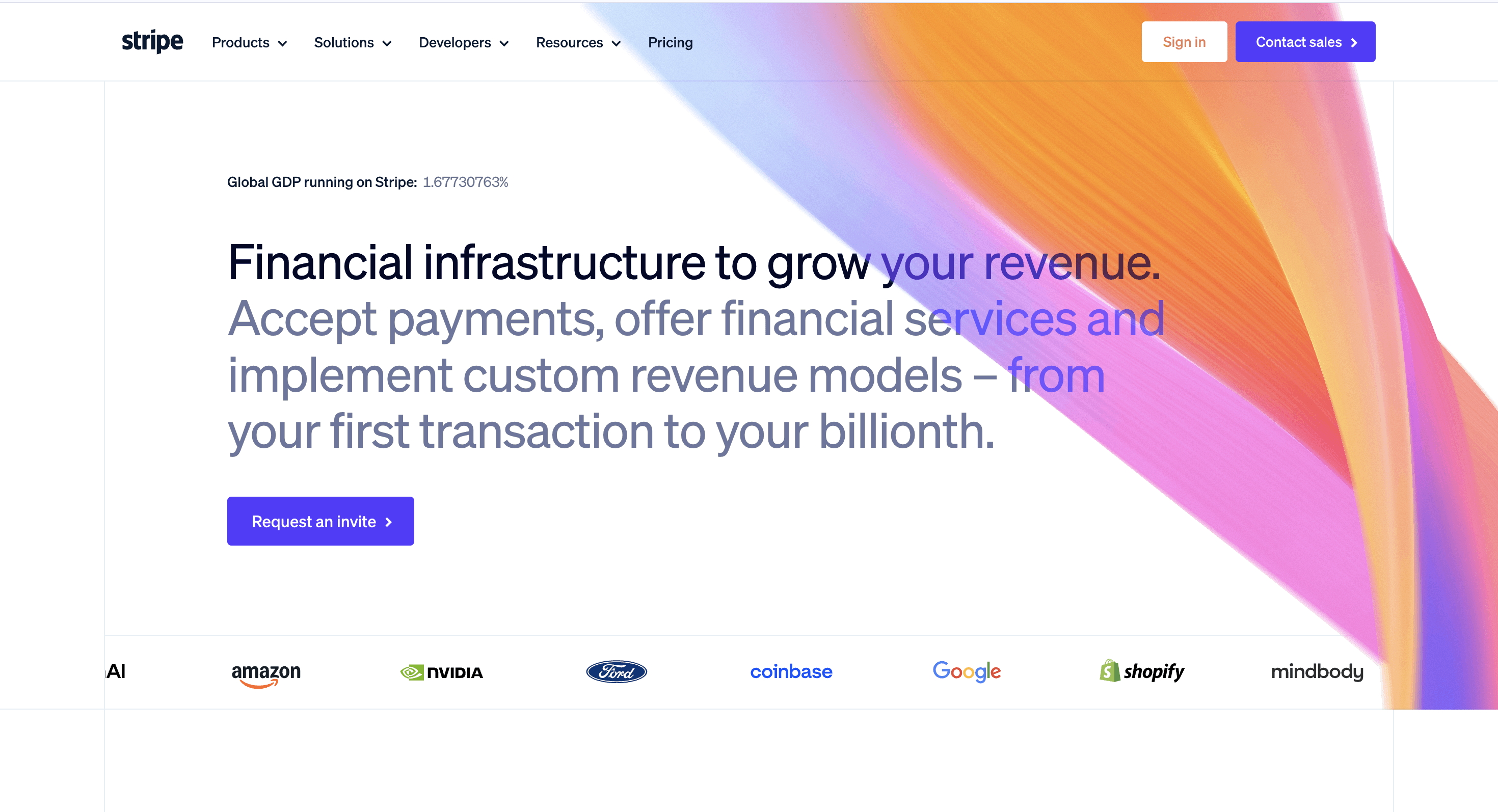
In India, Stripe is mainly relevant for businesses that need to accept online card payments, especially from international customers. It is different from India-native payment gateways that focus on UPI, wallets, net banking, and domestic payment methods.
Stripe's main products
Stripe offers a broad product suite, which includes:
Stripe Payments for card acceptance
Stripe Checkout and Stripe Billing for hosted flows and subscriptions
Stripe Invoicing for invoice-based billing
Stripe Radar for fraud detection
Stripe Connect for marketplace and platform payments
Stripe APIs for custom integrations
The Dashboard ties these together for reporting and reconciliation.
Is Stripe available in India in 2026?
Yes, Stripe is available in India. Stripe went invite-only in India in May 2024. You cannot sign up directly; you need to contact Stripe's sales team and request an invitation, and approval is not guaranteed.
Stripe’s general availability has not resumed as of 2026. If you need to start receiving international payments quickly, then the invite-only process is the first friction point to check.
You can request here.

Here's the response I got after requesting a Stripe India account.
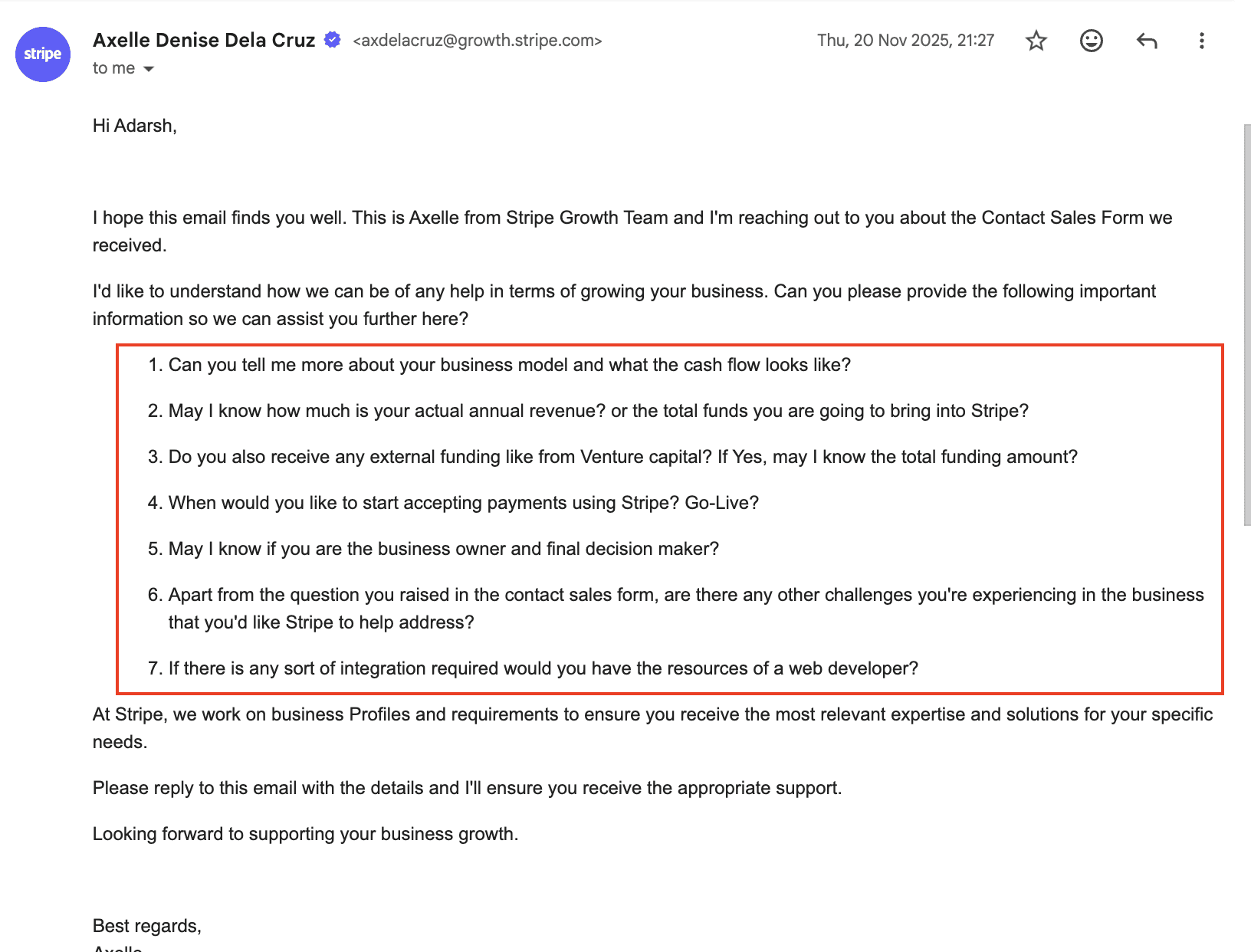
Remember, approval may depend on business type, documentation, risk category, website quality, and payment use case. A registered company with a clean website, verifiable export operations, and a GSTIN will have a materially better chance than an unregistered freelancer.
Who can apply for Stripe in India?
The following business types may be eligible, though approval is not guaranteed:
Registered companies,
LLPs,
Sole proprietorships with documented operations,
SaaS businesses,
E-commerce businesses,
Digital platforms.
Who may struggle with Stripe onboarding?
I’ve seen Stripe onboarding become difficult for freelancers, very small businesses, and exporters who do not have strong documentation in place.
If you are a freelancer without company registration, Stripe India may not be the easiest option. The same applies if you run a small business but do not have a GSTIN, a clear website, terms and conditions, privacy policy, refund policy, and proper business verification documents.
It can also be harder if your use case is closer to bank-transfer-style international collections rather than card-based payments. Exporters who need documentation-heavy compliance workflows may find Stripe limiting or difficult to get approved for.
In practice, Stripe India approvals usually lean toward registered businesses with GSTIN, a proper website, clear policy pages, and verifiable export operations. Individual freelancers without company registration are rarely approved.
What are the fees charged by Stripe India?
Usually, I tell Indian businesses not to look at Stripe pricing only from the base card-processing rate.
On paper, Stripe’s pricing can look simple. But in practice, your actual cost depends on the card type, where the card was issued, the currency used, whether Stripe has to convert the money into INR, and GST on Stripe’s service fees.
If you are receiving international payments in India, your effective cost is usually much higher than the headline processing fee.
Stripe India pricing table
Fee component | Stripe India charges | What it means |
|---|---|---|
India-issued Visa/Mastercard | 2% | Applies to domestic card transactions |
International Visa/Mastercard | 3% | Applies when the card is issued outside India |
International American Express | 3.5% | Higher rate for AmEx payments |
International cards with USD/other currency presentment | 4.3% | Applies to international card payments |
Currency conversion | Additional 2% | Charged when Stripe converts currency to INR |
GST on Stripe service fees | 18% on fees | Adds to the effective cost |
Disputes/chargebacks | ₹1,000 per lost dispute | Adds operational cost and cash-flow risk |
Why does Stripe become expensive for Indian businesses
Because the base fee is only one layer.
If you're receiving USD payments, the real all-in cost can cross 6% once you add the international card fee, currency conversion charge, and GST on Stripe’s service fees.
That is where Stripe starts becoming expensive for freelancers, agencies, exporters, consultants, and SaaS founders collecting from international clients.
For example, if you are billing overseas clients in USD or EUR, a few percentage points may not look like much at first. But on larger invoices, the difference becomes painful very quickly.
Example: Stripe fee on a $5,000 international payment
Item | Detail |
Invoice amount | $5,000 |
International card fee | 4.3% = $215 |
Currency conversion fee | 2% = about $97 |
GST on Stripe fee | 18% on service charges |
Effective cost | Approaches 6%+ depending on card type |
On a $5,000 payment, a 6% effective cost means roughly $300 is gone before you even account for settlement delays, chargeback risk, or documentation work.
Example: Stripe fee on a $10,000 international payment
For a $10,000 international payment, Stripe’s total cost can come to approximately ₹53,019, or around $624, once all fee layers are included.
So if you're agencies, freelancers, exporters, and consultants, this directly reduces the money that lands in your account.
This is why I would not compare Stripe only against another card-processing tool. I would compare it against the actual use case: receiving international business payments in India.
On another platform, you can collect the same invoice at around 0.5%; the difference is not small. On large recurring invoices, it can mean thousands or lakhs saved over time.
Stripe Features in India
Stripe is one of the strongest payment platforms in the world, but I would not describe Stripe India the same way I describe Stripe in the US, UK, or Singapore. In India, you get Stripe’s core card-payment infrastructure, subscription tools, developer APIs, dashboard, and fraud protection.
What you do not get is the full global Stripe stack with ACH, wire transfers, SEPA, local bank transfers, or broad alternative payment methods.
That difference matters if you are an Indian freelancer, SaaS founder, agency, exporter, or digital business trying to accept international payments.
1. Global Card Payment Acceptance
With Stripe India, you can accept international card payments from customers using major card networks like Visa, Mastercard, Maestro, and American Express. This is useful if you sell SaaS subscriptions, digital products, online services, memberships, or ecommerce products to customers outside India.
For Indian businesses, this is the biggest Stripe use case: a foreign customer enters their card details, Stripe processes the payment, and you receive the payout in India after Stripe’s checks and settlement process.
But there is a limitation I would not ignore:
Stripe India is mainly card-led for international payments. If your client wants to pay through ACH, SWIFT wire, local bank transfer, SEPA, or direct bank debit, Stripe India is not the right fit. That becomes a problem for agencies, consultants, exporters, and B2B companies where foreign clients often prefer bank transfers over card payments.
2. Subscription Billing for SaaS and Recurring Revenue
Stripe Billing is one of the best reasons to use Stripe if you are building a SaaS company in India. You can manage recurring subscriptions, free trials, invoices, upgrades, downgrades, coupons, failed-payment retries, and subscription analytics from one system.
This is useful if you run:
• a SaaS product
• a membership platform
• a creator subscription business
• a productised service
• a usage-based software product
• a recurring digital service
The advantage is control. I can build monthly, annual, metered, or tiered billing without stitching together multiple tools. Stripe also gives you hosted invoices and payment pages, so your team does not have to build every billing screen from scratch.
The catch is that recurring payments in India can involve extra rules, especially around Indian-issued cards and RBI e-mandate requirements. So Stripe Billing is powerful, but Indian businesses should still check whether their customer base is mostly international or domestic before relying on it fully.
3. Developer-Friendly APIs and Custom Checkout
Stripe is still one of the most developer-friendly payment platforms available to Indian startups. Its APIs, documentation, SDKs, webhooks, and testing environment are strong.
If you have an engineering team, you can build a custom checkout flow, connect payments to your app, automate invoices, track failed payments, and create a cleaner user experience.
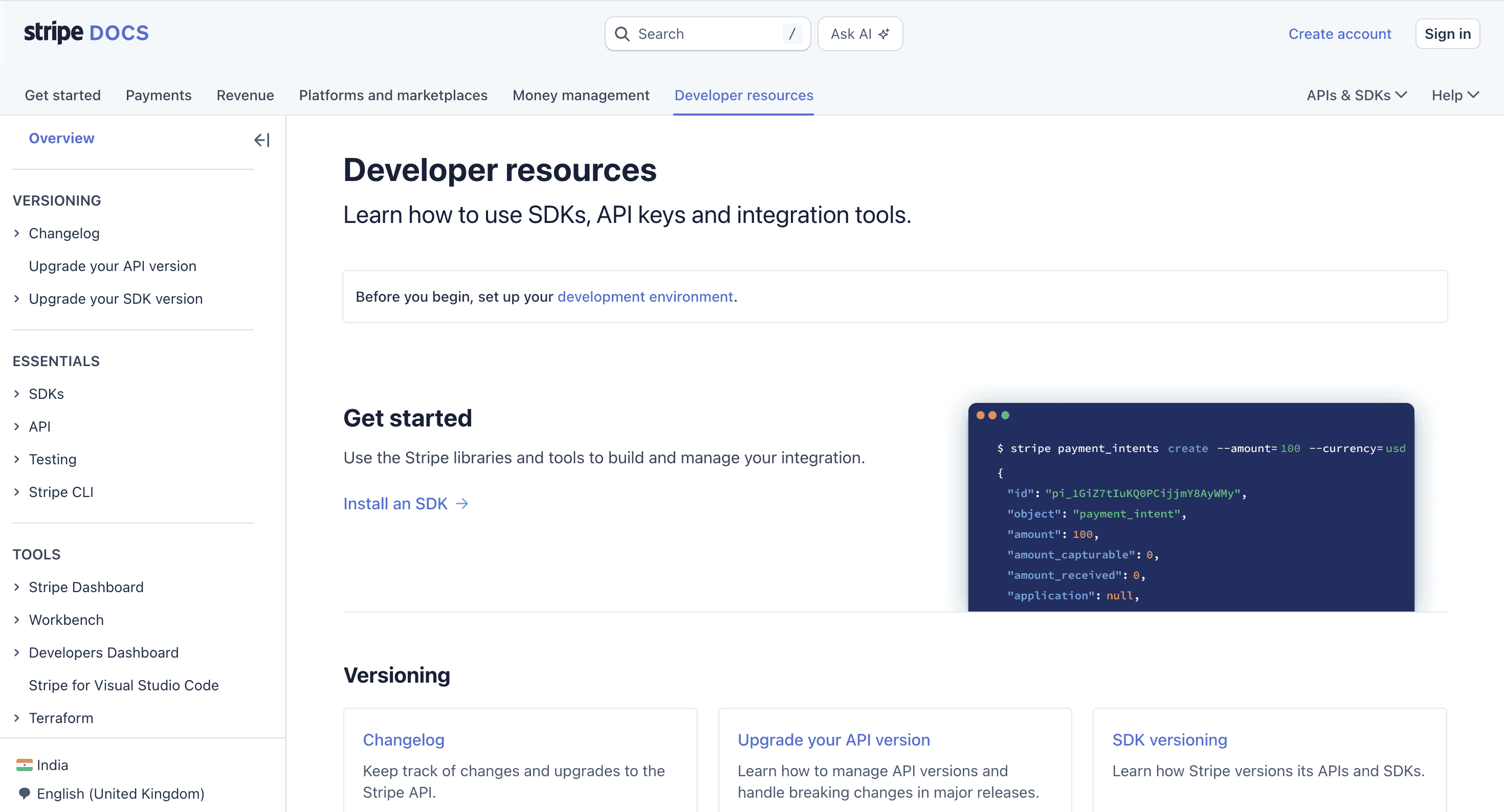
This is where Stripe works especially well for developer-led SaaS companies and platforms. Instead of using a basic payment link forever, I can build payments into the product itself.
For example, you can use Stripe to:
• create hosted checkout pages
• collect card payments from global users
• manage customer subscriptions
• trigger access after successful payment
• pause accounts after failed payments
• automate invoices and receipts
• listen to payment events through webhooks
That said, Stripe’s flexibility is more useful when you have technical bandwidth. If you just want to receive a foreign client payment into your Indian bank account with clean compliance documents, Stripe may feel heavier than necessary.
4. Dashboard, Reporting, and Revenue Visibility
Stripe’s dashboard is another strong feature. You can track payments, refunds, disputes, failed transactions, customers, invoices, subscriptions, and revenue trends from one place.
For Indian SaaS companies and online businesses selling globally, this visibility is useful because international payments are not just about receiving money. You also need to know:
• which payments succeeded
• which cards failed
• which customers churned
• which invoices are unpaid
• which refunds were issued
• which disputes need action
• how much revenue came from each market
This makes Stripe better than a simple payment collection tool. It gives you a proper payment operations layer.
But again, this dashboard does not solve every India-specific problem. You may still need separate handling for export documentation, FIRA/e-FIRC, accounting reconciliation, and bank-side compliance.
5. Fraud Detection and Dispute Management
Stripe Radar is Stripe’s fraud detection system. It uses machine learning to detect risky card transactions, suspicious payment behaviour, and potential fraud before it becomes a chargeback problems.
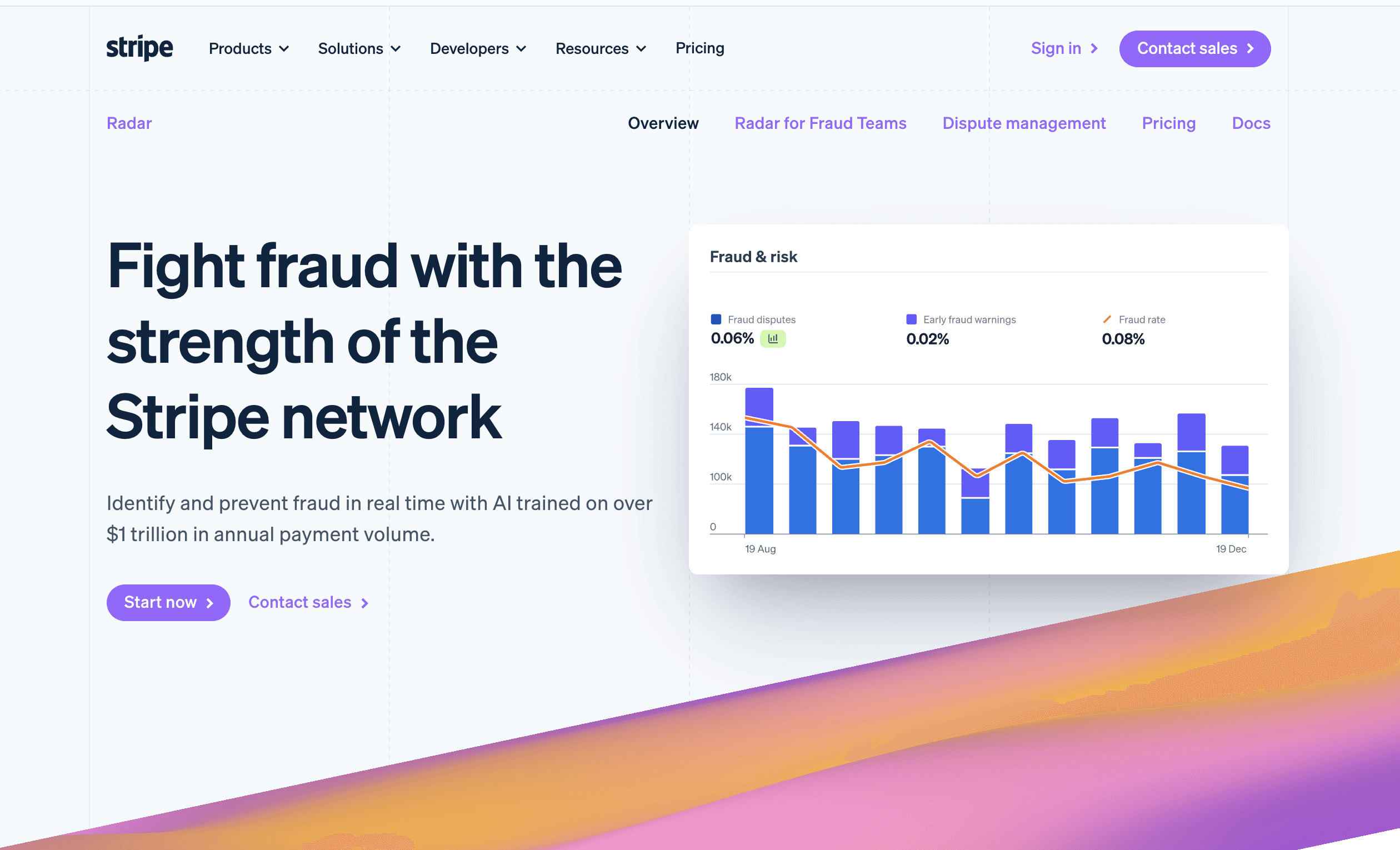
This matters if you accept a high volume of international card payments. Global card payments can bring failed transactions, stolen card attempts, refund abuse, and chargebacks. Stripe Radar helps reduce that risk with fraud scoring, rules, and dispute tools.
So, if you're an Indian business that's selling SaaS, digital products, or online services globally, this is a real advantage. A good fraud system can protect revenue and reduce operational headaches.
The tradeoff is that Stripe’s risk systems can also trigger reviews, reserves, or account checks in some cases. So while fraud protection is valuable, Indian businesses should keep their website, refund policy, business documents, customer communication, and payment descriptions clean from day one.
Pros of Stripe in India
Strong global reputation and developer trust.
Excellent APIs and documentation. It is well-suited for engineering-led product builds.
Subscription billing through Stripe Billing is genuinely best-in-class.
Supports international card payments from customers in 135+ countries.
Clean dashboard and reporting for tracking payment flows.
Stripe Radar provides solid fraud detection and risk management.
Scales well for complex, high-volume payment infrastructure.
Cons of Stripe in India
The biggest limitations are:
No broad ACH support for Indian Stripe users
No SWIFT/wire collection inside Stripe India
No local bank transfer option for foreign clients
Limited usefulness for B2B clients who prefer bank payments
Possible compliance and documentation friction
Not ideal if you need simple FIRA/e-FIRC handling
Not ideal for exporters who receive large invoice-based payments
Stripe is not a bad product. The issue is fit. If your business needs developer-first card infrastructure, Stripe can be excellent. If your business mainly needs low-cost international collections into India with documentation support, Stripe will feel heavier and more expensive than necessary.
Stripe for different business types in India
Stripe is strong for global card payments, subscriptions, and developer-led checkout. But if you receive international payments in India through invoices, retainers, exports, or bank-transfer-style collections, it may not be the easiest fit.
Business type | Fit | Summary |
|---|---|---|
SaaS companies | Good fit if approved | Works well for global SaaS companies that need subscriptions, checkout, invoices, and international card payments. Best suited for registered businesses with GSTIN, a proper website, and clear policies. |
Freelancers | Usually not the easiest option | Onboarding can be difficult without company registration, GSTIN, a website, and export documents. Fees can also rise with international card charges, FX conversion, and GST. |
Agencies | Depends on the billing model | Good for recurring card-based retainers or productized services. Less ideal for large overseas invoices where FX rates, settlement speed, and FIRA/FIRC documentation matter more. |
Exporters | Often not the right default | Exporters usually need inward remittance records, purpose codes, FIRA/FIRC-style documents, eBRC support, and clean bank reporting. India-first platforms are usually easier here. |
E-commerce businesses | Depends on customer location | Useful if most customers are outside India and prefer cards. For India-focused e-commerce, UPI-first gateways like Razorpay, Cashfree, or PayU usually make more sense. |
In simple terms, Stripe is better for global card payments. If you need INR settlement, lower FX costs, and export documentation, an India-first cross-border payment platform may be a better fit.
Stripe, FIRA, FIRC, eBRC, and export compliance in India
If you are receiving international payments in India, you usually need more than a payment link.
You may need documents for accounting, GST records, export compliance, bank reporting, and inward remittance proof. This is where many businesses underestimate the operational work.
What is FIRA or FIRC?
FIRA, FIRC, or eFIRC-style documentation is used to show that a foreign inward remittance was received in India.
Freelancers, agencies, exporters, consultants, and service providers may need this for accounting, GST export records, bank documentation, and compliance checks.
The exact document name and format can vary depending on the bank, payment provider, and transaction type. That is why you should not only ask, “Can this platform receive international payments?” You should also ask, “What document do I get after the payment settles?”
What is eBRC?
eBRC stands for Electronic Bank Realisation Certificate.
It helps exporters prove that export proceeds have been received in India. This can matter for export compliance, DGFT workflows, and GST refund-related documentation.
Not every freelancer or SaaS company will need eBRC. But exporters and businesses with formal export reporting requirements should check this before choosing a payment platform.
Does Stripe automatically provide FIRA, FIRC, or eBRC in India?
I would not assume that Stripe automatically solves this entire workflow for you.
Stripe’s support material refers to payment advice or payee advice for international transactions in India. That may help in some cases, but you should still verify whether the document is enough for your CA, bank, GST filing, and export compliance process.
Before committing to Stripe, ask these questions:
What exact document will I receive for each international payment?
Is it FIRA, FIRC, eFIRC, payment advice, or payee advice?
Who issues the document: Stripe, the partner bank, or another entity?
Will my CA accept it for accounting and GST records?
Will my bank accept it for inward remittance reporting?
If I am an exporter, does it support my eBRC-related workflow?
This matters because receiving the payment is only one part of the job. The bigger issue is whether the documentation is clean enough after the money lands.
Why documentation matters
For one-off international payments, documentation friction may be manageable.
But if you receive recurring payments from global clients, missing or delayed documentation creates problems over time. Your CA may need follow-ups. Your bank may ask for clarification. Your GST records may not stay clean. Your export reporting may become harder than it needs to be.
That is why I would treat documentation as a core payment feature, not an afterthought.
When to choose an India-first cross-border payment platform
If you invoice foreign clients directly, need INR settlement, want lower FX costs, need FIRA/FIRC-style documentation with each transaction, require eBRC-related support, or want human support for Indian compliance questions, an India-first cross-border payment platform will usually serve you better than Stripe.
This is especially true for freelancers, agencies, consultants, exporters, and service businesses that receive payments through invoices rather than checkout pages.
Stripe is strong for global card payments. But if your workflow is closer to “send invoice, receive foreign money, settle in INR, collect compliance documents,” then Stripe may not be the cleanest fit.
Stripe settlement timelines in India
Settlement speed matters because payment cost is not only about fees.
You also need predictable cash flow for salaries, vendor payments, subscriptions, taxes, and working capital.
Stripe notes that the first payout can take longer because of risk checks. International payments may also involve review or documentation checks, especially if the transaction looks unusual or the account is new.
For freelancers, retainer-based agencies, SaaS founders, and exporters, this matters. A platform that is cheap but slow can still create cash-flow pressure. A platform that is fast but weak on documentation can create compliance pressure.
So when you compare Stripe with alternatives, compare the full workflow:
Transaction fee
FX markup
GST on service fees
Settlement time
FIRA/FIRC-style documentation
eBRC-related support
Chargeback risk
Human support availability
That gives you a more accurate picture than only comparing headline fees.
Is Stripe approved by the RBI in India?
Yes, Stripe India Private Limited received RBI approval to operate as an online Payment Aggregator in India in January 2024.
But this does not automatically mean Stripe is the best fit for every international payment workflow.

There are two separate questions here:
Can Stripe legally operate as a payment aggregator in India? Yes.
Is Stripe the easiest option for your export, inward remittance, settlement, and documentation workflow? That depends on how you receive money.
If you are using Stripe for domestic or global card payments, the fit may be strong. If you are using Stripe as a replacement for bank-transfer-style international collections, you should check the documentation workflow carefully before relying on it.
What you should check before using Stripe for international payments
Before using Stripe to receive international payments in India, I would verify these points:
Is your Stripe account eligible for international payments?
Is your business approved or still waiting for an invite?
Do you need an IEC for your use case?
Are you collecting domestic payments or export payments?
Will the customer pay in INR, USD, EUR, or another currency?
Will Stripe convert the money into INR?
What is the all-in cost after card fees, FX conversion, and GST?
What document will you receive after settlement?
Will your CA, bank, and GST workflow accept that document?
Do you need FIRA, FIRC, payment advice, or eBRC-related support?
What happens if the payment is held, disputed, or reviewed?
Stripe may process the payment, but you still need to handle the compliance side correctly.
For international payments in India, this includes inward remittance records, GST documentation, purpose codes, bank-side reporting, and export documentation where applicable.
Stripe vs Alternatives
If you're comparing Stripe, the better question you must ask: do I need developer-grade SaaS payments, India-first cross-border collections, Merchant of Record support, or a domestic-plus-international payment stack?
1. Stripe vs Infinity
Parameter | Stripe India | Infinity |
|---|---|---|
Fees | Variable | 0.5% all-inclusive |
Settlement time | Varies | 24 hours |
FX markup | Yes / varies | No |
eFIRC support | No / manual | Yes |
FIRA support | No / manual | Yes |
Documentation process | Manual / separate | Built-in |
Account approval time | Slow / selective | Faster KYC-based |
Bank transfer support | No | Yes |
Card payment support | Yes | Yes |
Best for SaaS billing | Yes | No |
Best for exporters/agencies | No | Yes |
2. Stripe vs Dodo Payments
Parameter | Stripe India | Dodo Payments |
|---|---|---|
Fees | Variable | 4% + $0.40+ |
Settlement time | Varies | Varies |
FX markup | Yes / varies | Varies |
eFIRC support | No / manual | Depends on payout route |
FIRA support | No / manual | Depends on payout route |
Documentation process | Manual | MoR-managed |
Account approval time | Slow/selective | Review-based |
Bank transfer support | No | Depends on setup |
Card payment support | Yes | Yes |
Merchant of Record | No | Yes |
Tax compliance handled | No | Yes |
Best for SaaS billing | Yes | Yes |
Best for digital products | Yes | Yes |
Best for exporters/agencies | No | No |
3. Stripe vs Razorpay International
Parameter | Stripe India | Razorpay International |
|---|---|---|
Fees | Variable | 1%-3% depending on method |
Settlement time | Varies | Varies |
FX markup | Yes / varies | Low / varies |
eFIRC support | No / manual | Yes / product-dependent |
FIRA support | No / manual | Yes / product-dependent |
Documentation process | Manual / separate | More India-focused |
Account approval time | Slow / selective | KYC + approval |
Bank transfer support | No | Yes / product-dependent |
Card payment support | Yes | Yes |
Domestic payments in India | No / limited | Yes |
International payments | Yes | Yes |
Best for SaaS billing | Yes | No / limited |
Best for Indian businesses | No | Yes |
By Use Case:
Use Case | Best Option |
|---|---|
Global SaaS with custom checkout | Stripe |
Indian agency/exporter receiving foreign client payments | Infinity |
Digital product business needing tax compliance | Dodo Payments |
Indian business needing domestic + international gateway | Razorpay International |
Lowest FX friction for Indian cross-border collections | Infinity |
Best developer APIs | Stripe |
Best Merchant of Record support | Dodo Payments |
Best India-first payment stack | Infinity / Razorpay |
Conclusion: Is Stripe Worth It For International Payment Acceptance?
Stripe is a strong payment platform, but it is not the right fit for everyone receiving payments in India.
I would consider Stripe if you are an approved SaaS company, startup, or developer-led platform that needs global card payments, subscriptions, checkout, invoices, and flexible APIs. For this use case, Stripe is still one of the strongest options.
But if you are a freelancer, agency, exporter, or service business receiving international payments into India, Stripe can feel expensive and operationally heavy.
The main issues are invite-only access, high international card fees, FX conversion charges, GST on service fees, settlement delays, and documentation friction around inward remittance and export workflows.
So my verdict is simple: Stripe is best for global card-based payments and SaaS billing. If you mainly receive foreign client payments into India through invoices, retainers, or export collections, compare Stripe with India-first cross-border payment platforms based on real cost, settlement speed, documentation support, and compliance workflow, not just brand recognition.


