


Discover infinity

![9 Best Cross Border Payment Platforms in India [Based on Real User Reviews]](https://framerusercontent.com/images/ZOzvHCU1ezQxfPmG2hFSGdvRrWE.png?width=1536&height=1024)
Subscribe to our newsletter
Get the latest updates, insights, and tips delivered straight to your inbox.
Getting paid from another country should not feel like unpaid finance work.
But you and I both know it usually does.
If you are an Indian freelancer, agency owner, consultant, SaaS founder, exporter, or marketplace seller, the payment is rarely the clean moment people imagine. The client says the money has been sent. Your bank asks for details. The platform shows one number. Your account receives another.
The client wants to pay in USD. Your bank wants a purpose code. The payment platform says “low fee.” Then the INR lands, and somehow the final amount is worse than expected.
That is the real cross-border payment problem in India. It is not just receiving foreign currency. It is receiving it without getting punished by FX spreads, platform fees, compliance delays, missing FIRA, weak support, or a checkout experience that makes your business look smaller than it is.
We built Infinity for exactly this problem, but this guide is not going to pretend every business should use the same tool. You should choose based on how you get paid, how much you receive, what documentation you need, and how much margin you are tired of losing.
The Real Problems Indian Businesses Face With Cross-Border Payments
Most articles make cross-border payments sound clean. Client sends money. The platform converts it. You get paid.
That is brochure logic. In real life, you are checking exchange rates, explaining payment methods to clients, waiting for settlement, forwarding documents to your CA, and wondering why the final INR is lower than expected.
The invoice says $2,000. The bank account says something else. The difference hides inside FX spread, platform fee, intermediary bank deductions, GST on fees, and poor conversion timing. You should not need a spreadsheet to understand what happened.
The payment lands, but the paperwork does not. For Indian exporters, FIRA/eFIRA is not a “nice to have.” Without clean documentation, accounting and compliance become messy later.
The client wants convenience. You want compliance. A US client may prefer PayPal because it is familiar. You may prefer a cheaper platform with FIRA support. The right platform has to satisfy both sides without making you look difficult.
Support matters only when things break. Nobody cares about support during onboarding. They care when $8,000 is stuck, the client is asking for confirmation, and the dashboard says “processing.”
One tool rarely solves every use case. A freelancer invoice, SaaS subscription, marketplace payout, card checkout, and enterprise vendor payout are different payment jobs.
The cheapest-looking option can be expensive. A low platform fee with weak FX can lose more money than a higher fee with better conversion. Always check final INR received.
The practical test is simple: if a client pays $5,000 today, how much INR lands, when does it land, what document do you get, and who helps if it gets stuck? That is the test we would want you to run before trusting any platform, including us.

TL;DR: Best Cross-Border Payment Platforms in India
Tool Name | Best If You're... |
|---|---|
Infinity | Best if you're receiving small to mid-sized international invoices and want a low-fee, high-savings PayPal alternative with simple pricing around the 0.5% range. |
Xflow | Best if you're a growing B2B exporter or platform moving larger payment volumes and want infrastructure, compliance, and eFIRA workflows more than a basic wallet. |
Skydo | Best if you're receiving higher-value invoices where flat fees can save more than percentage-based platforms. |
BriskPe | Best if you're an SMB exporter or service provider who wants support-led onboarding, virtual accounts, and help with FIRA documentation. |
Salt.Pe | Best if you're an Indian export-led business comparing newer India-first cross-border platforms and want to validate pricing directly. |
Wise | Best if you're in a supported corridor and want transparent FX, clear fees, and a globally trusted transfer experience. |
PayPal | Best if your client insists on PayPal and you are willing to accept higher fees for buyer familiarity. |
Payoneer | Best if you're receiving marketplace payouts from platforms like freelance, creator, e-commerce, or affiliate ecosystems. |
Razorpay | Best if you're an Indian business that needs international card payments and checkout flows, not just invoice collections. |
How To Find The Right Cross-Border Payment Platforms
Most people choose a cross-border payment platform by asking one lazy question:
“What is the fee?”
That is not enough.
The better question is:
“How much INR lands in my account, how fast, with what documentation, and how much support pain?”
That is the only comparison that matters.
1. Compare Total Cost, Not Just Platform Fee
A 0.5% platform fee can be cheaper than a flat fee for some invoices. A flat fee can be cheaper than a percentage fee for larger invoices. PayPal may look easy but can become expensive once fees and FX conversion are included.
Always calculate the final INR received.
2. Check FIRA/eFIRA Support
If you are an Indian exporter or service provider, payment documentation is not optional admin. It affects accounting, compliance, GST treatment, and export proof. If the platform does not make FIRA/eFIRA easy, you may save 30 minutes during payment and lose three hours later.
3. Match the Tool to the Payment Type
Invoice collection, card checkout, marketplace payout, SaaS subscription, and enterprise vendor payout are different jobs. Do not force one platform to do all of them.
4. Read Negative Reviews First
Positive reviews tell you what the product wants to be known for. Negative reviews tell you what happens when the payment is stuck, KYC fails, support is slow, or money lands late.
5. Test With One Real Payment
Do not move all foreign receivables on day one. Send one real invoice. Check client experience, settlement time, INR landed, documentation, and support response. Then decide.
6. Run the 5,000 Dollar Test
Before choosing any platform, imagine a client pays you $5,000.
What exchange rate do you get?
What platform fee is charged?
Is there GST on the platform fee?
Are there intermediary bank deductions?
When does INR land in your bank?
Do you get FIRA/eFIRA without chasing support?
Can your client pay without calling their bank?
This test cuts through marketing copy. The best tool is the one that performs well on this exact workflow.
7. Understand What Reviews Actually Mean
Do not read reviews like a fan. Read them like a buyer.
If users praise speed, ask speed for what currency and what country. If users complain about support, check whether the issue was onboarding, KYC, payment hold, or account closure. If users praise low fees, check whether they compared the final INR or only the visible fee.
The review that matters most is not “great app.” It is “I received my client payment, got the right documentation, and support helped when something got stuck.”
8. Avoid the Common Mistakes
Do not choose PayPal only because the client has heard of it.
Do not choose flat-fee pricing without checking invoice size.
Do not choose a global transfer app if you need export documentation.
Do not choose a merchant-of-record platform for simple consulting invoices.
Do not choose a payment gateway when the real job is B2B bank collection.
Do not move a large payment volume before testing one real transaction.
Best Cross-Border Payments Platforms in India
Tool | India-first | FIRA/eFIRA Support | Good for Freelancers | Good for Exporters | Good for SaaS | Flat/Transparent Fee | Global Buyer Trust |
|---|---|---|---|---|---|---|---|
Infinity | Yes | Yes | Yes | Yes | Partial | Yes | Growing |
Xflow | Yes | Yes | Partial | Yes | Yes | Yes | Growing |
Skydo | Yes | Yes | Yes | Yes | Partial | Yes | Growing |
BriskPe | Yes | Yes | Yes | Yes | Partial | Partial | Growing |
Salt.Pe | Yes | Likely | Partial | Yes | Partial | Validate | Growing |
Wise | No | Limited | Yes | Partial | Partial | Yes | Yes |
PayPal | No | Limited | Partial | No | Partial | No | Yes |
Payoneer | No | Limited | Yes | Partial | Partial | Partial | Yes |
Razorpay | Yes | Partial | Partial | Partial | Yes | Partial | Medium |
#1. Infinity
Infinity is our platform, so let us explain it plainly. We built Infinity for Indian businesses that want to receive international payments without the usual PayPal fee pain, bank-wire confusion, and “why did this much INR land?” problem.
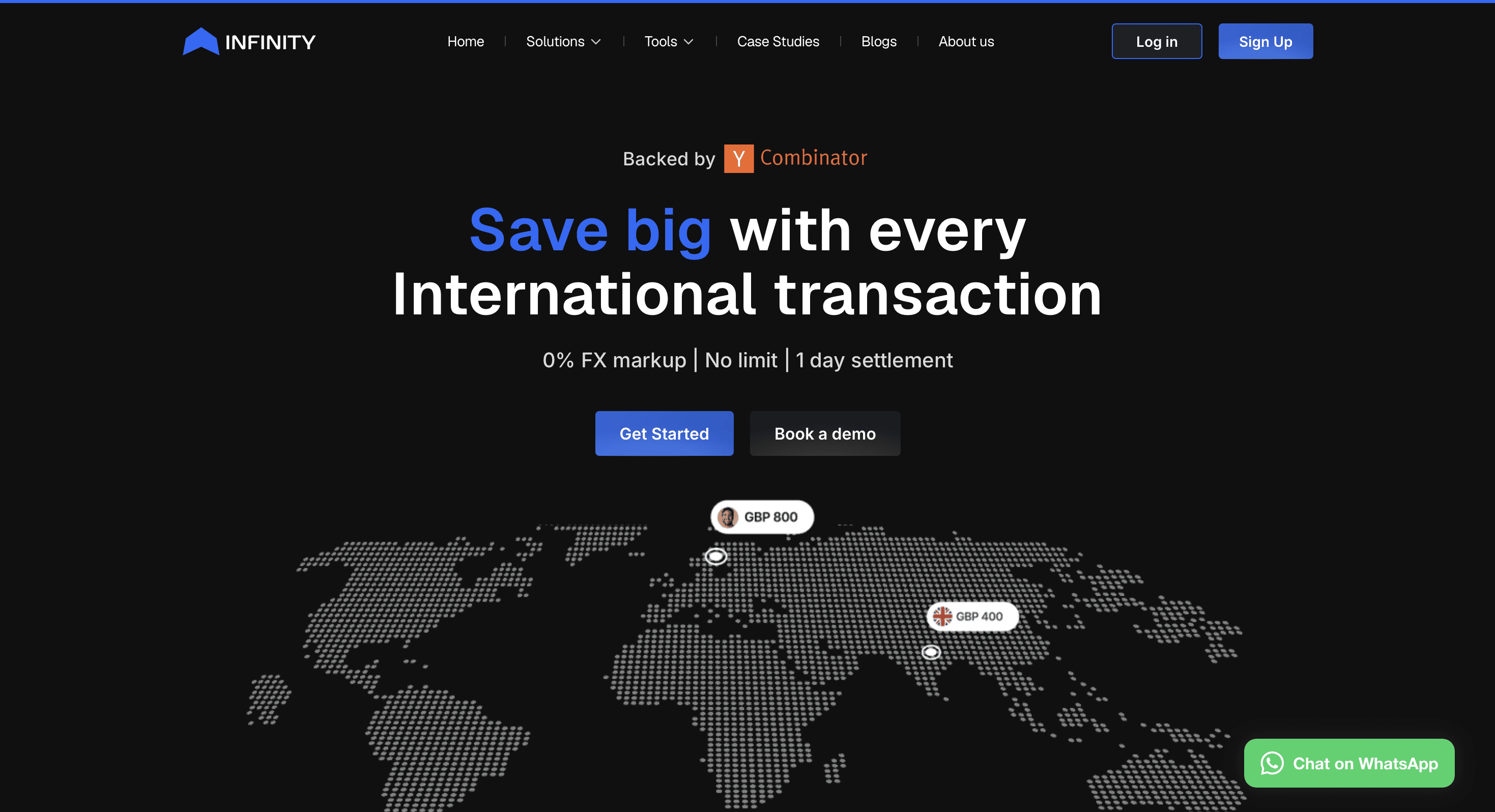
It is especially relevant if you are a freelancer, consultant, agency, remote service provider, or export-led business billing global clients directly. You send the invoice. The client pays. You want clear costs, better value, INR settlement, and documentation that does not become a weekend project.

Fees Structure
Infinity is commonly positioned around simple percentage-based pricing in the 0.5% range. The appeal is not just the headline fee. The real point is predictability: you should know what the payment costs before the money lands, not after.
For many Indian service exporters, that is the difference between “payment received” and “payment received, but margin quietly leaked.”
Example Use Case
Say you are a performance marketing agency in India billing a US client $3,000 every month. PayPal is easy for the client, but the final INR keeps looking worse than expected. You know you are making money, but you can also feel the payment stack taking a cut you did not properly price into the project.
That is where Infinity fits. You want the client experience to stay simple while protecting your received amount and keeping export documentation cleaner.
It also works well for consultants, design studios, dev shops, content agencies, legal/accounting service providers, and remote service businesses that invoice clients directly instead of getting paid through marketplaces.
Features
Receive payments from international clients.
INR settlement into Indian bank accounts.
Simple pricing for service exporters.
Useful alternative to PayPal and traditional SWIFT payments.
India-first workflow for freelancers and agencies.
Things Users Liked About Infinity
Users like that the 0.5% Fee is easier to understand than PayPal-style deductions.
Freelancers and agencies respond well to the idea of keeping more INR from each client invoice.
Users looking for a cleaner PayPal alternative see Infinity as more practical for direct B2B payments.
Users like not having to explain a complicated bank-wire process to every new overseas client.
Things Users Disliked About Infinity
It is not meant to replace enterprise-grade payout automation tools.
SaaS founders with tax-heavy global checkout needs may need a merchant-of-record platform instead.
If your clients only pay through a marketplace, Payoneer or the platform-native payout method may still be more practical.
Summary:
Infinity is the best overall pick if you are an Indian freelancer, agency, consultant, or service exporter and want a practical, low-fee way to receive foreign client payments. We are biased, yes. But the buyer logic is still straightforward: if you send direct invoices and care about final INR, start here.
#2. Xflow
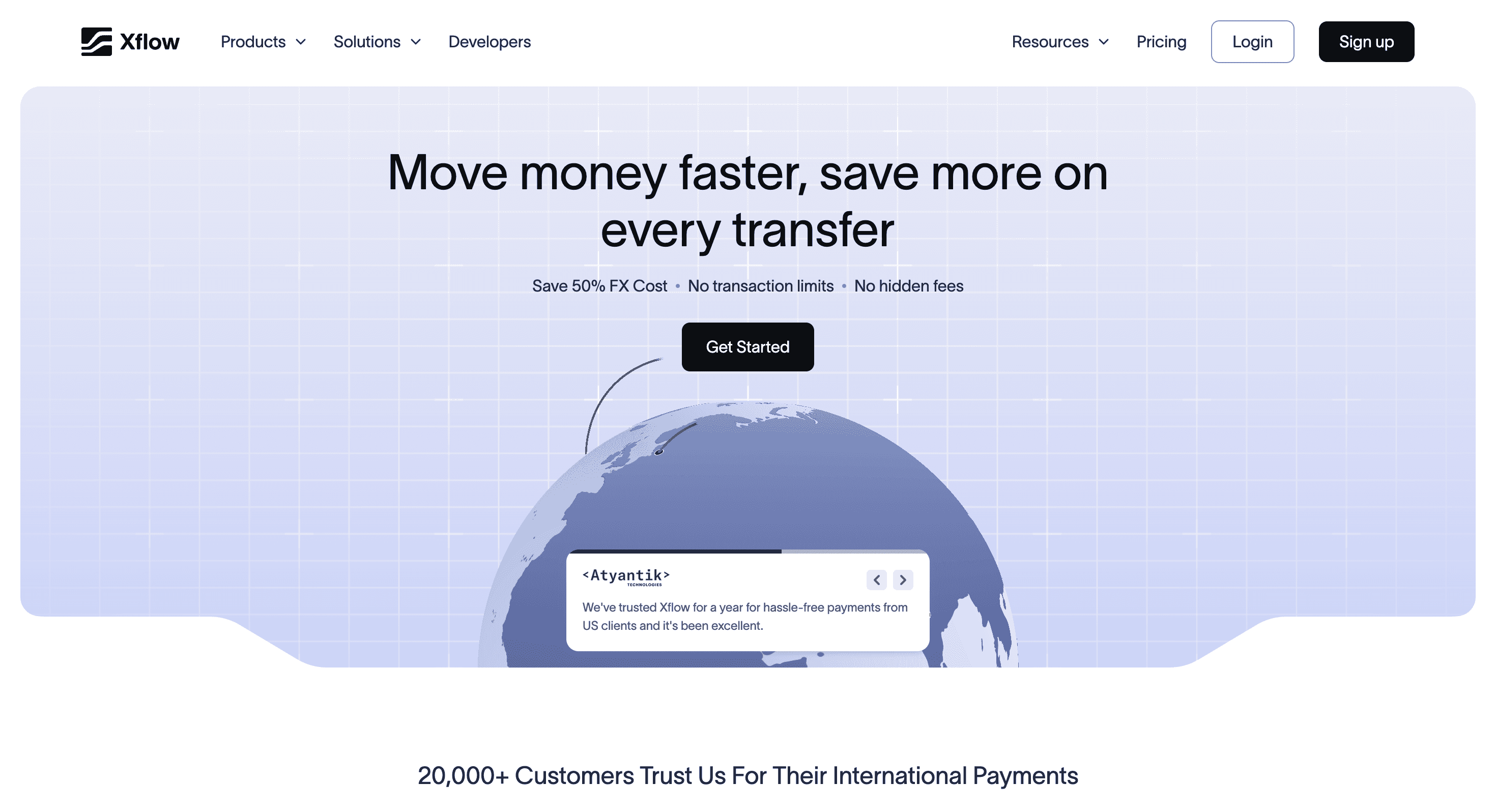
Xflow is a serious cross-border payment infrastructure platform for Indian businesses. It is better suited for B2B exporters, platforms, and larger companies that need more structure than a simple payment link.
Fees Structure
Xflow typically needs to be evaluated based on transaction size, business type, and volume. Its value is strongest when compliance, automation, eFIRA, and operational reliability matter more than the lowest headline fee.
Example Use Case
Imagine an Indian B2B SaaS or export-services company receiving payments from 40 overseas customers every month. The finance team does not just need “a payment link.” They need repeatability, reconciliation, documentation, and fewer bank follow-ups. That is where Xflow makes more sense than a simple wallet.
It is also relevant if you are building a platform where international collections need to plug into a broader finance workflow instead of being handled manually by the founder.
Features
Global collections for Indian businesses.
Compliance-first payment workflows.
eFIRA/documentation support.
Useful for platforms and repeat B2B flows.
Better fit for finance teams than casual freelancers.
Things Users Liked
Transparent pricing and competitive foreign exchange rates.
The ability to hold USD and convert it when the exchange rate is more favourable.
Fast settlements, with some users reporting payments arriving within 24 hours.
Lower transaction and conversion costs compared with banks, Payoneer, and similar platforms.
Real-time forex tracking, frequent rate updates, and features such as limit orders or automated withdrawal triggers.
Easy onboarding, a simple dashboard, and convenient invoice creation and payment collection.
Responsive customer support that helps with setup, failed payments, and transaction-related questions.
Things Users Disliked
Limited support for certain currencies, particularly EUR, CAD, and AUD.
No direct cross-currency conversion, such as converting USD balances into GBP.
Some users want better Euro account functionality and broader multi-currency capabilities.
Bank integration and FIRC-related processes could be more seamless.
Traditional accountants or first-time users may need more onboarding guidance, tutorials, or product demo videos.
A few users experienced minor technical glitches, although they said the support team resolved them quickly.
Summary:
Xflow is best when cross-border payments are becoming a real business operation, not just one invoice from one overseas client. It is less about convenience and more about infrastructure, compliance, and scale.
#3. Skydo
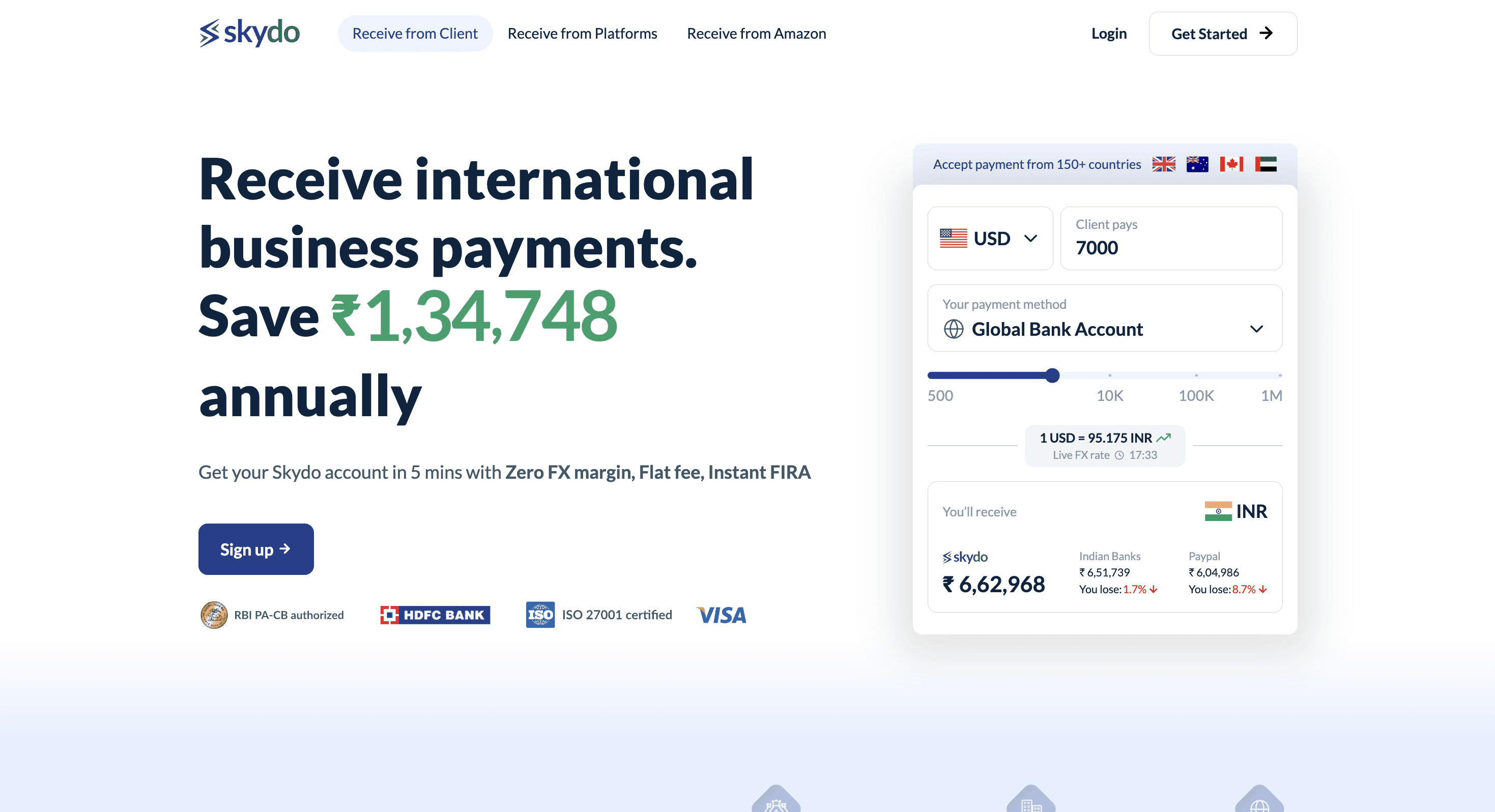
Skydo is one of the strongest India-first platforms for exporters, freelancers, and agencies that want transparent international payment collection with FIRA support.
Fees Structure
Skydo is known for a flat-fee model. That can be powerful for larger invoices because the fee does not keep growing with the payment amount. But for smaller invoices, flat fees need to be compared carefully against percentage pricing.
Example Use Case
Say you are a software development agency receiving $10,000 from a UK client. A percentage fee keeps growing as your invoice grows. A flat fee can become attractive because the cost does not scale linearly with the payment size.
But if you receive $300 or $500 invoices, the same flat-fee logic may stop looking attractive. This is why Skydo should be evaluated with your actual invoice size, not generic advice.
Features
International payment collection for Indian businesses.
Flat-fee style pricing.
FIRA/eFIRA support.
Good fit for freelancers, agencies, and service exporters.
PayPal alternative positioning.
Things Users Liked
Fast settlements, with several users reporting that international payments reached their Indian accounts within one business day or around 36 hours.
Transparent fees and competitive foreign exchange rates compared with PayPal, traditional banks, and other cross-border payment platforms.
Simple onboarding, including quick creation of virtual international bank accounts.
Automatic settlement, which reduces the need to manually withdraw or convert incoming payments.
Easy-to-use dashboard and a straightforward process for receiving payments from overseas clients.
Responsive account managers who guide users through onboarding, invoice submission, and their first settlement.
Automatic delivery of FIRA, payment receipts, and other compliance documents, reducing follow-ups with banks.
Cost savings for freelancers and businesses receiving recurring international payments.
Things Users Disliked
Compliance reviews can delay or block payments, particularly when Skydo does not clearly understand the customer’s business model, service, or transaction purpose.
Some users reported poor communication when funds were placed on hold, with unclear timelines for resolution.
Account approval or payment acceptance may depend heavily on invoices, purpose codes, business categories, and compliance documentation.
Currency-routing mistakes can result in double conversion or unexpected foreign exchange losses, especially when the sender uses the wrong currency or transfer route.
Earlier users reported a transaction limit of $10,000 and requested support for larger individual payments.
Some users want stronger login security, such as mobile-number OTP authentication.
Refunds after rejected transactions may cause additional fees or losses for both the business and its overseas client.
Customer support appears strong during normal onboarding and successful payments, but some negative reviews describe slower or less helpful support during compliance disputes.
Summary:
Skydo is a top-tier option when your invoice size is high enough for flat-fee pricing to create real savings. The bigger and more predictable your invoices, the more interesting it gets.
#4. BriskPe
BriskPe focuses on helping Indian exporters and service businesses receive international payments through virtual accounts and simpler compliance workflows.
Fees Structure
BriskPe should be compared on transaction fee, FX rate, currency support, and documentation timelines. Its value is often in support and operational help, not just the lowest visible fee.
Example Use Case
Picture a small textile exporter, Amazon seller, handicraft exporter, or services company that does not have a finance team. The founder wants to receive USD or EUR, get INR settlement, and avoid running between bank emails, CA questions, and client follow-ups.
BriskPe fits that buyer because support is part of the value. When a payment gets delayed, a dashboard alone is not enough. You want someone who can explain what is happening.
Features
Virtual accounts for global collections.
INR settlement for Indian businesses.
FIRA support for eligible export payments.
Useful for SMB exporters and service providers.
Support-led onboarding.
Things Users Liked
Fast settlements, with many users reporting that funds reached their Indian bank accounts within one business day or 24–48 hours.
Competitive transaction fees compared with traditional banks, PayPal, Razorpay, and other cross-border payment providers.
Instant or timely e-FIRA and FIRC generation, making compliance documentation easier to manage.
Smooth onboarding and virtual account setup, with relationship managers helping users complete documentation and their first transaction.
Responsive customer support, with several users praising specific account managers for proactive assistance and clear communication.
Live exchange rates and competitive forex conversion, helping businesses reduce losses from bank spreads and hidden charges.
Simple invoicing and payment tracking through an easy-to-use dashboard.
Reliable support for ACH and SWIFT payments, particularly for service exporters and small businesses receiving overseas payments.
Things Users Disliked
Some users reported delays in payment clearance and said they had to follow up with multiple team members before funds were released.
A small number of users said payments were held and later refunded to clients even after account verification and document submission.
Forex conversion could be more transparent, particularly the exact time and rate at which currency conversion takes place.
Percentage-based fees can become expensive for high-value payments because charges increase with the transaction amount.
GST and other deductions may not always be communicated clearly enough before the first transaction.
The app and dashboard could be more intuitive, with cleaner navigation and a more polished user experience.
Customer support is generally well reviewed, but some users want faster resolutions and more proactive updates when a payment is delayed.
Access to payment-link features may depend on third-party partners such as PayU, which can create additional onboarding or compliance friction.
Summary:
BriskPe is strong for Indian SMB exporters who want payment collection plus support, not just a dashboard. It is a good fit when the founder still owns finance operations personally.
#5. Salt.Pe
Salt.Pe is another India-first cross-border payment option for businesses that want to collect from overseas clients and manage export payment workflows more cleanly.
Fees Structure
Public fee clarity and review depth should be validated directly before choosing Salt.Pe. Ask for transaction fee, FX spread, FIRA process, settlement timeline, and supported currencies.
Example Use Case
Salt.Pe is worth checking if you are already comparing India-first alternatives and want a platform focused on export payments rather than generic global transfers. For example, an export-services company receiving from two or three countries may shortlist Salt.Pe alongside Infinity, Skydo, BriskPe, and Xflow.
The smart move is to run one controlled payment first. Check the landed INR, FIRA process, support response, and client-side experience before routing important invoices through it.
Features
Cross-border collection for Indian businesses.
Export-payment oriented workflows.
Potential compliance and settlement support.
Useful for businesses comparing newer India-first platforms.
Things Users Liked
Easy-to-use platform for receiving international payments.
Support for multiple currencies, including USD, GBP, and CAD.
Straightforward process for receiving earnings from overseas clients or campaigns.
Payments generally arrive within a few days.
Users appreciated the simpler experience compared with other available payment options.
Customer service was described as helpful and responsive.
Things Users Disliked
The available reviews provide very little specific negative feedback.
Settlement may take a few days rather than arriving instantly.
Users did not provide much detail about fees, forex markups, compliance documents, or transaction limits.
Most of the supplied reviews were incentivized, so they may not represent the full range of customer experiences.
There are not enough detailed reviews to assess how SALT handles delayed payments, compliance checks, refunds, or support escalations.
Summary:
Salt.Pe is worth evaluating, but it needs a tighter buyer check: fees, FX, FIRA, settlement time, and support quality. Treat it as a serious shortlist candidate, not an automatic default.
#6. Wise
Wise is one of the most trusted global names for transparent international transfers. Its strongest advantage is the way it frames fees and FX more clearly than banks.

Fees Structure
Wise usually shows fees upfront and is known for mid-market rate positioning. For Indian business receiving workflows, the real question is not whether Wise is transparent. It is whether the exact corridor, account setup, and compliance workflow fit your use case.
Example Use Case
Wise makes sense when the transfer corridor is supported cleanly and both sides want transparent fees. For example, a consultant receiving money from a European client may like the clarity around conversion and fee display.
The catch is India-specific documentation. If your CA needs export paperwork and you need a clean FIRA/eFIRA trail, validate that before choosing Wise as your main business receivables setup.
Features
Transparent global transfers.
Clear fee display.
Strong consumer and business trust globally.
Useful for supported transfer corridors.
Things Users Liked
Fast international transfers, with many users reporting that payments arrive within minutes or a few hours.
Competitive foreign exchange rates and lower fees than traditional banks.
Strong multi-currency support for holding, converting, and sending different currencies.
Simple interface that makes it easy to manage balances and international transactions.
Useful for frequent travellers, remote workers, freelancers, and businesses operating across countries.
Reliable performance for routine transfers, with some long-term users reporting years of trouble-free use.
Transparent transfer estimates and reasonable costs for commonly supported currency routes.
Convenient Wise Business accounts and cards for managing international expenses.
Things Users Disliked
Some users reported transfers remaining stuck in a “sending” or processing state for days or even months.
Customer support was described as slow, repetitive, or unable to provide clear explanations during delayed-transfer cases.
Accounts, cards, or transactions may be restricted while Wise completes fraud, identity, or anti-money-laundering checks.
Verification requirements can be difficult for customers whose local banks do not provide documents in the format Wise expects.
Some users said their accounts were closed even after submitting the requested identity or source-of-funds documents.
Access to funds can be disrupted when cards are cancelled or accounts are restricted during fraud investigations.
Users sometimes receive conflicting information from different support representatives.
Certain transfers or funding methods can become slower or more expensive depending on the country, bank, currency, or payment route.
Wise does not support some transaction types, including payments to certain cryptocurrency platforms.
Refunds or cancelled transfers may take additional time, especially when a transaction is disputed or placed under review.
Summary:
Wise is excellent when the corridor works. For Indian export receivables, validate documentation before treating it as the default. It is transparent, but transparency alone does not solve every compliance workflow.
#7. PayPal
PayPal is the platform everyone knows. That is its strength. It is also the reason many Indian freelancers keep using it longer than they should.

Fees Structure
PayPal can become expensive after platform fee, currency conversion, and receiving deductions. The headline convenience often hides the final INR problem.
Example Use Case
PayPal is useful when a US client says, “We only pay through PayPal,” and you do not want payment friction to delay the deal. For a one-off $200 or $500 project, convenience may matter more than optimization.
But if you are receiving $2,000, $5,000, or $10,000 every month, PayPal should not be the lazy default. At that point, every percentage point and FX difference is real margin leaving the business.
Features
Global buyer recognition.
Easy checkout and invoice payment experience.
Useful for one-off payments.
Works well when the client already prefers PayPal.
Things Users Liked
Widely accepted by online stores, marketplaces, freelancers, and international customers.
Straightforward and familiar checkout experience for both buyers and sellers.
Helps businesses accept payments from a larger global audience without building their own payment infrastructure.
Reliable for routine purchases and payments, with some users reporting many years of trouble-free use.
Offers consumer and seller protection mechanisms for eligible transactions.
Strong security controls that can detect potentially suspicious activity.
Convenient access to additional products such as debit cards, credit cards, Venmo, and business payment tools in supported markets.
Easy to connect with bank accounts, cards, ecommerce platforms, and online marketplaces.
Things Users Disliked
Accounts may be temporarily or permanently restricted, sometimes with limited explanation about what triggered the action.
Automated security and compliance systems can incorrectly flag normal transactions or customer information.
Users reported difficulty accessing funds while an account, payment, or identity check was under review.
Customer support was frequently described as slow, difficult to reach, repetitive, or unable to resolve complex cases.
Different support agents may provide conflicting information or repeatedly open new cases without reaching a resolution.
Buyers and sellers both reported dissatisfaction with dispute and chargeback decisions.
Sellers may lose disputes even after submitting tracking details, photographs, videos, or other supporting evidence.
Refunds can be slow or difficult to process, particularly when a transaction is already disputed.
PayPal may automatically convert currencies using its own exchange rate, creating additional costs on top of transaction fees.
Users can face repeated document requests, long investigation periods, and unclear complaint or appeal processes.
Summary:
PayPal is a fallback when the client insists. It should not be the default for serious Indian cross-border collections because convenience gets expensive at scale.
#8. Payoneer
Payoneer is strong for marketplace payouts, freelance platforms, ecommerce sellers, affiliate networks, and partner ecosystems. It is practical because many platforms already support it.
Fees Structure
Payoneer pricing depends on payment source, withdrawal method, currency conversion, and platform relationship. It can be useful, but not always cheapest for direct B2B invoice payments.
Example Use Case
Payoneer makes sense if your money comes from marketplaces: freelance platforms, e-commerce platforms, affiliate networks, creator platforms, or partner payout ecosystems. In those cases, Payoneer is not just a payment tool. It is part of the platform rail.
But if a direct client can pay you through an India-first cross-border platform, compare the final INR before assuming Payoneer is best.
Features
Receiving accounts in multiple currencies.
Marketplace and platform payout support.
Global user base.
Useful for freelancers and sellers working through platforms.
Things Users Liked
Users like that it works with many global marketplaces.
Freelancers appreciate receiving accounts for platform payouts.
It is familiar and widely accepted in global earning ecosystems.
Things Users Disliked
Users complain when fees and conversion reduce the final amount.
Support and account verification can be frustrating in edge cases.
It may be weaker than India-first platforms for direct export invoices.
Summary:
Payoneer is best when the money comes from marketplaces. For direct client payments, compare the final INR against Infinity, Skydo, and Xflow before committing.
#9. Razorpay
Razorpay is a payment gateway, not a pure cross-border receivables specialist. That distinction matters. It is useful when international card payments or checkout flows are the main job.
Fees Structure
Razorpay fees depend on payment method, domestic/international cards, and gateway setup. It should be compared as a checkout/payment gateway, not only against invoice collection platforms.
Example Use Case
Razorpay makes sense if you sell courses, services, events, digital products, or website-based offerings where buyers pay by card. The buyer experience is checkout-first, not bank-transfer-first.
If you are sending monthly invoices to a US client, Razorpay may not be the best comparison. If you need international cards on your site, it becomes much more relevant.
Features
International card payment acceptance.
Checkout and payment links.
Strong Indian payment ecosystem.
Useful for websites, courses, and digital businesses.
Domestic and international payment stack in one place.
Things Users Liked
Indian businesses like the familiar gateway ecosystem.
Developers and merchants appreciate checkout and payment-link options.
It works well when international cards are part of the buying flow.
Things Users Disliked
It may not be the cheapest way to receive direct international invoices.
Some users need more exporter-specific documentation support.
Gateway workflows are not the same as cross-border bank collection workflows.
Summary:
Razorpay is the right choice when checkout matters. For direct B2B export payments, compare it against cross-border specialists before assuming a gateway is the answer.
Final Verdict
Most cross-border payment content gives safe advice.
“Compare fees.”
“Choose based on your needs.”
That is technically true and practically useless.
Here is the clearer version from our side.
If you are an Indian freelancer, agency, consultant, or service exporter receiving direct international payments, start with Infinity. That is the problem we are building for.
If your business is scaling into serious B2B export volume, compare Xflow and Skydo.
If you need more support as an SMB exporter, look at BriskPe.
If you sell through marketplaces, use Payoneer.
If you sell SaaS globally, evaluate Dodo Payments.
If you are using PayPal by default, check the final INR after all fees and conversion. That number will do the arguing for you.
You do not need a famous payment brand. You need the right amount landing in your bank, the right document for compliance, and a payment flow your client can actually complete.
Cross-border payments are not about moving money.
They are about keeping it.


