

Discover infinity


Subscribe to our newsletter
Get the latest updates, insights, and tips delivered straight to your inbox.
Getting paid across borders is not as simple as sending money from one account to another. A cross-border payment can pass through banks, card networks, payment systems, or payment providers before the money reaches the recipient.
The cost can also vary. You may pay a transaction fee, an FX markup, a bank charge, or a combination of these. Processing time can change too, depending on the payment method, currency, banks involved, compliance checks, and when the payment is submitted.
For an Indian business, another layer comes into play. The money may need to be converted and settled in INR, the transaction needs to be classified correctly, and records such as remittance documentation may be required.
In this guide, we break down how global payment processing works, where costs come from, why payments get delayed or rejected, and what Indian businesses should consider before choosing a payment solution.
TL;DR
Global payment processing covers the steps involved in initiating, checking, routing, settling, and, where required, converting a cross-border payment.
International payment costs may include transaction fees, FX markups, fixed charges, and bank or intermediary fees.
Indian businesses may need to deal with INR settlements, purpose codes, FIRA or other remittance records, and applicable FEMA and RBI requirements.
When comparing providers, look beyond the headline transaction fee. Check the exchange rate, settlement process, supported currencies, documentation, compliance requirements, and payment tracking.
What is Global Payment Processing?
Global payment processing refers to the steps involved in sending and receiving money across countries and currencies. It can include checking payment details, routing the transaction through the relevant financial institutions or payment networks, converting currencies when required, and settling the funds with the recipient.
The exact path depends on the payment method, country, currency, and providers involved. Card payments, bank transfers, and digital-wallet payments can each follow a different route.
Term | Meaning |
Cross-border payment | A payment between parties in different countries or jurisdictions. |
Payment processing | The steps involved in checking, routing, and processing a payment. |
Settlement | The transfer of processed funds to the recipient under the agreed payment arrangement. |
Reconciliation | Matching the payment received with invoices, fees, and accounting records. |
How Does Global Payment Processing Work?
There is no single route that every international payment follows. Still, most cross-border payments involve the same broad stages.

1. Payment Initiation
It starts when the payer chooses a payment method and sends the transaction. That could be a bank transfer, card payment, payment link, digital wallet, or another supported option. The payment carries basic information such as the amount, currency, and recipient details.
2. Verification and Authorisation
The bank, payment network, or provider then checks the transaction. What gets checked depends on the payment method. A card transaction may go through card authorisation, while a bank payment may involve account checks, identity verification, or compliance screening.
3. Payment Routing
Once the transaction passes the required checks, it needs to reach the recipient. For an international bank transfer, that may mean going through correspondent or intermediary banks.
Card payments can instead move through card networks and payment-provider infrastructure. The institutions or processing stages involved can affect how the payment moves and how long it takes.
4. Currency Conversion
If the payer and recipient use different currencies, the payment needs to be converted. For example, an overseas customer may pay in USD while an Indian business ultimately receives INR. The conversion rate and any FX markup can affect how much the business receives.
5. Settlement
After processing, the funds are settled according to the payment arrangement. This distinction matters. Processing handles and confirms the transaction. Settlement makes the funds available to the recipient.
6. Reconciliation
The final step is matching the payment with the business record. The business may need to check the invoice, amount received, fees deducted, exchange-rate difference, and any remaining amount due. This becomes particularly important when a business handles a large number of international payments.
Which Payment Methods are Used for Global Payments?
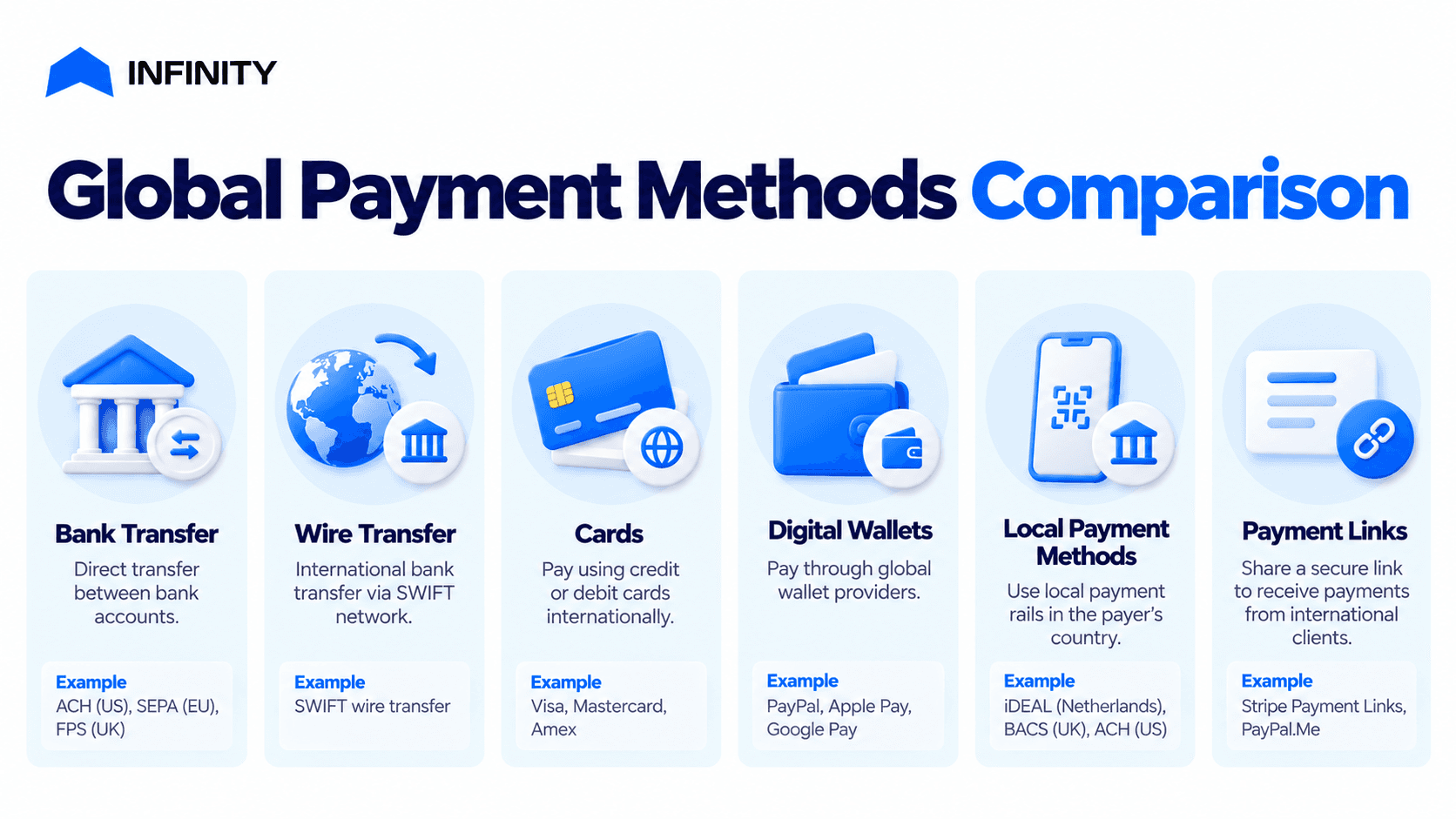
No single payment method is best for everyone. Bank transfers can make sense for larger business payments, while cards and payment links may be more convenient for online customers.
The choice usually comes down to the transaction, the market, the currency, and how the recipient wants to pay.
1. Bank Transfers
Bank transfers move money between bank accounts and are commonly used for invoices, client payments, supplier payments, and larger transactions.
For cross-border payments, an Indian business may receive funds through supported foreign-currency account details or other receiving arrangements offered by its payment provider. Infinity, for example, enables eligible businesses to receive international payments and settle supported foreign currencies into INR.
2. International Wire Transfers
International wire transfers move funds between banks in different countries. The payment may pass through one or more correspondent or intermediary banks before reaching the recipient. That can add another processing step and, in some cases, another fee.
3. Card Payments
Cards are a familiar option for customers buying products or services from businesses in another country.
Credit, debit, and prepaid cards can be processed through networks such as Visa, Mastercard, and American Express. The fees and acceptance rules are not identical across providers, card types, countries, or transactions.
4. Digital Wallets
Digital wallets let customers pay from a wallet balance or through a linked card or bank account.
Common examples include PayPal, Apple Pay, Google Pay, Amazon Pay, Alipay, and WeChat Pay.
The important point is availability. A wallet that customers commonly use in one market may not support the same payment flow in another.
5. Local Payment Methods
Local payment methods reflect how people in a particular market prefer to pay. They can include local bank transfers, real-time payment systems, bank redirects, and country-specific wallets.
UPI is India's major real-time payment system. According to the Press Information Bureau (PIB), UPI accounts for nearly 49% of global real-time payment transaction volume.
Other examples include Pix in Brazil, PayNow in Singapore, and BLIK in Poland. A local payment method does not automatically become a cross-border payment option. Whether it can be used internationally depends on the provider and the specific payment flow.
6. Payment Links
A payment link gives the customer a payment page that the business can share through email, messaging apps, or other channels.
Depending on the provider, that page may offer cards, bank transfers, digital wallets, or other payment methods.
For businesses that invoice customers or sell through channels without a full checkout, payment links can be a practical way to collect payments.
How Much Does Global Payment Processing Cost?
The headline transaction fee is only part of the picture. Depending on the payment route, the total cost can include a transaction fee, FX markup, fixed charge, sending-bank fee, intermediary-bank fee, or receiving-bank charge.
That is why comparing the total amount paid or received is more useful than comparing transaction fees alone.
Costs Included in an International Payment
A simple way to look at the flow is:

The exchange rate determines how much one currency is worth when converted into another. An FX markup is an additional margin applied to the exchange rate. It is different from a transaction fee, so a provider can charge a transaction fee even when it does not add an FX markup.
There can be other costs too. Card payments may involve acquiring, network, interchange, and processing costs. Bank transfers can involve charges from the sending bank, intermediary banks, or the receiving bank.
So, when a provider advertises 0% FX markup, that does not mean the payment has no cost. It means the provider is not adding an FX margin to its stated exchange rate.
Example: How a 0.5% Transaction Fee Affects the Amount Received
Suppose an Indian business receives USD 2,000 and the applicable exchange rate is ₹83.68 per USD.
Amount received | USD 2,000 |
Exchange rate | ₹83.68/USD |
Gross INR value | ₹1,67,360 |
0.5% transaction fee | ₹836.80 |
Amount after transaction fee | ₹1,66,523.20 |
Note: This example is meant only to show how a transaction fee changes the final amount. The actual amount received may differ because the exchange rate, fees, payment route, settlement terms, and other charges may change.
Why Do Global Payments Fail or Get Delayed?
International payments can get stuck for reasons unrelated to the amount being sent. Incorrect beneficiary details, an unsupported currency, a compliance review, or even a bank holiday can affect the payment.
Why Can a Global Payment Fail?
Some of the more common reasons are:
Incorrect payment details: A wrong account number, IBAN, SWIFT/BIC code, routing detail, or beneficiary name can lead to rejection.
Unsupported currency or route: The bank or provider may not support the selected currency or payment path.
Insufficient funds or limits: The payer may not have enough funds, or the payment may exceed an applicable transaction limit.
Missing information: Incomplete or inconsistent details can prevent the transaction from being processed.
Compliance checks: AML, KYC, sanctions screening, or other checks may require additional information or stop the payment.
Bank rejection: One of the banks involved may reject the transaction because of its internal rules or the information provided.
Technical problems: A temporary issue with a bank, network, or payment provider can also interrupt processing.
Why Can a Global Payment Be Delayed?
A payment can be valid and still take longer than expected. Common causes include:
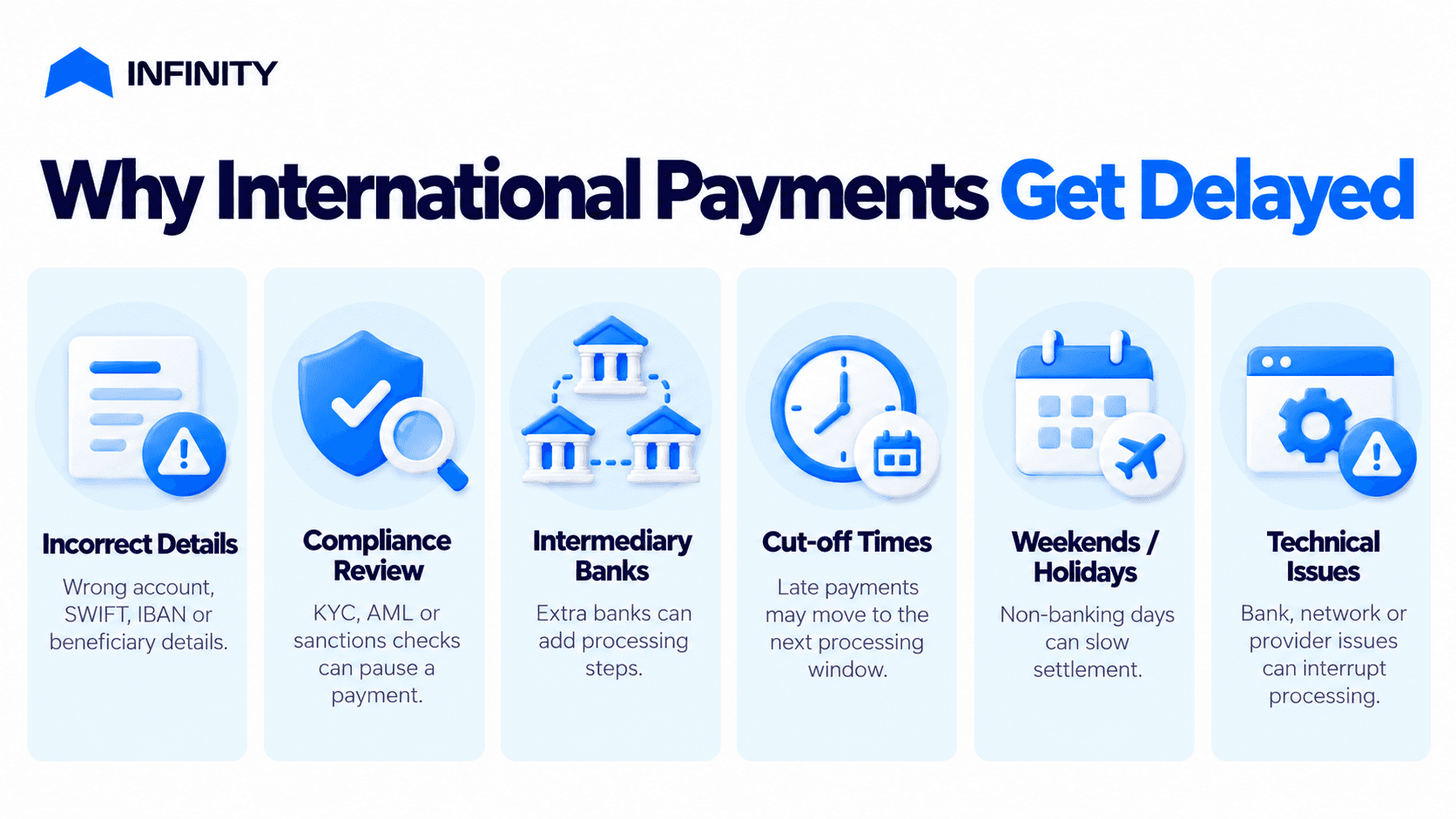
Bank cut-off times: A payment submitted after the bank's cut-off may move to the next processing window.
Weekends and holidays: The sending and receiving countries may have different banking holidays or working schedules.
Time-zone differences: The payment may reach the next bank after its business hours have ended.
Intermediary banks: More institutions in the payment chain can mean more processing stages.
Compliance reviews: The bank or provider may pause the payment while checking the transaction or requesting documents.
Routing issues: A payment may need to move through another available route.
Technical issues: Temporary system problems can hold up an otherwise valid transaction.
If a payment is delayed, check its status before resending it. Confirm the beneficiary details, currency, and payment route, and respond to any request for additional information.
Do not resend a payment while it is still pending until you confirm its status. Otherwise, you could end up making the same payment twice.
What Does Global Payment Processing Mean for Indian Businesses?
For an Indian business, receiving or sending money internationally involves more than simply getting the funds into a bank account.

Depending on the transaction, the business may need to deal with:
Payment purpose and transaction classification
Currency conversion
INR settlement
Invoices and supporting documents
Purpose codes
Remittance records
Applicable FEMA and RBI requirements
Export-related reporting or declarations, where applicable
According to NITI Aayog, India’s total merchandise and services trade reached $1.84 trillion in FY2025-26. This reflects the scale of India’s trade with global markets and the growing need for businesses to manage cross-border payments efficiently.
The process differs for each transaction. Money received for an exported service, for example, may be subject to different requirements than an import payment, investment, loan, or other foreign-exchange transaction.
How Do RBI and FEMA Apply to International Payments?
The Foreign Exchange Management Act, 1999 (FEMA) provides the broader legal framework for foreign-exchange transactions in India, along with the regulations and directions issued under it.
Authorised Dealer (AD) banks handle eligible foreign-exchange transactions. Depending on the payment, they may also carry out checks, collect documents, handle reporting, and manage the applicable settlement process.
The exact requirements depend on what the payment represents. For instance, an Indian business receiving money from an overseas customer for an eligible service export may need to provide transaction details and supporting records so that the payment can be classified and settled correctly.
If you are unsure about the requirements for a particular transaction, confirm them with your Authorised Dealer bank or a qualified professional.
What Should Indian Service Exporters Know About the 2026 Export Framework?
India updated its foreign-exchange framework for exports of goods and services in 2026. The applicable documentation and reporting requirements depend on the type of export, the transaction, and the current RBI framework.
An overseas payment is not automatically an export transaction that follows one standard declaration or reporting process. Service exporters should check the latest RBI requirements and confirm the applicable process with their Authorised Dealer bank before relying on a specific form, declaration, or deadline.
What are FIRA and Purpose Codes Used For?
A purpose code tells the bank what a foreign-exchange transaction is for. It helps the bank classify the payment correctly.
FIRA, or another applicable inward-remittance record, documents money received from overseas. The exact document and process can vary by bank and transaction.
How Should You Choose a Global Payment Processing Solution?
The best place to start isn't the provider's fee page. Start with the way your business actually moves money.
A business receiving payments from overseas clients may need something quite different from a company running international e-commerce checkout or making supplier payouts.
Here are seven things worth checking:
Payment flow: Are you receiving payments, sending them, or doing both?
Countries and currencies: Does the provider support the markets and currencies you actually use?
Payment methods: Can your customers or business use the required methods, such as cards, bank transfers, payment links, or local payment methods?
Total cost: Look at transaction fees, exchange rates, FX markup, fixed charges, and bank or intermediary costs together.
Settlement: Find out where the money settles, which currencies it supports, and when the funds become available.
Documentation and compliance: Understand what KYC information, invoices, transaction details, remittance records, and other documents you may need.
Tracking and reconciliation: Make sure you can see payment status and retrieve records that match invoices and accounting entries.
Fund flow and scalability: Understand which banking and financial institutions are involved, whether the provider holds funds, and whether the setup can handle your expected transaction volume as the business grows.
How Does Infinity Support Global Payments for Indian Businesses?
For Indian businesses receiving payments from overseas clients or customers, Infinity brings the receiving, currency conversion, INR settlement, tracking, and applicable remittance documentation into one payment flow.
Depending on the transaction, businesses can:
Receive international payments: Eligible businesses can receive overseas payments through supported global receiving arrangements.
Convert and settle funds: Eligible foreign-currency funds can be converted into INR and settled into an Indian bank account.
Track payments: Businesses can monitor payment status and access transaction records.
Manage remittance records: Applicable FIRA and purpose-code support can help businesses maintain records for received payments.
The available options depend on the currency, country, transaction type, business eligibility, and applicable requirements.
For applicable standard global bank-payment flows, Infinity charges a 0.5% transaction fee with 0% FX markup. Check the current pricing, supported currencies, eligibility criteria, and applicable terms before using the service.
Receiving overseas payments and settling them in INR? Explore Infinity's supported currencies, receiving options, fees, and settlement process.
Frequently Asked Questions About Global Payment Processing
1. Why did I receive less money than the amount sent internationally?
The amount you receive may be lower because of the exchange rate, FX markup, transaction fees, intermediary-bank charges, receiving-bank fees, or other applicable costs.
2. How long does an international payment take to reach India?
There is no single processing time for every international payment. The timing can depend on the payment method, currency, banks involved, intermediary institutions, compliance checks, cut-off times, weekends, holidays, and the route used for the payment.
3. Can Indian freelancers receive payments from overseas clients?
Yes. Indian freelancers can receive payments from overseas clients through supported international payment routes, subject to applicable foreign-exchange and transaction requirements.
Depending on the payment, they may need an invoice, payment purpose, purpose code, remittance details, or other supporting information.
4. Does 0% FX Markup mean international payments are free?
No. It only means the provider does not add an FX margin to its stated exchange rate. Transaction fees, fixed charges, intermediary-bank fees, receiving-bank charges, and other costs can still apply.
5. What information does a business need to receive an international payment?
The business will generally need its beneficiary or business details, relevant bank or account details, payment currency, and payment purpose. The bank or payment provider may also ask for an invoice, KYC information, or other supporting documents depending on the transaction.


