

Global payments

Subscribe to our newsletter
Get the latest updates, insights, and tips delivered straight to your inbox.
The first time a client abroad asked me for my “receiving bank details,” I genuinely didn’t know what to send. I sent my regular savings account number and IFSC code. Three days later, I got an email from my bank asking for a purpose code, along with a form for something called an FIRA. The payment finally landed, but almost 4% of it had quietly disappeared. This went into bank charges and a poor exchange rate I never agreed to.
If you’re a freelancer, agency, SaaS founder, or exporter working with clients outside India, this is an extremely common story. Once you know the system, getting paid from abroad isn’t complicated. Most people only learn the rules after losing money to hidden fees or delayed settlements.
This guide covers exactly how international payments work in India, which method fits your situation (freelancer, agency, SaaS, or exporter), what details to share with a foreign client, what it actually costs, and what documents you need for compliance. Read on to find out when a straightforward option like Infinity can make this whole process more predictable.
TL;DR
Indian freelancers, agencies, SaaS companies and exporters can receive international payments through SWIFT bank transfers, international payment gateways, PayPal, Wise, Payoneer, or virtual receiving accounts like Infinity.
The right method depends on cost, FX markup, settlement time, FIRA/FIRC support, purpose code handling and client convenience, and not just the headline fee.
For direct B2B client payments, virtual accounts and fintech platforms often work out cheaper than PayPal or SWIFT. This is because they reduce hidden FX loss and simplify documentation.
No method is completely free. Compare the final INR amount you receive, not just the advertised fee.
You’ll need an FIRA, FIRC, or eFIRA as proof of inward remittance for most business and tax purposes.
Quick Answer: How Can You Receive International Payments in India?
You can receive international payments in India through several routes: SWIFT bank transfers, international payment gateways, PayPal, Wise, Payoneer, or virtual receiving accounts such as Infinity. Each route moves money differently and comes with its own cost structure, settlement speed, and documentation support.
The best method depends on your situation. Large, one-off enterprise payments often suit SWIFT. Recurring SaaS or e-commerce checkouts suit a payment gateway. Marketplace payouts suit Payoneer or Wise. For direct client billing, freelancers, agencies, and exporters typically find Infinity as the more cost-effective option. This is because they reduce hidden FX loss and make FIRA/FIRC documentation simpler as compared to PayPal or a traditional bank wire.
Quick Comparison: Best Ways to Receive International Payments in India
Method | Best for | Typical fees | Settlement time | FIRA/FIRC support | Main drawback |
Virtual receiving accounts like Infinity | Freelancers,agencies, exporters, service businesses | Transparent platform fee (Infinity charges a flat 0.5%, inclusive of all charges) | As fast as within 24 hours | FIRA/eFIRA auto-generated | Client must pay using the receiving details you provide |
International payment gateway | SaaS, e-commerce, payment links, card payments | Gateway fee + FX markup (varies by provider) | 1-3 business days | Usually supported | Card processing fees and chargeback risk |
PayPal | Small, one-off clients | Transaction fee + FX markup (check PayPal’s current India rates) | Wallet instant, bank withdrawal slower | Limited, varies by account type | Expensive for frequent or high-value payments |
Wise / Payoneer | Freelancers, marketplace sellers, global clients | Varies by platform and currency | 1-3 business days | Varies by provider | Withdrawal limits and platform-specific rules |
SWIFT bank transfer | Large one-off B2B payments | Bank fee + intermediary bank fee + FX markup (varies by bank; check with your bank for current rates) | 2-5 business days | Available from bank, often a manual request | Multiple hidden deductions along the way |
How International Payments Work in India
Whichever method you use, the underlying flow is similar:
Client initiates the payment from their bank, card, or other payment platform abroad.
The payment moves through a rail. This could be bank/SWIFT rails, card networks, a payment gateway, or a virtual account provider’s own rails.
Currency conversion happens. The foreign currency (USD, GBP, EUR, and so on) is converted into INR at some point in the journey.
Purpose code and compliance details are captured. This tells the RBI why the money is coming into India (export of services, goods, and so on).
Money settles into your Indian bank account.
Proof of inward remittance is issued in the form of an FIRA, FIRC, or eFIRA. You will need this for tax filing, GST, and sometimes for your foreign client’s own records.
Client abroad → payment rail/platform → FX conversion → Indian bank settlement → FIRA/FIRC
Details to Share With a Foreign Client to Receive Payment
Sharing incomplete or incorrect payment details is one of the most common reasons why international payments get delayed. Before you send an invoice, make sure you have the following ready:
Legal name/beneficiary name (as per your bank or platform account)
Invoice number
Amount and currency
Bank account number, or virtual receiving account details if using a platform like Infinity
SWIFT/BIC code (for bank wire transfers)
IFSC code (for Indian bank details, where applicable)
Bank name and address
Purpose code
Payment reference
Charge instruction for SWIFT transfers: OUR, SHA, or BEN (this determines who pays the wire charges)
Any platform-specific receiving instructions
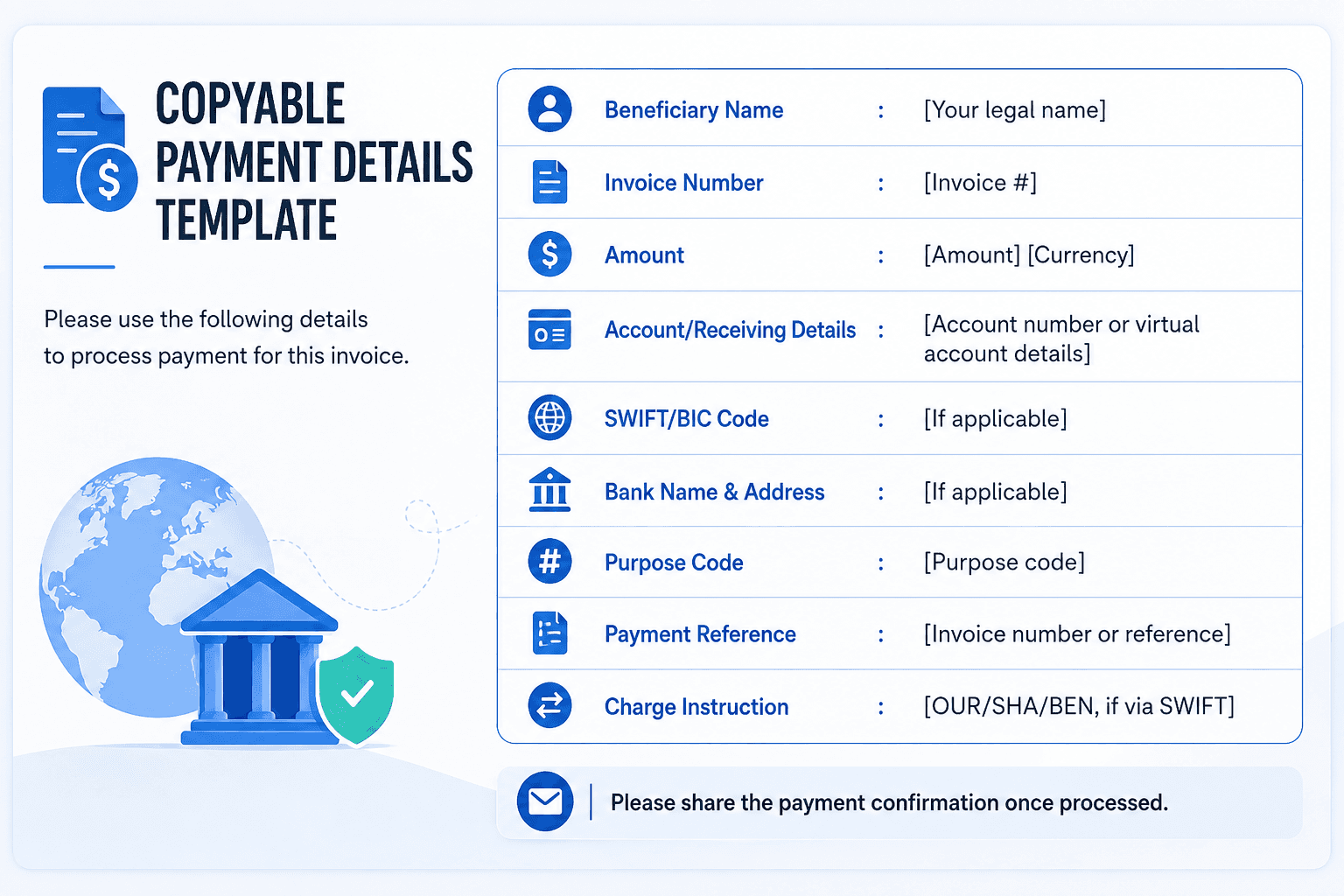
Copyable Payment Details Template
Please use the following details to process payment for this invoice:

Method 1: Receive International Payments Through Virtual Receiving Accounts, like Infinity
Virtual receiving accounts like Infinity have become one of the more practical options for freelancers, agencies, exporters, and SaaS companies who bill clients directly and want more predictable costs.
How it works: You get local receiving account details in currencies like USD, EUR, or GBP. Your client pays as if they’re paying a local account in their own country. The platform then converts the funds and settles them into your Indian bank account, typically along with documentation like an FIRA or eFIRA.
Why this method appeals to many businesses:
Fewer intermediary banks in the chain, which usually means fewer deduction points.
Greater FX transparency compared to SWIFT, PayPal or banks.
Automated and free FIRA support that simplifies tax and compliance work.
It is well-suited to freelancers, agencies, exporters, and SaaS companies who are billing clients directly.
Infinity helps with virtual accounts for receiving international payments in India to Indian freelancers, agencies, and exporters who receive direct payments from global clients. In this flow, the client pays using the receiving details that Infinity provides. The payment is converted and settled into your Indian bank account within 24 hours. Along with it, you receive payment records such as an FIRA, with a free FIRA Analyser tool available to help make sense of your remittance history. Infinity is AD-1 certified and RBI-regulated, and its flat fee structure (0.5%, inclusive of all charges) means the fee is visible upfront rather than buried in the exchange rate.
Method 2: Receive International Payments Through SWIFT Bank Transfer
SWIFT (Society for Worldwide Interbank Financial Telecommunication) is the traditional way businesses have received international payments for decades. Your client’s bank sends the payment through a network of correspondent banks until it reaches your Indian bank account.
How it works: You share your bank’s SWIFT/BIC code and account details with the client. Their bank routes the payment through one or more intermediary banks before it reaches your bank in India.
What to expect:
Intermediary bank deductions: Each correspondent bank in the chain can deduct a handling fee, and these aren’t always disclosed upfront.
Receiving bank charges: Your Indian bank may also charge a fee to credit the amount.
FX markup: Banks typically convert at a rate less favourable than the mid-market rate.
Settlement time: Usually 2 to 5 business days.
FIRA/FIRC: Available from your bank, but often requires a manual request and can take time to process.
Pros and cons:
Pros | Cons |
Widely trusted and understood by corporate clients | Multiple intermediary banks mean multiple deduction points |
Works for very large payment amounts | FX markup is often unfavourable |
No separate platform sign-up needed | Slower settlement (2-5 days) |
FIRA/FIRC often requires manual follow-up with the bank |
SWIFT is best suited for large, one-off enterprise payments where the amount justifies the fees. It’s less practical for frequent, smaller invoices, since the fixed costs eat into margins disproportionately.
Method 3: Accept International Payments Through Payment Gateways in India
If you run a SaaS product, e-commerce store, or need to send payment links to clients who prefer to pay by card, an international payment gateway is usually the better fit.
How it works: Payment gateways let your customers pay by card or other online methods, and the funds settle into your Indian bank account after processing.
What to know:
Best suited for checkout flows, payment links, SaaS subscriptions, and e-commerce transactions, rather than one-off large B2B invoices.
You’ll typically pay a transaction fee plus an FX markup on non-INR payments.
Chargebacks are a real risk with card payments and can affect your payout.
FIRA/FIRC support varies by provider, so check this before committing to one, especially if you need it for GST or tax purposes.
Providers commonly used for this in India include Razorpay, Stripe (where available), Cashfree, and PayPal checkout. Some virtual account platforms, including Infinity, also support payment-link style flows depending on your use case, so it’s worth checking what fits your billing pattern.
Gateways are the right tool when your customers are paying you directly through a checkout page rather than wiring funds from their own bank.
Method 4: Receive International Payments Through PayPal, Wise and Payoneer
PayPal

PayPal remains popular simply because it’s globally recognised and clients are comfortable using it.
Useful when a client specifically insists on PayPal.
High transaction fees and FX markup compared to other methods, particularly for larger or recurring payments.
Business accounts generally offer better terms and reporting than personal accounts. If you’re invoicing clients regularly, a personal account is not the right setup for business income.
Not ideal as your primary channel if you’re billing internationally on a recurring basis, the costs add up quickly.
Wise

Wise is known for using the li e mid-market rate. This can make it more transparent than a traditional bank.
Wise's product availability, account types, and documentation support for India-based users should be checked directly on Wise’s platform. This is because these details change and vary by account type.
Read more: Infinity vs Wise: Best way to receive international payments
Payoneer
Payoneer is widely used by marketplace freelancers.
Payoneer has a strong marketplace-integration with platforms like Upwork, Fiverr, and various marketplace-style payouts.
Transaction fees is always layered (marketplace fee, Payoneer fee, withdrawal fee). You can read more about Payoneer fees here.
Check current withdrawal and FX charges directly, since these vary based on how you withdraw funds and to which currency.
Read more: Infinity vs Payoneer: Best way to receive international payments
Comparing Providers in This Category
Provider/type | Best for | Strength | Limitation to check |
Infinity | Indian freelancers, agencies and exporters receiving direct client payments | Flat 0.5% fee inclusive of all charges, settlement within 24 hours where supported, auto-generated FIRA with a free FIRA Analyser tool, AD-1 certified and RBI-regulated | Newer to the market than PayPal or traditional banks; client must follow the payment instructions you provide |
Wise | Users who need global account details and mid-market-rate-style pricing | Strong global brand and wide currency support | India-specific availability and documentation should be checked directly |
Payoneer | Marketplace sellers and freelancers | Deep marketplace integrations | Layered fees and FX charges depending on withdrawal method |
Can You Receive USD or Foreign Currency Directly in India?
Yes, you can receive USD or foreign currency directly in India. Indian residents usually receive final settlement in INR into a domestic bank account, even when the payment originates in a foreign currency. Some platforms, including virtual account providers, give you USD, GBP, or EUR receiving details so your client can pay in their own currency, but the amount is normally converted and settled into INR before it reaches your account.
USD payments from US clients are common for freelancers and SaaS companies.
GBP payments from UK clients follow the same principle.
EUR payments from European clients work similarly.
The rate you get on this conversion (compared to the mid-market rate) is where a large part of your effective cost sits, so it’s worth checking whether a provider discloses its FX markup clearly before you commit to using it.
What Are the Charges for Receiving International Payments in India?
This is where most of the confusion (and lost money) happens. No method is truly free. The cost is either visible as a stated fee, or hidden inside the exchange rate you’re given.
Types of charges to watch for:
FX markup/spread (the gap between the mid-market rate and the rate you actually get)
Intermediary bank fee (for SWIFT transfers)
Receiving bank fee
Withdrawal fee (relevant for PayPal, Wise, Payoneer)
FIRA/FIRC issuance fee (some banks charge for this; several fintech platforms, including Infinity, provide it as part of the service)
GST on the platform’s service fee, where applicable
Chargeback fee (relevant for payment gateways)
The key principle: compare the final INR amount that lands in your account, not just the headline fee percentage. A method with a “low fee” but a poor FX rate can cost you more overall than a method with a slightly higher visible fee but a transparent, near mid-market rate.
Illustrative Example: $10,000 Invoice From a US Client
Note: The figures below are illustrative only, to show how costs stack up across methods. Actual fees change frequently and vary by bank, provider, and account type, so always check current rates directly with the provider before comparing.
Method | What typically gets deducted |
SWIFT bank transfer | Intermediary bank fee(s) + receiving bank fee + FX markup, several deduction points |
PayPal | Transaction fee + FX markup, generally on the higher end for this amount |
Wise/Payoneer | Platform fee, closer to mid-market FX depending on the provider |
Virtual receiving account (e.g. Infinity) | Flat, disclosed platform fee with FX markup handled transparently at the point of conversion |
The practical takeaway: for a payment this size, ask each provider for their exact current fee and the exchange rate they’ll apply, then compare the final INR credit, not the advertised percentage.
What Is the Cheapest or Best Way to Receive International Payments in India?
There isn’t a single “best” method; it depends on how you’re getting paid and by whom.
User type | Best starting method | Why |
Freelancer with direct clients | Virtual accounts like Infinity | Lower FX loss and cleaner FIRA documentation |
Agency with retainers | Virtual receiving account like Infinity | Handles repeat payments and reconciliation well |
SaaS startup | Stripe or Infinity | Matches whether customers pay by card (recurring) or by bank transfer |
E-commerce seller | Payoneer | Aligns with checkout flow and platform rules |
Exporter | SWIFT or Infinity | Suited to compliance and documentation needs for goods/services export |
Marketplace freelancer | Payoneer or Wise | Built for platform compatibility |
One-off small client | PayPal or SWIFT | Convenience matters more than cost for a single small payment |
Documents Required to Receive International Payments in India
Keep these ready, especially if you’re billing clients regularly:
Invoice
Contract or agreement, if available
PAN
GST registration details, if applicable
IEC (Import Export Code), if applicable for exporters
Purpose code for the transaction
FIRA / FIRC / eFIRA
Bank advice or payment advice
LUT (Letter of Undertaking), for export of services where applicable
Compliance: FIRA, FIRC, Purpose Code, RBI and GST
FIRA / FIRC / eFIRA
These documents prove that the money you received was a legitimate inward remittance from abroad. Banks and RBI-regulated platforms issue these, and they’re often required for tax filing, GST refunds or zero-rating, and sometimes by the foreign client themselves for their own compliance.
Purpose Code
The purpose code identifies why you’re receiving foreign money, for example, export of services, export of goods, or consulting income. It’s a mandatory field in most inward remittance processes, and getting it wrong can delay your payment or complicate your records later.
RBI/FEMA Authorised Channels
Foreign inward payments into India should come through RBI/FEMA-authorised channels. This is one reason using unregulated apps or asking a friend to receive payment on your behalf isn’t a safe substitute for a proper receiving method.
GST and Tax Basics
Business income received from abroad is taxable as income in India.
Export of services may be zero-rated under GST if the relevant conditions are met.
An LUT (Letter of Undertaking) may apply for exporters to avoid paying GST upfront on qualifying exports.
Always consult a CA for exact tax treatment specific to your situation. This guide is not a substitute for professional tax advice.
Common Mistakes While Receiving International Payments
Comparing methods only by the stated transaction fee, while ignoring FX markup
Ignoring FX markup altogether, which is often the highest hidden cost
Using a personal remittance app for business income, which can create compliance issues later
Missing or delaying the FIRA/FIRC, which can cause problems at tax filing time
Using the wrong purpose code, which can hold up the payment or complicate records
Sending unclear or incomplete invoice details to the client, causing payment delays
Not checking PayPal or Payoneer withdrawal fees before choosing that route
Not checking the GST and tax treatment of foreign income in advance
Frequently Asked Questions
How can I receive international payments in India?
You can receive international payments through SWIFT bank transfers, international payment gateways, PayPal, Wise, Payoneer, or virtual receiving accounts like Infinity. The right choice depends on payment size, frequency, and how your client prefers to pay.
What is the best way to receive international payments in India?
It depends on your use case. Freelancers and agencies billing clients directly often find virtual receiving accounts more cost-effective due to lower FX loss and simpler FIRA documentation. Large one-off payments may still suit SWIFT, and card-based checkouts suit a payment gateway.
Can I receive money from abroad in India?
Yes. Indian residents can receive money from abroad through RBI/FEMA-authorised channels, including banks, payment gateways, and regulated fintech platforms. The money typically settles into your Indian bank account in INR after conversion and compliance checks.
Can I receive international payments directly in my Indian bank account?
Yes. Most methods, including SWIFT transfers and virtual receiving accounts like Infinity, ultimately settle funds into your Indian bank account directly.
How do I receive payment from international clients?
Share your payment details like Infinity’s account number (bank or virtual account information, SWIFT code if applicable, purpose code, and invoice reference) with your client, and they initiate the payment from their end. The funds move through the relevant payment rail and settle into your account, along with compliance documentation like an FIRA.
What details should I share with a foreign client for payment?
Your legal/beneficiary name, invoice number, amount and currency, account or receiving details, SWIFT/BIC code (for wire transfers), bank name and address, purpose code, payment reference, and charge instructions (OUR/SHA/BEN) if it’s a SWIFT payment.
What are the charges for receiving international payments in India?
Charges can include a transaction fee, FX markup, intermediary and receiving bank fees, withdrawal fees, and sometimes an FIRA/FIRC issuance fee. These vary significantly by method and provider, so always compare the final INR amount you’ll receive rather than just the stated fee.
Is there a way to receive international payments without charges?
No route is completely free. Some methods charge a visible fee, while others hide the cost inside a less favourable exchange rate. The goal is to find the method with the most transparent and lowest total cost for your situation, not a zero-cost option.
Can I receive international payments through PayPal in India?
Yes, you can receive international payments through PayPal in India. PayPal is a widely used option, particularly for smaller or one-off payments.
Can I accept international card payments in India?
Yes, you can accept international card payments in India. This can be done through an international payment gateway that supports card processing. Infinity accepts card payment through QuickLinks.
Can I receive USD payments in India?
Yes. Many platforms, including Infinity, provide USD receiving details so your US client can pay locally. Once the payment is made, it is then converted and settled in your Indian bank account.
Is money received from abroad taxable in India?
Yes, business income received from abroad is generally taxable in India. Export of services may qualify for GST zero-rating under certain conditions.


