


Discover infinity

Subscribe to our newsletter
Get the latest updates, insights, and tips delivered straight to your inbox.
You have probably searched for an alternative to Infinity. The best alternatives for receiving international payments in India are PayPal, Wise and Payoneer for business payments, and Revolut for personal remittances. But the right one depends on why you want to look.
Before you pick, ask yourself these questions:
Does my client only pay through PayPal?
Does my marketplace pay out through Payoneer?
Do I need to send money abroad, not just receive it?
Is this personal money for family, not business income from clients?
Am I unhappy with the cost, speed or support I get right now?
Your answers point to the right option. This guide compares PayPal, Wise, Payoneer and Revolut with Infinity on fees, FIRA and who each one suits, so you can choose with confidence.
TL;DR
What are the best alternatives to Infinity? PayPal, Wise and Payoneer for business payments, and Revolut for personal remittances are the best alternatives to Infinity, depending on your needs.
Client only pays through PayPal? Use PayPal for that client and add its fees to your invoice.
Marketplace pays through Payoneer? Use Payoneer, and watch for the 1% to 4% conversion fee on INR withdrawals.
Moving personal money? Revolut suits personal remittances, not business income.
Unhappy with cost, speed or support? Compare total cost, FIRA and settlement time, not just the headline fee, to actually know the total cost of receiving international payments.
When should you look for an alternative to Infinity?
You should look for an alternative when your client or marketplace pays only through one specific platform, or when you mostly need personal money transfers. Infinity is built for receiving international payments for freelancers, exporters, agencies and SaaS businesses. If your situation is different, another tool may suit you better.
Here are the common situations where people start comparing:
Your client insists on PayPal. Some clients only pay through PayPal and will not switch.
Your marketplace pays out through Payoneer. Some marketplaces send earnings to a Payoneer account, so you may need one anyway.
You are moving personal money. Sending money to family or receiving it from them is a different job from collecting client invoices.
You have never compared your all-in cost. Even if nothing is wrong, a quick comparison tells you what you really pay per international payment.
How to choose between Infinity and its alternatives
Choose based on five things: total cost, FIRA, settlement time, support, and the type of payment you receive. A low headline fee does not help if the exchange rate or paperwork costs you more later.
1. Total cost
Add up the receiving fee, the currency conversion markup and any GST. Compare this for your usual payment size. For example, on a USD 1,000 payment, PayPal's receiving fee alone is about USD 44.30 (4.40% plus a fixed fee of around USD 0.30 for USD payments), and a currency conversion fee applies on top. Infinity's all-inclusive 0.5% on the same payment is USD 5.
2. FIRA
A Foreign Inward Remittance Advice (FIRA) is your proof of an international payment received in India. Check whether the payment platform issues it, how quickly, and whether it charges for it.
3. Settlement time
Check how long money takes to reach your Indian bank account after your client pays.
4. Customer Support
Find out if you can reach a real person when a payment is stuck, ideally someone who understands Indian rules.
5. Type of payment
Business income from clients and personal remittances are different. Tools built for personal transfers are not designed for invoices and export proofs.
What are the alternatives to Infinity?
The main alternatives to Infinity are PayPal, Wise and Payoneer for business payments, and Revolut (personal remittances). Here is how each one works for people in India.
1. PayPal
Summary: PayPal is a globally trusted checkout and invoicing platform that many international clients already use. In India, PayPal supports only international payments. You can receive money from abroad, but you cannot use it for domestic payments.
Fees:
4.40% plus a fixed fee to receive international commercial payments. The fixed fee depends on the currency. For USD, it is around USD 0.30.
A currency conversion fee is added above the base exchange rate when you convert to INR. Reviews of PayPal India put this at roughly 3% to 4%.
PayPal publishes the exact rates on its India fees page, so check it before you invoice.
Pros:
Clients around the world know and trust it.
Useful when a client will only pay by PayPal.
Digital FIRA is available.
Cons:
The receiving fee and the conversion markup together make it one of the more expensive options.
It supports only international payments in India.
Check how often FIRA is issued, as it may not arrive per payment.
Read more: PayPal India Review: Fees, Charges & Alternatives
2. Wise
Summary: Wise Business lets you receive money through local account details in 8 currencies: USD, GBP, EUR, AUD, CAD, NZD, SGD and HUF. Your client pays like a local transfer. Wise then converts the money to INR and sends it to your verified Indian bank account. In India, these account details cannot be used to hold balances or send money.
Fees:
Wise converts at the mid-market rate and charges a conversion fee that varies by currency. Reviews put it at roughly 1.6% to 1.8% for major currencies.
A small fee applies for FIRA. Reviews put it at around USD 2 for every international payments.
Wise sets a minimum of USD 5 and a maximum of USD 29,000 (or equivalent) per transaction. Check Wise's India pricing page for the current numbers.
Pros:
Clients can pay with local bank details, which feels familiar to them.
Conversion uses the mid-market exchange rate, hence there is no FX markup.
It is well known worldwide.
Cons:
You cannot hold foreign currency. Money is converted to INR as soon as it arrives.
FIRA is not free.
Wise's India setup has changed during 2026, so confirm what is available for your account type before relying on it.

3. Payoneer
Summary: Payoneer is popular with freelancers and sellers who are paid through global marketplaces. It gives you receiving accounts in multiple currencies. You can then withdraw to your Indian bank account.
Fees:
Receiving USD is free from some countries and marketplaces, according to Payoneer. Other methods can carry a fee.
Converting USD to INR when you withdraw costs 1% to 4% of the amount, according to Payoneer's India pricing.
An annual account fee of USD 29.95 applies if you receive less than USD 6,000 in any 12 consecutive months.
Your bank may add its own charges on top.
Pros:
Widely supported by marketplaces.
Multi-currency receiving accounts.
FIRA is delivered free of charge.
Money can go to your bank account or an EEFC account.
Cons:
The conversion markup on INR withdrawals can be high.
The annual fee hurts low-volume users.
The Payoneer card is not available in India.
Read more:Payoneer Review: Fees, User Complaints, and Alternatives
4. Revolut (for personal remittances)
Summary: Revolut is a UK fintech app known for multi-currency wallets and cards. Think of it as a personal money app, not a tool for collecting client invoices. In 2026, Revolut began a controlled beta in India with UPI wallets, prepaid cards and multi-currency cards, and a wider launch is still to come. Revolut Business is not open to Indian companies. People abroad who use Revolut can send money to family in India.
Fees:
Revolut shows the exchange rate and fee in the app before you confirm a transfer.
India pricing may change as the rollout widens, so check the app for the latest.
Pros:
A polished app with multi-currency cards and UPI support.
Transfers between Revolut users are fast.
Good fit for personal use, travel and family transfers.
Cons:
Not built for business income from clients.
Business features such as FIRA for Indian businesses have not been announced.
Availability in India is still limited.
Read more: Revolut India: Availability & Best Alternatives
Infinity vs alternatives: side-by-side comparison
Infinity, PayPal, Wise and Payoneer all help you receive business payments, but they differ on cost and paperwork. Revolut is built for personal use. Here is the quick view.
Feature | Infinity | PayPal | Wise | Payoneer | Revolut |
Best for | Business payments from international clients | Clients who insist on PayPal | Clients who pay by local bank transfer | Marketplace payouts | Personal remittances |
Receiving fee | 0.5% all-inclusive | 4.40% plus fixed fee | Conversion fee varies by currency | Free from some sources, varies by method | Shown in app before sending |
Currency conversion | No separate FX markup | Fee above base rate | Mid-market rate plus fee | 1% to 4% on USD to INR | Shown in app |
FIRA | Free, auto-generated | Digital FIRA available | 2 USD | Free | Not built for business income |
Built for business income | Yes | Yes | Yes | Yes | No |
Which Infinity alternative is right for you?
Pick the platform that matches how you get paid. Here are simple picks for common situations.
Freelancers and agencies paid by international clients on invoices →Infinity is a strong fit, with a 0.5% all-inclusive fee and free FIRA. Wise is another option if your clients like paying by local bank transfer.
Freelancers paid through a marketplace →Use Payoneer if your marketplace pays through it. Compare the conversion fee against other options for the money you withdraw.
Anyone whose client only pays by card or PayPal →Use PayPal for that client, and price the fees into your invoice.
Exporters and SaaS businesses with regular inbound payments →Compare total cost and FIRA first. Infinity and Wise are worth comparing here.
Personal remittances and family transfers →Look at Revolut or your bank. These tools are not meant for business income.
How to switch from your current platform to Infinity
You can switch to Infinity in a few simple steps, and verification is usually completed the same day. Here is how it works.
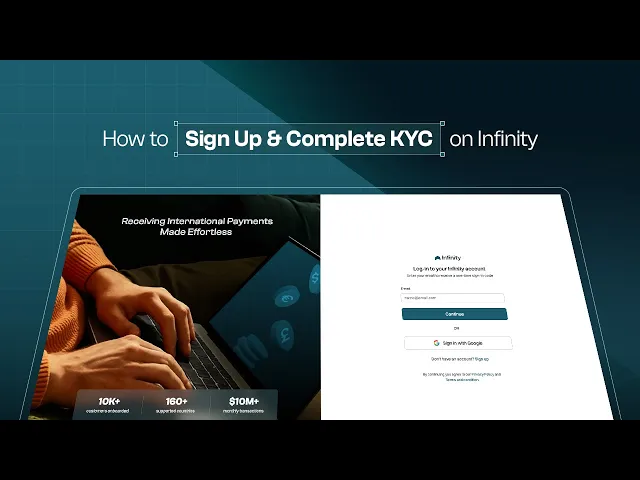
1. Sign up with Infinity through Infinity’s Dashboard
Create your account with Infinity. It takes about 2 minutes.
2. Complete verification by completing KYC
Finish KYC by providing your basic business documents. This is usually completed the same day.
3. Get your virtual bank account details
Infinity provides you with virtual bank account details. This helps you receive international payments in up to 50+ currencies.
4. Share them with your clients
Update your invoices and send your clients the bank account details provided by Infinity.
5. Receive your International payment
Infinity lets your clients make payments as if they are making a domestic transfer. Your payment then reaches your Infinity account and is credited to your local bank account in 1 business day.
6. Wind down your old platform
Keep your old account until all pending payments have landed, then close it if you no longer need it.
How does Infinity help receive international payments?
Infinity helps Indian freelancers, exporters, agencies and SaaS businesses receive international payments at a flat, all-inclusive cost. Here is what that looks like in practice.
0.5% all-inclusive fee. There is no separate FX markup and no additional GST.
24-hour settlement. Money reaches your Indian bank account in about a day.
Free FIRA. It is generated automatically for you.
Hold your currencies. You can hold your money in all the currencies and convert whenever you choose.
Wide coverage. Infinity supports 50+ currencies and 160+ countries.
Dedicated account manager. You have a personal contact to help when you need it.
Mobile app. Track and manage payments from your phone.
Trusted by 10,000+ users. Infinity is an AD-1 certified, RBI-regulated platform.
FAQs
1.What are the best alternatives to Infinity for receiving international payments in India?
The best alternatives are PayPal, Wise and Payoneer for business payments, and Revolut for personal remittances. Choose based on how you get paid, your total cost after conversion, and whether you get FIRA.
2.Is PayPal or Wise better for Indian freelancers?
Wise usually costs less to receive, while PayPal is easier when a client insists on it. PayPal charges 4.40% plus a fixed fee and a conversion markup. Wise charges a conversion fee but cannot hold foreign currency in India.
3.Is Payoneer a good alternative to Infinity?
Payoneer is a good alternative if your marketplace pays through it. Watch the 1% to 4% conversion fee on INR withdrawals and the annual fee for low-volume accounts.
4.Can I use Revolut to receive client payments in India?
No, Revolut is not built for receiving client payments in India right now. Revolut Business is not open to Indian companies, and the India rollout is focused on personal use.
5.Which platform has the lowest fees for receiving international payments in India?
Compare the total cost, not the headline fee. Infinity charges 0.5% all-inclusive with no separate FX markup or GST. PayPal charges 4.40% plus a fixed fee and a conversion fee. Wise and Payoneer charge conversion fees that vary.
6.Do PayPal, Wise and Payoneer give FIRA?
Yes, all three provide it, but the cost and timing differ. Payoneer delivers FIRA free of charge, Wise charges a small fee, and PayPal offers digital FIRA. Infinity generates FIRA free and automatically.
7.How long does it take to receive international payments in India?
Settlement time depends on the platform and your bank. Infinity settles in about 24 hours. Check each platform's current timelines before you choose.
8.Can I switch from Payoneer or PayPal to Infinity?
Yes, you can switch in a few steps. Sign up, complete KYC, share your new bank details with clients, and keep your old account until pending payments land.
Related reads


