

Global payments


Subscribe to our newsletter
Get the latest updates, insights, and tips delivered straight to your inbox.
Payoneer is a cross-border payments platform founded in 2005. It helps businesses and individuals send and receive international payments, whether you are paying partners, freelancers, or affiliates. It is available in 200+ countries and offers payout options like bank transfers, local wallets, prepaid Payoneer Mastercard cards, and mobile payments.
For businesses, Payoneer is designed to make bulk payouts easier. Companies can pay multiple contractors, suppliers, vendors, and freelancers in one go across 200+ countries and regions.
Our Verdict: Is Payoneer Worth It in India?
Rating: 3.5 / 5
Payoneer has been serving the Indian freelancer community for over a decade. It is widely accepted for receiving payments from international marketplaces like Upwork, Fiverr, Amazon, and Airbnb. However, in 2026, stronger alternatives have emerged for those users who prioritise FX transparency, lower fees, and faster customer support.
Payoneer is best for:
Indian freelancers receiving international payments from marketplaces like Fiverr, Upwork, etc.
Indian sellers who are registered on marketplaces like Amazon, eBay, Walmart, etc.
Payoneer is not ideal for:
Indian professionals who receive international payments but prioritise FX markup and transaction fees. As Payoneer charges up to 2% FX markup, this increases the cost of receiving global payments.
Whereas Infinity only charges 0.5% with 0 FX Markup, which makes it the best option in the segment.
Indian users who rely heavily on customer support. Customer support quality is a persistent complaint among Indian users.
Payoneer is not ideal for small freelancers who receive low-value payments frequently. This is because Payoneer has withdrawal fees, and minimum thresholds can eat into small amounts.
How We Have Reviewed Payoneer for Indian Users
We have evaluated Payoneer for Indian freelancers, agency owners and business owners who receive international payments. Here is what we have reviewed:
Account Setup Experience: It is easy to create and verify a Payoneer account from India. This includes getting the KYC done, verification timelines, and onboarding clarity.
Receiving International Client Payments: We have tested how Payoneer handles incoming international payments. This includes bank transfers, Payoneer-to-Payoneer transfers, and third-party payment requests.
Withdrawal to Indian Bank Accounts: We have evaluated Payoneer’s full withdrawal journey. This starts from initiating a transfer to seeing INR getting credited in an Indian savings or current account.
FX Transparency: We did compare Payoneer's published conversion rates versus the mid-market rate on the same day. This helped in evaluating how the platform discloses what rate you will actually receive before you confirm a transaction.
Support Experience: We have reviewed publicly available support feedback from Indian users on forums, including Reddit (r/India, r/freelance), Trustpilot and others. We even checked from our end how the support system works.
Marketplace Compatibility: We have verified Payoneer's integration with major freelance platforms (Upwork, Fiverr, Toptal), e-commerce marketplaces (Amazon Global Selling, Etsy, Wish).
Key Features and Benefits of Payoneer for Indian Freelancers and Businesses
Payoneer helps users send and receive international payments and also provides tools like prepaid debit cards, a mobile app, and multi-currency support. Here are some of its key features:
1. Send and receive payments
With Payoneer, you can receive money into your Payoneer account quickly, often at no cost. When you withdraw funds to a bank account, it typically takes about 24 hours to process. For businesses, Payoneer also supports bulk payouts, allowing up to 200 payments in a single batch.
For freelancers and marketplace sellers on platforms like Fiverr, Upwork, Amazon, and Airbnb, Payoneer makes getting paid easier. You can send a payment request to clients, and they can pay in the currency they prefer.
Clients can pay you using the following:
Credit card
Local bank transfer
Payoneer account
PayPal is a well-known global payment platform used by individuals and businesses. It’s simple to set up, widely accepted, and handy for cross-border transfers. You can access your money quickly, hold balances in multiple currencies, and spend online from your PayPal account.
With Payoneer, you can also track the status of your payments directly from your dashboard.
2. Support for multiple currencies
Payoneer supports multiple currencies, and each currency has its own receiving details to help you collect payments.
• USD payments: Routing number and account number
• GBP payments: Account number, IBAN, and sort code
• EUR payments: IBAN and SWIFT/BIC
• AUD payments: Account number and BSB code.
• CAD payments:Transit number, institution number, and account number
• SGD payments: Bank name, bank code, and account number
• JPY payments: Bank code, branch code, and account number
• HKD payments: Account number and routing number
• AED payments: Bank name and IBAN
3. Payoneer prepaid Mastercard
With a Payoneer account, you can get a Payoneer Commercial Mastercard to spend on international business expenses. The Payoneer card comes with features like:
• Fee-free purchases: You can use the card to make purchases in CAD, USD, EUR, and GBP without extra purchase fees.
• Spending limit: There’s no monthly cap, and the daily spending limit can go up to USD 200,000.
• Wide acceptance: The card works anywhere Mastercard is accepted, which makes it usable across most countries and merchants.
The Payoneer Commercial Mastercard is currently not issued to residents of India due to local regulatory restrictions. So while these card features exist globally, Indian Payoneer users can’t rely on this card for spending or ATM withdrawals.
4. Mobile app
Payoneer also has a mobile app that lets users withdraw funds to bank accounts in 150+ countries. You can track balances and payment statuses, send or request payments, and manage your card settings and card balances from the app.
Common Payoneer Complaints from Indian and Global Users
After reading the feedback landscape from Trustpilot, Reddit and other platforms, here are certain common complaints from Payoneer users.
Account verification delays: This is a common problem for new Indian accounts. KYC can take anywhere from 5 to 15 business days, and rejections often come with little explanation. This means that you may need to resubmit and wait all over again. If you have a client ready to pay you this week, this can be a real blocker.
Customer support is slow: This is Payoneer's most consistent complaint globally, and Indian users face it more due to the time zone gap. What we found out is that email responses take 2–5 business days, live agents' wait time is around 30-60 minutes, and chat often escalates to email with no follow-through.

Source: Reddit
FX costs aren't shown clearly upfront: Most users discover the true cost of conversion only after the INR lands in their bank account. Payoneer embeds its 1.5–2% markup in the displayed exchange rate without showing you the mid-market rate for comparison. This has pushed many experienced Indian freelancers toward other platforms like Infinity.
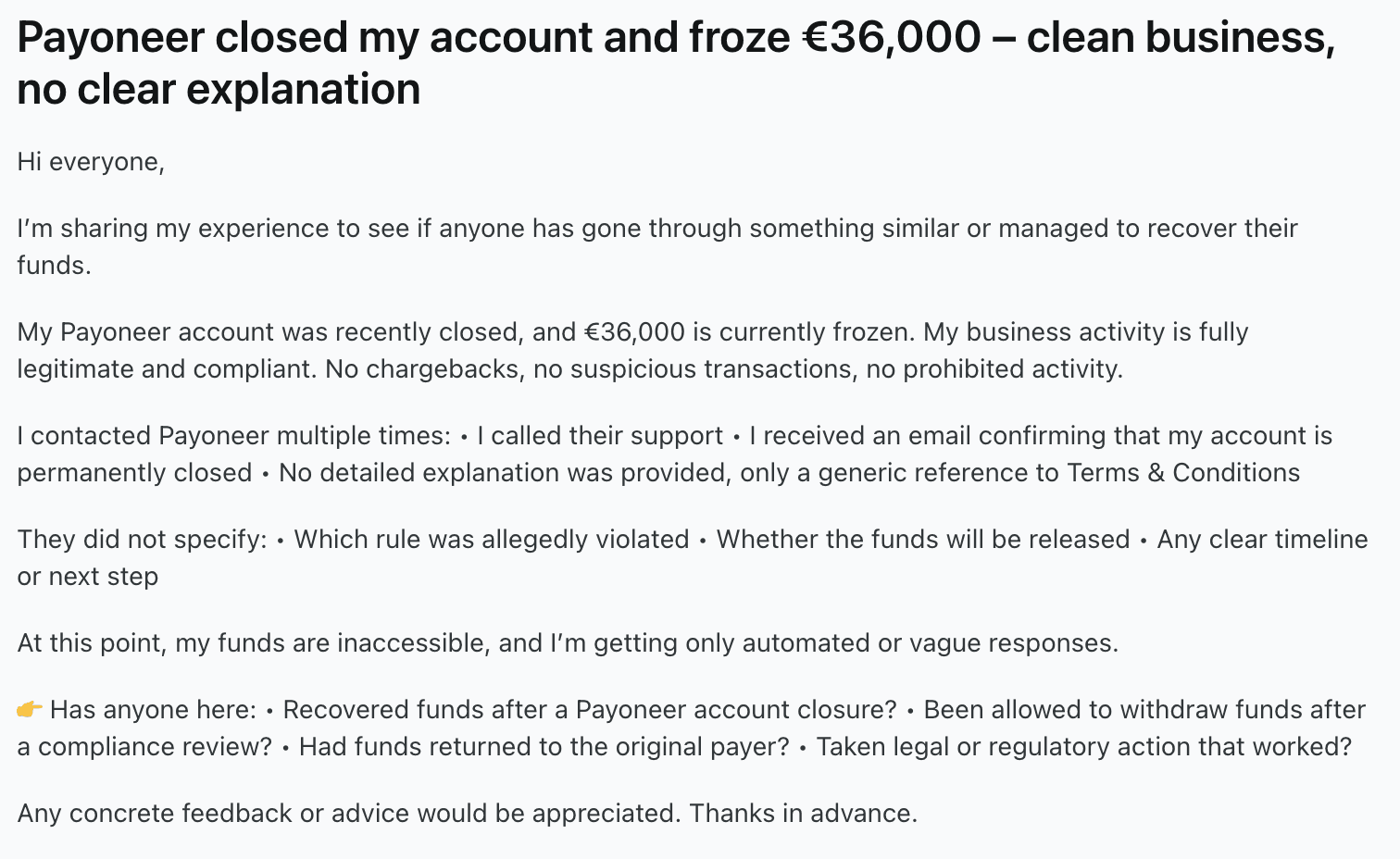
Account holds can freeze your money with little warning: Payoneer's fraud-detection system usually flags unusual activities. For example, large first invoice payments, multiple new clients, or metadata mismatch may place your funds under review.
Source:Reddit

How Payoneer Works in India: From Client Payment to Bank Credit
Creating a Payoneer account is free. Here’s how you can sign up:
Visit the Payoneer sign-up page.
Choose Individual if you’re a solo professional or don’t have a registered business, or Company if you do.
Fill in your basic information and email address, then continue.
Add your address, contact details, and bank account information as prompted; in some cases, Payoneer may also ask for ID documents for verification.
If any additional verification is needed, Payoneer will reach out with the required details.
Payoneer Fees in India
You can check Payoneer’s latest pricing on their website or in the app after you create an account. Below is a simple breakdown of the fees Indian users may see, based on how they receive money and withdraw it to India.
1.Receiving payments from other Payoneer accounts
You don’t pay any fee when you receive money from another Payoneer account. You can accept payments in USD, EUR, GBP, and other supported currencies at no extra cost.
2.Receiving payments from Non-Payoneer accounts
If your client pays you from outside Payoneer, these charges may apply:
Payment type | Fee |
Payments from another Payoneer customer | Free |
Payment request – Credit card | 3% |
Payment request – ACH bank debit (US only) | 1% |
Payment request – PayPal (US only) | 3.99% + $0.49 |
Marketplace payouts (Fiverr, Upwork, Airbnb, etc.) | Depends on the marketplace |
Via USD, EUR, or GBP receiving account | Usually free to receive |
If you’re getting paid through a marketplace, the fees are usually set by the platform itself. It’s best to review that marketplace’s payout terms for the exact charges.
3.Withdrawing funds to your Indian bank account
When you transfer money from Payoneer to your Indian bank account, withdrawal and currency conversion charges may apply.
Withdrawal type | Fee |
Foreign currency to INR | Typically 1% to 4% + currency conversion margin |
The conversion cost is often included in the exchange rate you get, so the rate may be marked up compared to the mid-market rate (the rate you see on Google). Your Indian bank may also add separate inward remittance or processing charges.
There’s also a conversion cost when money is converted between currencies, including when you withdraw to your Indian bank account in INR.
This is built into the exchange rate, so that each EUR or USD may be converted at a marked-up rate.
To reduce conversion losses, pick services that use the mid-market exchange rate (the rate you usually see on Google). Infinity keeps pricing transparent so you can see exactly what you’ll receive without hidden exchange rate markups.
4. Other fees
Some extra charges can apply in certain cases:
Fee type | Fee |
Moving money between Payoneer currency balances | 0.5% + currency conversion margin |
Account inactive for 12 months | $29.95 |
For the most accurate and up-to-date charges, check Payoneer’s fee page or review the fee preview in your account before you confirm the transaction.
Example: How Much INR Do You Actually Receive on a $1,000 Payment?
Let us walk through a real-world example. Suppose your US client sends you USD $1,000 via Payoneer.
Step | Amount | Notes |
Amount sent by client | USD 1,000.00 | Client sends in USD |
Payoneer receiving fee (client-to-Payoneer) | USD 0 | Payoneer-to-Payoneer transfers are free; third-party card payments may charge 3% |
Payoneer annual fee (if applicable) | ~USD 2.92/month | USD 29.95/year account fee (waived if you receive over USD 2,000/year) |
FX markup on USD→INR conversion | ~2% above mid-market | Approx. USD 20 lost on conversion |
Effective USD available for withdrawal | ~USD 980 | After FX cost |
Approximate INR at Payoneer rate (₹83 mid-market, Payoneer effective rate ~₹81.35) | ₹79,723 | Based on mid-market rate of ₹83/USD minus ~2% markup |
Withdrawal fee to Indian bank account | USD 1.50 or equivalent | Flat fee per withdrawal |
Approximate final INR credited | ~₹79,600 | After all costs |
Mid-market rate comparison: At ₹83/USD, USD 1,000 should give you ₹83,000. With Payoneer, you will receive approximately ₹79,600. This means you will lose roughly around ₹3,400 (about 4.1%) to fees and FX markup combined.
Pros and Cons of Payoneer in India
Payoneer can work well for Indian freelancers and small businesses, especially when you’re getting paid by overseas clients or through global marketplaces. That said, it isn’t a perfect fit for everyone. Here’s a clear look at what it does well and where users often face issues.
Pros
Global reach: You can get paid by clients in over 190 countries, which is ideal if you work with international customers or on global platforms.
Multi-Currency flexibility: You can hold multiple currencies and use local receiving details (like a US routing number or an EU IBAN), so clients can pay you in their preferred currency.
Strong marketplace integration: Payoneer integrates seamlessly with platforms like Upwork, Fiverr, Amazon, Airbnb, Shopify, and others, allowing payouts to flow straight into your Payoneer account with minimal setup.
Regulated and secure: Payoneer operates under regulations in multiple jurisdictions and follows compliance requirements, which helps build trust for cross-border payments.
Useful add-ons for businesses: Tools like the mobile app, mass payouts, and compliance documents such as FIRA can be useful if you handle frequent international payments.
Cons
Fees can add up: Certain payment methods can be expensive,especially card payments and currency conversion, where the cost is often baked into the exchange rate you receive.
Not ideal for small payments: For smaller amounts, fixed charges and FX margins can take a noticeable cut from your earnings.
Not ideal for small payments: On smaller transfers, fixed charges and FX margins can take a noticeable cut from your earnings.
Region-based limitations: Some features, like the Payoneer card, may not be available or may be limited depending on your location and account type.
Not a full payment gateway: Payoneer isn’t a website checkout or payment gateway tool, so it’s not built to accept payments like a typical card payment processor.
Limited advanced payment workflows: It can work well for freelancers and SMBs, but bigger businesses may find it limited for complex finance operations and large-scale payment automation.
Built more for payouts than collections: Payoneer works best for marketplace payouts, receiving-account transfers, and invoice-based business payments, not for broad consumer-style payment acceptance.
4 Best Payoneer Alternatives in India for International Payments
Infinity- Best alternative to Payoneer in India
Infinity is a cross-border payment platform tailored for Indian freelancers, agencies, exporters, and startup founders.
It lets you receive international payments into a multi-currency account (supporting 50+ currencies), without the high fees and FX markups you’d typically face with PayPal, enabling you to collect global funds at a much lower overall cost.
Low, transparent fees
Infinity uses a simple flat fee of 0.5% (all-inclusive), so you always know what you’re being charged.No FX markup, live exchange rates
Infinity doesn’t add any extra FX markup; the money you receive is converted at live exchange rates, so you’re not losing out to hidden spreads.Faster settlement to your Indian bank
Payments received through Infinity are typically credited to your Indian bank account within 24 hours.Built-in FIRA and compliance support
For users in India, Infinity automatically issues a FIRA (Foreign Inward Remittance Advice) after every successful transaction, making it easier to stay compliant with regulations and keep the required documents ready for tax and banking purposes.
If you’re an Indian freelancer, agency owner, exporter, or founder,Infinity is built for you.
It combines low, transparent fees with RBI and FEMA compliance, automatic FIRA, and a smooth payout experience without restrictive limits on transfers or withdrawals.
PayPal
PayPal is a well-known global payment platform used by individuals and businesses around the world. It’s simple to set up, widely accepted, and handy for sending and receiving international payments. You can usually access your funds quickly, hold money in different currencies, and pay online directly from your PayPal balance.
However, PayPal doesn’t provide local receiving details in multiple currencies (such as a US routing number or an EU IBAN) the way some other services do. That means international payments often end up costing more in currency conversion.
For business accounts, especially, the combination of higher receiving fees, fixed charges, and FX markups can make it quite expensive.
This becomes the reason for many freelancers and businesses to not rely only on PayPal.
PayPal for its wide acceptance and simplicity, and combine it with alternatives like Payoneer or other services when they want lower fees on larger transfers or need local receiving details in specific currencies.
Wise
Wise (formerly TransferWise) is built to make international transfers low-cost and straightforward. You can hold money in multiple currencies and get local bank details in regions like the UK, US, and EU, so overseas clients can pay you like a local, which is useful if you work with clients in different countries.
Wise does have some limitations. It doesn’t connect with as many freelance marketplaces as Payoneer, so if a lot of your income comes from direct payouts on platforms like Fiverr, Upwork, or Amazon, Payoneer is often the more suitable choice.
So, Wise tends to work best when your top priorities are strong exchange rates and low FX costs.
Payoneer often makes more sense when you need seamless marketplace payouts and broader platform coverage.
Bank transfers and other alternatives
Some businesses still rely on traditional bank transfers (such as SWIFT wires or bank remittance services) to receive payments internationally.
These channels are familiar and reliable, but they often come with higher fees, slower processing times, and less visibility than modern fintech solutions.
On top of that, charges can be deducted at multiple points by the sending bank, intermediary banks, and your bank in India, which pushes up the overall cost.
In the end, the right option depends on your priorities, whether that’s lower cost, faster transfers, specific countries or currencies, preferred payout methods, or smooth integration with your existing tools and processes.
Conclusion
Payoneer can be a handy way for Indian freelancers and businesses to get paid from abroad.
But between FX markups, fees, and feature gaps, it’s important to know exactly what you’re giving up in charges and convenience.
If you’d rather keep more of your earnings with live FX rates, lower fees, and clean RBI's FEMA-friendly documentation, a focused India-first solution can be a better fit.
If that sounds like what you need, try out Infinity and see how much more you can keep from every international payment.
Sign Up Today !
Frequently asked questions
1.Is Payoneer approved by RBI?
Yes. Payoneer India has in-principle RBI approval as a Payment Aggregator – Cross Border (PA-CB).
2.Does Payoneer have a monthly fee?
No, Payoneer doesn’t charge a fixed monthly account fee, but you may pay other charges like transaction fees, card fees, or an inactivity fee if your account isn’t used for a long time.
3. Can I withdraw money from Payoneer in India?
Yes. You can receive payments into your Payoneer account and then withdraw the money in INR to your linked Indian bank account.


