

Discover infinity


Subscribe to our newsletter
Get the latest updates, insights, and tips delivered straight to your inbox.
A few months ago, a friend who runs a small design studio in Pune called me in a mild panic. A client in London had agreed to pay her invoice, and she wanted to set up Stripe so the client could pay by card. She went to the Stripe website, looked for the sign-up button, and found a message saying Indian businesses now need an invite. Two weeks later she was still waiting. Meanwhile, the invoice sat unpaid and her team's salaries were due.
Her story is common, and it raises a fair question: Infinity vs Stripe, which fits Indian businesses better for global payments? The short answer is that they do different jobs. Stripe is a card checkout tool that is invite-only in India. Infinity is built to receive international payments by bank transfer and card transfer, with simple sign-up and RBI-compliant paperwork. If you collect client payments and invoices from abroad, Infinity usually fits better. If you need a card checkout on your own website or app, Stripe can make sense, once you have an invite.
This guide compares both fairly. It covers availability, how each one works, fees, settlement, compliance paperwork like FIRA and purpose codes, and which one suits which situation.
TL;DR
Which fits Indian businesses better, Infinity or Stripe? - They solve different problems. Infinity fits businesses that receive client payments and invoices from abroad by bank transfer. Stripe fits businesses that need card checkout, and only if they have secured an invite.
Is Stripe available in India? - Stripe is currently invite-only in India. New businesses cannot sign up on the website and must request an invite from Stripe.
How do the fees compare? - Stripe charges 2% to 4.3% depending on the card, plus a 2% fee when currency conversion is needed, and GST is charged on top. Infinity charges 0.5% all-inclusive, with no separate FX markup or GST.
How fast do you get paid? - Stripe settles card payments to your Indian bank account in INR after 3-4 business days. Infinity settles in 24 hours.
Which is simpler on compliance? - Infinity generates a free FIRA automatically. Stripe does not give an automatic FIRA, but it sends a payment advice that you can take to your bank to request a FIRC.
Infinity vs Stripe at a Glance
Quick answer: Stripe collects card payments from your customers. Infinity helps you receive international payments through bank transfer and card payments too (through Quicklinks). If your clients pay invoices, Infinity matches how they already pay. If your customers pay at an online checkout, Stripe matches that flow.
Point | Stripe | Infinity |
Type of product | Card payment gateway | International payments platform for receiving money |
How customers pay | Cards at checkout | Bank transfer to your account details |
Access in India | Invite-only for new accounts | Sign up in about 2 minutes |
Who can use it | Companies, LLPs and sole proprietorships (not individuals for international payments) | Freelancers, exporters, agencies, SaaS businesses and startup founders |
Fees | 2% to 4.3% by card type, plus 2% when conversion is needed, plus GST | 0.5% all-inclusive, no separate FX markup or GST |
Settlement | A few business days, paid out in INR | 24 hours |
Currencies and countries | 135+ currencies | 50+ currencies and 160+ countries |
FIRA | No automatic FIRA, payment advice sent instead | Free FIRA, auto-generated |
Support | Dashboard and email | Dedicated personal account manager |
Read more: How to Receive International Payments in India as a Startup Founder
Is Stripe Available in India? (Invite-Only Explained)
Yes, but only on an invite basis. Stripe has been invite-only in India since May 2024. New Indian businesses cannot sign up through the website and must request an invite from Stripe's sales team. Stripe has said it is supporting only a select number of businesses, with a focus on international expansion.
What does invite-only mean for you?
It means you cannot just create an account and start collecting payments the same day. You need to send a request, wait for Stripe to review it, and be approved. Accounts that were already active in India continue to work. If you were on an old waitlist and your account was never activated, Stripe has said it is unable to activate it for now.
Who can use Stripe in India?
Stripe's own help pages set out these conditions:
Your business must be registered as a company, LLP or sole proprietorship.
Individuals cannot accept international payments on Stripe in India.
Simple partnerships are not supported.
For goods exports, you need a valid Import Export Code (IEC). For services, the IEC is optional, but you still need one to accept American Express payments from international customers.
Your account can have only one transaction purpose code.
So if you are a freelancer without a registered business, Stripe may not be an option at all, even with an invite.
How do you request a Stripe invite in India?
You contact Stripe's sales team through the request form on its website and share details about your business. Expect to provide identification numbers, a website or app link, a description of what you sell and your bank details. Approval is at Stripe's discretion, so plan for delays if you have an urgent invoice.
For a deeper look, read our complete guide to Stripe in India: features, charges and usage.
What Is Stripe, and How Does It Work for Indian Businesses?
Stripe is a payment gateway that lets a business accept card payments online. In India, it is mainly used by exporters, SaaS companies and digital service businesses that sell to customers abroad.
How does Stripe collect international payments?
Your customer pays by card at your checkout or through a payment link. Stripe converts the amount to INR if needed and pays out to your Indian bank account in INR. Stripe supports presentment in more than 135 currencies, which means your customer can see the price in their own currency.
What are Stripe's strengths?
Stripe has strong developer tools, a clean checkout experience and good subscription billing, which suits SaaS businesses. If your customers pay by card, such as small online purchases or monthly subscriptions, Stripe's flow is smooth.
What should Indian businesses watch out for?
Access depends on getting an invite.
International payments are built around cards, so a client who wants to pay your invoice by bank transfer is not served by the same flow.
Fees stack up when a foreign card and currency conversion are involved, and GST applies on top.
Export payments need extra data. Stripe requires merchants in India to pass the customer's name, billing address and an order description for regulatory reporting.
If you want to see how Stripe compares with other options, our Stripe review for Indian businesses goes through it in detail.
What Is Infinity, and How Does It Work?
Infinity is an RBI-regulated, AD-1 certified platform that helps Indian freelancers, exporters, agencies and SaaS businesses receive international payments. Infinity makes the process of receiving international payments seamless and faster than any other platform.
How does Infinity work?
Once you sign up and complete your KYC with Infinity, you get virtual bank details in multiple currencies. You can use these details to receive payment in multiple currencies. You share them with your client, the client pays by bank transfer, and the money reaches your Indian account in INR. There is no card checkout involved, so your client pays the way most businesses already pay invoices. The amount is settled and credited to your account within 24 hours.
If your customer wants to pay by card, then Infinity provides you a payment link, known as Quicklink, which you can send to your clients.
How do you get started with Infinity?
Sign up in about 2 minutes.
Complete verification and KYC, which is done the same day.
Receive your bank details in multiple currencies.
Start receiving international payments.
What does Infinity cost?
Infinity charges 0.5%, all-inclusive. There is no separate FX markup and no additional GST. The FIRA is free.

Infinity vs Stripe: Head-to-Head
This section compares both on the five points that matter most to an Indian business: how you get paid, fees, speed, compliance and support.
1. How you get paid
Stripe collects card payments, and Infinity collects bank transfers. That is the biggest difference, and it decides who each one suits.
With Stripe, your customer enters card details and pays. This works well for online shops, subscriptions and quick purchases. With Infinity, your client sends money from their bank to the account details you share. This works well for invoices, retainers, project payments and export receipts.
Many businesses see both types of payments, which is why some use both tools.
2. Fees and pricing structure
Stripe's fee depends on the card type, and a currency conversion fee and GST are added on top. Infinity charges a flat 0.5% that includes everything.
Here is Stripe's fee structure for India as published:
Type of card | Stripe fee |
Mastercard issued in India | 2% |
Visa issued in India | 2% |
American Express issued in India | 3.5% |
Mastercard or Visa from outside India | 3% |
American Express from outside India | 3.5% |
Other international cards | 4.3% |
If a currency conversion is required on a transaction, Stripe adds a 2% fee. GST is charged on Stripe's fees.
To see how that stacks up, take a customer paying with a Visa or Mastercard issued outside India. The card fee is 3%. If the payment needs currency conversion, add 2%. That is 5% before GST. For other international cards, the base fee is 4.3%, and with conversion it is 6.3% before GST.
Infinity's fee is 0.5% all-inclusive, with no separate FX markup and no extra GST.
Fee point | Stripe | Infinity |
Base fee | 2% to 4.3% by card type | 0.5% all-inclusive |
Currency conversion | 2% when conversion is needed | No separate FX markup |
GST | 18% Charged on fees | No additional GST |
FIRA | Not generated automatically | Free |
3. Settlement speed
Infinity settles in 24 hours. Stripe settles your payments in 3-4 days to your Indian bank account in INR.
For a business that runs on tight cash flow, the gap matters. Waiting several days for card payouts is workable for steady online sales, but it can feel slow when you are waiting on a large client invoice to pay salaries or vendors.
4. FIRA, purpose codes and RBI compliance
Infinity generates a free FIRA automatically. Stripe does not give an automatic FIRA, but it sends a payment advice that you can use to request a FIRC from your bank.
Here is what each term means in simple words:
FIRA (Foreign Inward Remittance Advice): a document that proves you received money from abroad.
FIRC (Foreign Inward Remittance Certificate): a similar certificate issued by your bank.
Purpose code: an RBI code that tells the bank why the money was sent, such as software services.
On Stripe, Indian users get a payment advice from Standard Chartered Bank by email on the day the export payout is processed. You take this advice to your bank to obtain a FIRC. So the paperwork is possible, but it is a manual step.
Stripe also lets an account carry only one transaction purpose code. It evaluates the code you pick against your business, and says it cannot advise you on the right code. If you offer more than one kind of service, that single code can become a limit.
On Infinity, the FIRA is generated automatically and is free. Infinity also has a purpose code finder tool, which helps you pick the correct purpose code for your payment.
Why does this matter? Exporters often need proof of receipt for GST refunds, export incentives and records. Having it ready without chasing the bank saves time.
5. Support and onboarding
Infinity gives you a dedicated personal account manager. Stripe's help runs mainly through its dashboard and email.
On onboarding, Infinity takes about 2 minutes to sign up, with KYC completed the same day. Stripe requires an invite first, then identification details, a website or app link, a business description and bank details.
When Does Stripe Make More Sense, and When Does Infinity?
This decision is based on how your customers pay you:
1.Stripe may fit better if:
You run a website or app where customers pay by card at checkout.
You sell subscriptions and need built-in recurring billing.
You are a registered company, LLP or sole proprietorship and have secured an invite.
Your developers want to build a custom checkout.
2. Infinity may fit better if:
You bill clients abroad by invoice, and they pay by bank transfer.
You are a freelancer, agency, exporter or startup founder who wants simple sign-up without waiting for an invite.
You want a flat 0.5% all-inclusive fee with no separate FX markup or GST.
You want a free FIRA without manual follow-ups.
You want settlement in 24 hours.
3. Can you use both?
Yes. A SaaS company might use Stripe for card subscriptions from customers and Infinity for larger client contracts paid by bank transfer. The two do not compete for the same payment flow.
If you are comparing more options, see our guide to the best alternatives to Stripe for global payments in India. If PayPal is also on your list, read our Stripe vs PayPal comparison.
How to get started with Stripe in India
Follow the following ways to get started with Stripe in India:
Request an invite through Stripe's sales contact form.
Keep your business registration details, identification numbers, website or app link and bank details ready.
Get your IEC if you export goods, or if you want to accept American Express payments.
Select your transaction purpose code during onboarding.
Complete KYC and integrate checkout, passing the customer details Stripe needs for export reporting.
How to get started with Infinity
Follow the following ways to get started with Infinity in India:
Sign up on the Infinity website or mobile app in about 2 minutes.
Complete verification and KYC, which is done the same day.
Receive bank details in multiple currencies.
Share the details with your client and start receiving payments.
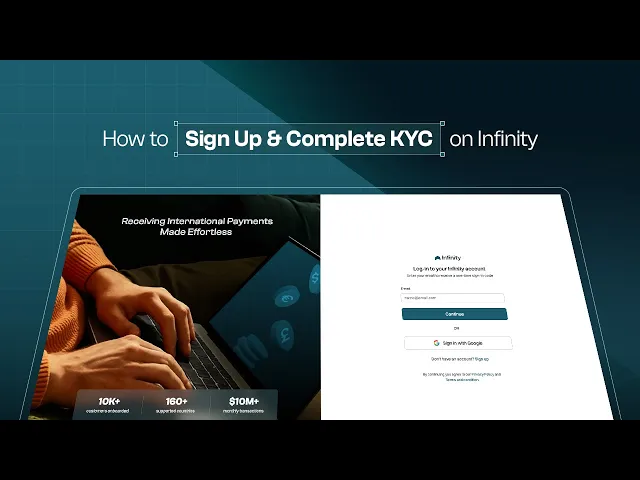
You can also refer to this video on Infinity's Youtube channel:
How Does Infinity Help Receive International Payments?
Infinity is built for Indian businesses that get paid from abroad. It supports 50+ currencies and 160+ countries, and it charges 0.5% all-inclusive with no additional GST. Settlement takes 24 hours, and a free FIRA is generated automatically. You also get a dedicated personal account manager and a dedicated mobile app to track your payments.
It is RBI-regulated and AD-1 certified, and more than 10,000 users have already onboarded. If you want to start receiving international payments without waiting for an invite, you can sign up with Infinity in about 2 minutes.
Conclusion
Stripe and Infinity are different tools for different jobs. Stripe is a strong card checkout tool, but it is currently invite-only in India, charges fees that depend on card type plus conversion and GST, and does not give an automatic FIRA. Infinity is built to receive international payments by bank transfer, with simple sign-up, a flat 0.5% all-inclusive fee, 24-hour settlement and a free FIRA.
If your business bills clients abroad, Infinity is likely the better fit. If you need card checkout and can get an invite, Stripe is worth considering, and some businesses will use both.
FAQs on Stripe vs Infinity for International Payments
Infinity vs Stripe: Which Fits Indian Businesses Better for Global Payments?
Infinity fits better if you receive client payments and invoices from abroad by bank transfer. Stripe fits better if you need card checkout on a website or app and have an invite. They are built for different payment flows, so some businesses use both.
Is Stripe available in India?
Yes, but only by invite. Indian businesses cannot sign up for a new Stripe account on the website and must request an invite from Stripe.
Is Stripe invite-only in India?
Yes. Stripe moved to invite-only in India in May 2024. Active accounts continue to work, and new businesses need to request an invite.
How much does Stripe charge in India for international payments?
Stripe charges 3% for Visa or Mastercard issued outside India, 3.5% for American Express and 4.3% for other international cards. A 2% fee is added when currency conversion is needed, and GST is charged on top.
Does Stripe charge GST in India?
Yes. GST is charged on Stripe's fees in India. Infinity charges no additional GST on its 0.5% all-inclusive fee.
Does Stripe give an automatic FIRA?
No. Stripe does not generate a FIRA automatically. It sends a payment advice from Standard Chartered Bank, which you can take to your bank to request a FIRC. Infinity generates a free FIRA automatically.
Does Stripe India need an IEC?
For goods exports, yes. For services, an IEC is optional, but you still need one to accept American Express payments from international customers.
Can freelancers use Stripe in India?
Only if they are registered as a company, LLP or sole proprietorship. Individuals cannot accept international payments on Stripe in India, and new accounts are invite-only.
How do I get a Stripe account in India?
Request an invite through Stripe's sales contact form, then share your business details, identification numbers, a website or app link and bank details for review.
Is Infinity cheaper than Stripe?
For international payments, Infinity's 0.5% all-inclusive fee is lower than Stripe's 3% to 4.3% card fee plus a 2% conversion fee and GST. The right choice still depends on how your customers pay you.
Can I use Infinity and Stripe together?
Yes. Many businesses use Stripe for card checkout and Infinity for client payments received by bank transfer.


