

Global payments


Subscribe to our newsletter
Get the latest updates, insights, and tips delivered straight to your inbox.
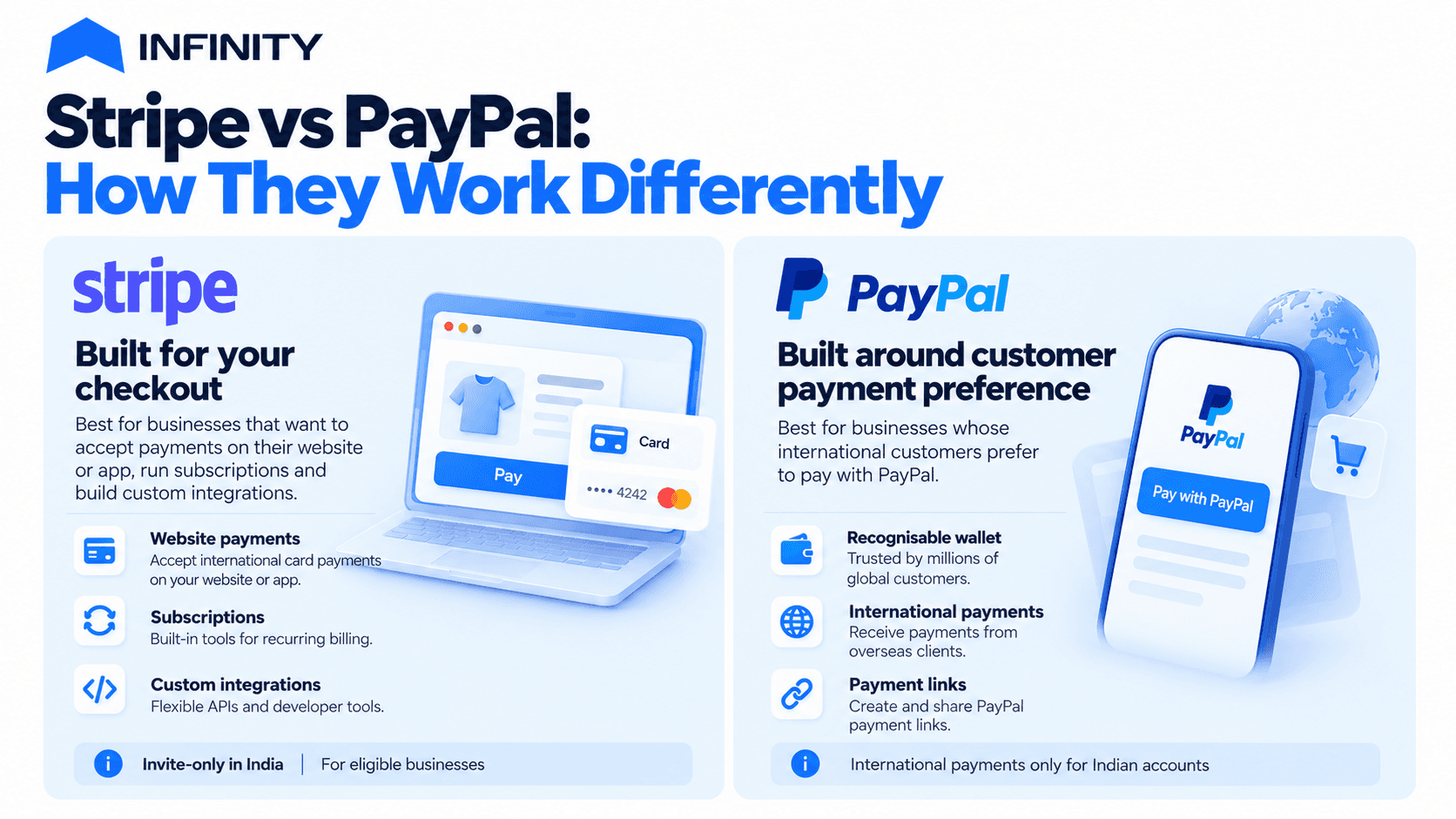
Stripe vs PayPal comes down to how you take payments. Stripe works best if you're accepting payments on your own website or app, running subscriptions, or building a custom checkout. In India, check whether your account will be approved before you plan around it. PayPal makes sense if your international customers specifically want to pay with PayPal. If you mostly bill overseas clients by invoice, look at how each platform handles foreign currency, what it charges to convert, and what payment paperwork you get afterwards, before you settle the Stripe vs PayPal question.
The right choice depends on more than the advertised transaction fee. You also need to compare currency conversion, settlement time, export documentation, and how much reaches your Indian bank account.
In this guide, we compare Stripe and PayPal on these factors, explain their fees with examples, and help freelancers, agencies, exporters, and online businesses choose the right payment setup.
TL;DR
Stripe: Best for eligible Indian businesses that need website payments, subscriptions, and custom integrations.
PayPal: Best for businesses whose international customers prefer PayPal. Indian accounts cannot receive domestic payments.
Compare total costs: Check processing fees, currency conversion charges, and applicable taxes before choosing.
Check export requirements: Depending on the transaction, you may need FIRA and other export documents.
Consider alternatives: If you mainly receive international invoice payments, compare platforms based on fees, INR settlement, payment tracking, and remittance records.
Stripe vs PayPal: What is the Difference?
Stripe vs PayPal has no single winner. Both accept international payments, but Stripe is built for websites, apps, and recurring billing. PayPal is mostly a way for overseas customers to pay you from an account they already have. Which one suits your business depends on where your customers are and how they prefer to pay.
Feature | Stripe | PayPal |
Main use | Website checkout, payment processing and billing | Receiving international commercial payments |
Indian account access | Invite-only | Business account subject to verification |
Receive domestic payments in India | Depends on Stripe’s supported setup | No; Indian PayPal accounts cannot receive domestic payments |
International payment fees | Depends on pricing setup and card type | 4.40% + fixed fee under the published India merchant schedule |
Currency conversion | Additional fee may apply | Conversion cost is reflected in the rate when conversion occurs |
Subscriptions | Available through supported billing products | Available through supported products |
Payment links | Available | Available |
INR settlement | To an Indian bank account | To a linked Indian bank account |
Export documentation | Payment Advice under the applicable international setup | Free Weekly Digital FIRA for PayPal Business accounts |
Best fit | Businesses needing integrated payment tools | Businesses whose customers prefer PayPal |
PayPal India supports international payments, not domestic payments between Indian customers and Indian sellers. Stripe’s account access and international pricing are subject to its India-specific requirements.
How Much Do Stripe and PayPal Charge in India?
The total cost can include a processing fee, a fixed transaction fee, currency conversion, and tax on provider fees. Comparing only the processing percentage can give you the wrong answer.
Stripe Fees for International Payments
Stripe’s published India pricing lists different rates depending on the payment setup and currency presentation.
Stripe Pricing | Processing Fee | Additional Currency-Conversion Fee |
Mainly domestic: international cards charged in INR | 3% per successful international charge | The customer’s card issuer may charge a conversion fee |
Mainly international: supported foreign-currency presentment | 4.3% per successful charge | Additional 2% if required |
International American Express cards | 3.5% under the applicable international-card pricing | Additional 2% if conversion is required |
Stripe’s pricing lists 3% for non-India Visa/Mastercard, plus 2% for currency conversion. The 4.3% rate applies to its international-currency presentment setup. These are different pricing options, not fees that should automatically be added together.
Under the mainly international approach, eligible Indian businesses can accept supported foreign currencies and receive settlement in INR. Exporters using this setup must meet the relevant documentation requirements, including Purpose Codes and an IEC.
Stripe is invite-only in India. Its eligibility requirements also distinguish between individual accounts and registered business structures. Check the current requirements before applying.
PayPal Fees for International Payments
PayPal’s India merchant fee schedule lists the following charges for international commercial payments:
Transaction fee: 4.40% of the payment amount.
Fixed fee: Depends on the currency received. For USD payments, the listed fixed fee is $0.30.
Currency conversion: The conversion rate includes a markup when PayPal converts the payment into INR.
GST: Applicable taxes may add to the cost of PayPal’s services.
PayPal lists the transaction fee and fixed fee separately. The exchange rate is another important cost factor because Indian PayPal accounts receive payments in INR rather than holding an ongoing USD balance.

What Does a $100 International Payment Cost?
The following calculation assumes a reference exchange rate of ₹96.76 per USD and a $100 payment:

Item | Stripe: International Setup | PayPal: International Payment | Infinity: Receiving Service |
Gross payment | $100.00 | $100.00 | $100.00 |
Processing fee | $4.30 at 4.3% | $4.40 + $0.30 fixed fee | $0.50 at 0.5% |
Additional FX cost | $2.00 if the 2% conversion fee applies | Included in the applied conversion rate | 0% FX markup |
Net before other charges | $93.70 if the Stripe conversion fee applies | Depends on the actual conversion rate and applicable taxes | $99.50 |
Main cost to check | Pricing setup and conversion fee | Processing fee, fixed fee, FX rate and taxes | Eligibility and payment route |
How Much Could Reach Your Indian Bank Account?
On a $100 payment at a reference rate of ₹96.76 per USD, you'd receive roughly:
Provider | Fees Assumed | INR Payout |
Stripe | 4.3% processing fee, 2% conversion fee | ₹9,068 |
PayPal | 3-4% FX markup, 18% GST on the transaction fee | ₹8,750-₹8,850 |
Infinity | 0.5% transaction fee, 0% FX markup | ₹9,628 |
Note: The above figures are worked examples. Your actual payout will differ with the exchange rate on the day, your account's fee terms, and the transaction itself.
What matters most: Compare the amount that reaches your bank after every applicable charge. A provider with a lower headline processing fee may still cost more once you include currency conversion.
How Does Currency Conversion Affect Your INR Payout?
Two providers can charge the same processing fee and still pay you different amounts, because each converts dollars to rupees at its own rate. On a $100 payment, a 2% conversion fee costs you about ₹194, while a 0% markup costs nothing. The processing fee never shows that gap.

Before choosing a provider, compare:
The exchange rate applied to your payment.
The processing fee and any fixed fee.
Any additional currency-conversion charge or FX markup.
Taxes on provider fees.
Settlement and withdrawal conditions.
Stripe settles eligible Indian payments in INR. Under its mainly international approach, an additional conversion fee may apply when required.
PayPal converts international payments into INR for Indian accounts. The rate it applies affects how much you receive after the transaction fee and any applicable taxes.
For regular overseas payments, calculate your total cost using each provider's rate. Do not compare one provider’s processing fee with another provider’s all-in cost.
Is PayPal Available in India for Domestic and International Payments?
PayPal India allows eligible accounts to receive payments from international customers, but it does not allow Indian accounts to receive domestic payments from customers in India.
To receive international payments, you need to complete the required identity verification, link an Indian bank account, verify your PAN, and select a Purpose Code. Businesses exporting goods may also need a valid IEC.
This makes PayPal a potential option for freelancers and businesses serving overseas clients. It is not a solution for collecting domestic payments from Indian customers.
Which is Better for Freelancers, Agencies, SaaS Businesses and Exporters?
The best payment setup depends on how you earn and collect revenue. A business selling through a website has different needs from a freelancer receiving invoice payments from overseas clients.

Business Type | What May Fit Best | Why |
Freelancer receiving overseas client payments | PayPal or a dedicated receiving platform | Compare the client’s preferred payment method, total fees and remittance documents |
Design, marketing or software agency | Stripe for integrated checkout; a receiving platform for invoice payments | The choice depends on whether you need payment infrastructure or mainly need to receive client payments |
SaaS business | Stripe, if eligible | Checkout integration, subscriptions and recurring billing |
Exporter of goods | A receiving platform or bank-supported export payment route | Settlement, export documentation and reconciliation matter |
Online store selling internationally | Stripe or PayPal, depending on checkout needs | Customer preferences, supported payment methods and fees |
Business accepting both online checkout and invoice payments | A hybrid setup | Different payment methods can serve different customer needs |
When is Stripe the Better Choice?
Stripe is a good fit for SaaS and online businesses that need website or app payment integration, subscription management, or a custom checkout experience, provided they meet Stripe’s eligibility requirements in India.
When is PayPal the Better Choice?
PayPal may be the better fit when your international customers prefer paying through PayPal and its total fees and withdrawal process work for your business. Remember that Indian accounts cannot receive domestic payments.
When Should You Consider a Receiving Platform?
If clients pay your invoices from overseas and you mainly need to receive the money in India, a dedicated international receiving platform may be more suitable than a checkout-focused payment gateway.
For example, Infinity offers international receiving services with a 0.5% transaction fee, inclusive of GST, 0% FX markup, INR settlement, payment tracking and free FIRA with each withdrawal. It also provides payment-related records and Purpose Code support for applicable transactions. Review the service’s eligibility and payment route before choosing it.
Explore the relevant options for freelancers, agencies and exporters.
What is the Difference Between a Payment Gateway and a Receiving Platform?
A payment gateway helps a business accept payments through a website, app or checkout page. A receiving platform focuses on collecting international business payments and settling the funds into the business’s bank account.
Requirement | Payment Gateway | International Receiving Platform |
Website or app checkout | Core use | May offer payment links, but not always a full checkout integration |
Subscription billing | Often available | Depends on the provider |
Receiving invoice payments | May be supported | Core use |
Currency conversion and INR settlement | Depends on the provider | Usually a key part of the service |
Export payment records | Depends on the provider | Often a key part of the workflow |
Best for | Businesses collecting customer payments online | Businesses receiving payments from overseas clients |
Some businesses need both. For example, an online store may use a payment gateway for checkout and a separate receiving service for overseas invoices. Choose based on your actual payment flow rather than assuming one product must handle everything.
How Do Stripe and PayPal Handle Export Documentation in India?
Receiving an international payment does not automatically complete your export-compliance obligations. Your documentation requirements depend on what you export, the payment route, and the rules that apply to your transaction.
FIRA and Payment Advice
A Foreign Inward Remittance Advice (FIRA) is a remittance document that records an inward payment from overseas. Exporters and service providers may need it for their records.
PayPal now offers a free Weekly Digital FIRA that Business account holders can download from their PayPal accounts. The company announced that the service became available in February 2026.
Stripe states that eligible exporters using its international setup receive a Payment Advice with details of incoming foreign remittances. Confirm with your bank or adviser that this document meets the requirements for your specific transaction.
EDF: Export Declaration Form
EDF stands for Export Declaration Form. Exporters of goods may need to complete the applicable export declaration and provide the required information through the prescribed process. The exact procedure depends on the export and applicable regulations.
SOFTEX for Software Exports
SOFTEX is a declaration used for specified software exports, including relevant software transmitted electronically. It is not a blanket requirement for every service exporter. Check whether your software export and business category fall within the applicable SOFTEX process.
What About Other Service Exports?
Freelancers and service exporters should keep invoices, contracts or statements of work, payment records and relevant remittance documents. Depending on the service and transaction, additional declarations or records may be required.
Payment collection is not the same as export compliance. A payment platform can help you receive money and provide remittance records, but it does not automatically complete every declaration or regulatory requirement for your business. Confirm your obligations with your authorised dealer bank or a qualified adviser.
You can use the Purpose Code Finder to help identify a potentially relevant code, then confirm the correct code for your transaction with your bank or payment provider.
What Should You Check About Settlement Time and Payment Holds?
Settlement timelines vary by provider and account status. Infinity settles eligible transactions within one business day after conversion. PayPal takes 1 to 3 business days for withdrawal to Indian bank accounts, subject to verification. Stripe's settlement timeline depends on the account setup and verification status. First payouts can take longer on any platform while initial verification is completed.
Factor | What to Check |
First payout | Whether the provider applies an initial settlement delay |
Regular payouts | The provider’s published settlement schedule |
Currency conversion | Whether conversion happens before settlement |
Verification | Whether identity or business documents are outstanding |
Holds or reviews | Whether a transaction can be delayed for risk, dispute or compliance checks |
Disputes | Any applicable dispute fees and the process for responding |
Stripe and PayPal can review transactions or delay funds under their applicable risk, dispute, and compliance policies. No provider can guarantee that every payment will settle immediately.
Before choosing, check the first-payout timeline, the normal settlement schedule, and the conditions that can lead to a review or hold. Also check whether dispute fees apply and whether they are refundable if a dispute is resolved in your favour.
Some businesses use a hybrid setup: a payment gateway for website checkout and a receiving platform for overseas invoice payments. This works well if you sell online and also invoice international clients. Account for the separate fees, records, and reconciliation processes when using multiple providers.
Look Beyond Stripe and PayPal: Who Can Help With International Receiving?
If your main requirement is collecting overseas client payments and receiving the proceeds in INR, compare the total cost and the paperwork each service provides, not just whether it offers a payment button.
Infinity is one option for eligible freelancers, agencies, and exporters who need international receiving accounts, payment tracking, INR settlement, and export-related remittance records. Its stated pricing is a 0.5% transaction fee, inclusive of GST, with 0% FX markup. Settlement timing and documentation depend on the selected service and applicable transaction requirements.
Final Verdict: Stripe vs PayPal
Choose Stripe if you need integrated checkout, custom payment flows, or recurring billing and can obtain an eligible Indian account.
Choose PayPal if your overseas customers prefer PayPal and the total processing and conversion costs work for your business. Remember that Indian PayPal accounts cannot receive domestic payments.
Consider a receiving platform if you primarily collect overseas invoice payments and want a clear view of your INR payouts, settlement process, and remittance documents.
The right choice fits your payment flow, offers an acceptable total cost, and supports the records your business needs.
Frequently Asked Questions [FAQs] About Stripe vs PayPal
1. Is Stripe cheaper than PayPal for international payments?
No, never. Stripe charges depend upon what plans are utilized and what kind of card is being used, as well as whether currency conversion is necessary or not. PayPal charges an international transaction fee of 4.40% plus a fixed charge, as per the Indian schedule, and the total cost depends on its conversion rate. It is best to compare the final amount payable for a specific transaction.
2. Is Stripe available in India in 2026?
No, only eligible businesses can use Stripe in India; they must apply and meet all eligibility and verification criteria.
3. Can freelancers in India receive payments through PayPal?
Yes. Eligible recipients can receive funds from foreign clients after completing the required verification and setting up their account. Indian PayPal accounts do not allow domestic payments from Indian customers.
4. Does PayPal provide FIRA in India?
Yes. PayPal offers a free Weekly Digital FIRA for Business accounts. Users can download it from the Reports section of their PayPal account.
5. Do Indian service exporters need EDF or SOFTEX?
Not every service exporter will have both. The export declarations and transactions described in EDF and SOFTEX are very specific. SOFTEX is relevant in respect of software licensing; other types of service exports may have different documentation requirements. Please check the applicable procedure with your authorized dealer bank or qualified adviser.
6. Is PayPal available in India for domestic and international payments?
Freelancers receiving overseas client payments should compare total fees, client preferences and remittance documentation. PayPal suits freelancers whose clients prefer its payment experience and who need simple invoice collection. A dedicated receiving platform may be more cost-effective for freelancers who receive regular USD, EUR, or GBP payments and prioritise lower FX costs and automated FIRA.


