

Global payments


Subscribe to our newsletter
Get the latest updates, insights, and tips delivered straight to your inbox.
TL;DR
Infinity, PayPal, Wise, Payoneer, and Stripe are a few of the international payment alternatives available to Indian freelancers and businesses. But the majority of these options usually have slower settlements, foreign exchange markups, and hidden costs.
A number of criteria, including overall cost, speed, and compliance requirements, affect the choice of a user while choosing an international payment gateway.
Infinity is becoming a preferable choice among Indian professionals and businesses for their transparent pricing, 0% FX markup, and 24-hour settlement feature.
Introduction
For millions of people in India, freelancing has evolved from a side gig to a full-time career. Indian freelancers are now working with clients from the US, UK, Europe, and beyond due to the growth of remote work, global markets, and digital services.
India is one of the world's fastest-growing freelancing markets, with workers in design, development, marketing, and consulting earning internationally, according to recent industry estimates. This creates tremendous revenue possibilities, but also comes with certain hurdles, such as how to receive international payments efficiently.
Initially, receiving international payments could seem a simple task. Money is simply sent to your bank account by your foreign client. However, the procedure is actually far more complex. International payments often include several intermediary banks, unstated fees, and currency conversions, and all of these eventually reduce your profit margin.
This is something that a lot of freelancers become aware of when they compare the amount invoiced and the final amount received.
Why did ₹1,00,000 become ₹95,000?
Where did the extra charges come from?
Why did my payment take 3–5 days?
These questions are very common among freelancers in India.
An international payment gateway is a good option in such situations. They are designed to reduce friction, streamline international payments, and improve transaction visibility. But not every payment gateway is made equally.
This blog will explain all you need to know, from the best platforms for freelancers in India to receive international payments to how international payment gateways operate, so that you can make an informed choice that maximises your profit margin.
What Is an International Payment Gateway?
A platform that allows companies and individuals to accept payments from clients in different countries is known as an international payment gateway. It ensures that the transaction is handled securely and effectively by serving as a middleman between the sender (your client) and the recipient (you).
Payment gateways are intended to simplify the process by managing international transactions, compliance, and settlement in a more user-friendly manner than traditional bank transfers, which can be more tedious and complex.
This implies that you don't have to depend solely on banks to get paid as a freelancer. Alternatively, you might make use of a platform designed especially for international transactions.
Technically speaking, the payment gateway carries out several tasks at once. It receives the payment from your client, processes the transaction through financial networks, converts the currency if necessary, and then deposits the money into your Indian bank account.
Payment gateways are especially helpful since they provide an extra degree of simplicity and transparency. Many payment gateways include a simplified dashboard that lets you create invoices, manage your earnings, and track payments in real time.
How International Payments Gateways Work for Freelancers in India
It is very important to understand how a payment gateway actually operates to make an informed decision about receiving your international payments.
When a foreign client sends you payment from another country, the money does not go straight from their account to yours. Rather, it goes through several tiers of financial infrastructure.
The client usually starts the procedure by making a payment using a payment provider or their bank. After that, the money is transferred via global networks like SWIFT, which interlinks different banks in different nations.
Before the payment reaches your Indian bank account, it usually goes through one or more intermediary banks. For executing the transaction, each of these intermediaries may impose a fee.
The payment is then converted into Indian rupees (INR) using the applicable currency rate once it arrives in India. Because banks and payment platforms apply a markup to the exchange rate, this is another crucial point where freelancers often lose money. After all deductions, the money is finally credited to your account.
Depending on the platform, this complete procedure may take a few hours to several days.
The key takeaway here is that costs and delays can occur at multiple stages:
During processing
At intermediary banks
During currency conversion
During final settlement
A good payment gateway minimises these inefficiencies by reducing intermediaries, offering better exchange rates, and speeding up settlements.
Key Factors to Consider Before Choosing an International Payment Gateway
Choosing the right payment gateway is not just about convenience, as it directly impacts how much money you actually receive and how quickly you get access to it. Here are a few key factors to consider before choosing a payment gateway for your business:
The entire cost of receiving international payments is one of the most important factors to take into account. While promoting affordable transaction fees, several platforms add hidden costs elsewhere to make up for it. These may consist of currency conversion costs, withdrawal fees, or even intermediary deductions that are not made very clear up front.
The FX markup is closely associated with this. These are usually the highest hidden fees. Over time, even a minor currency conversion markup of 2-4% can drastically lower your profits. This might result in monthly losses of thousands of rupees for freelancers who frequently work with international clients.
Settlement time is another important consideration. Cash flow is crucial, particularly for freelancers who depend on timely payments. While some platforms offer very instantaneous or same-day settlements, others require several days to execute payments.
Another factor to take into account is ease of usage. A decent payment platform should include a user-friendly interface that lets you create invoices, keep track of payments, and handle your money without any unnecessary complications.
Lastly, it is important to pay attention to compliance regulations such as FIRA (Foreign Inward Remittance Advice). These documents are necessary for many freelancers' tax and regulatory needs, yet not all platforms offer them easily.
By considering all of these aspects, you can make sure that the payment gateway you select is more in line with your financial objectives than with convenience.

Best International Payment Gateways for Freelancers in India
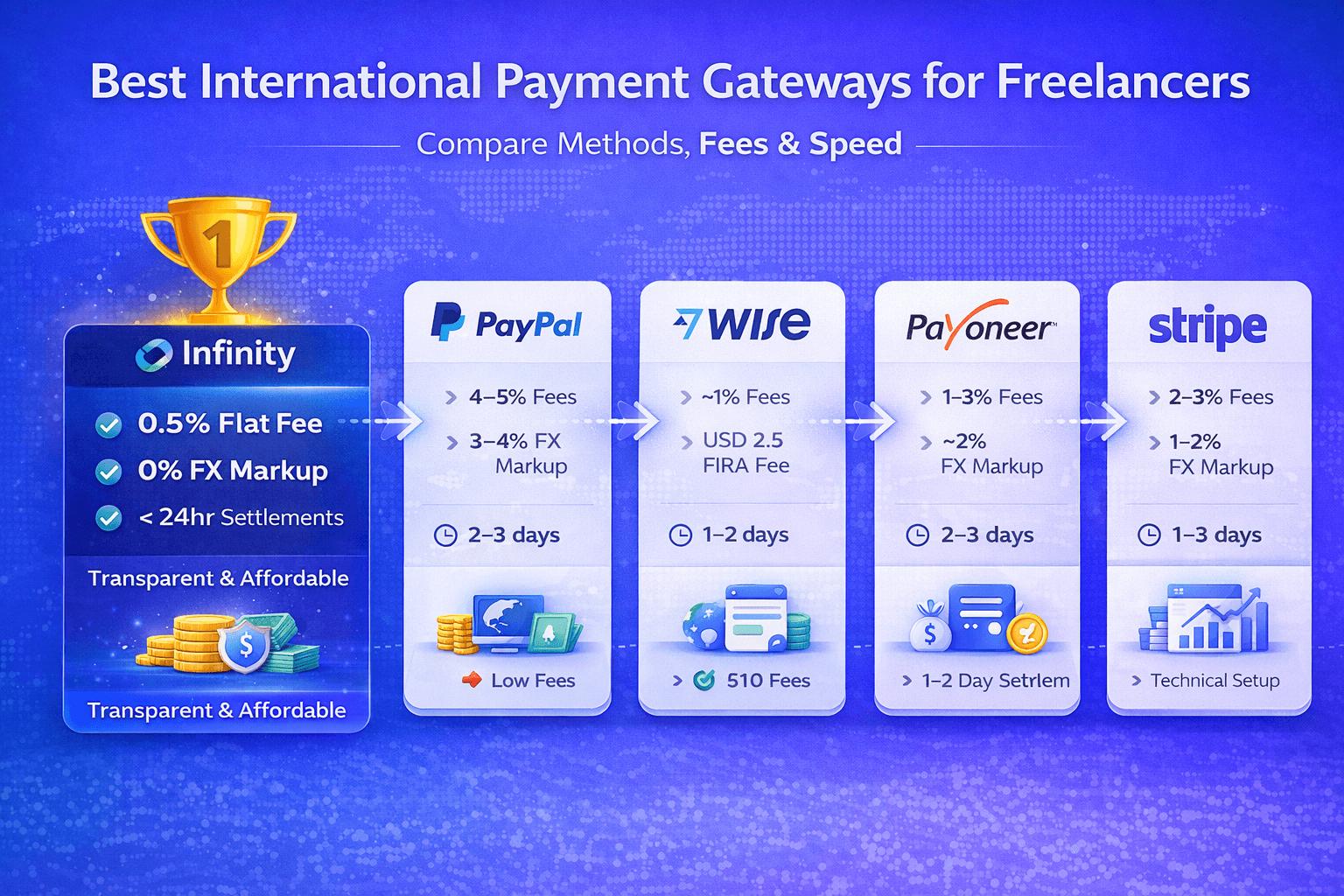
1. Infinity
Although Infinity does not position itself as a payment gateway, it is still built to resolve the issue that other payment gateways are resolving. Infinity is built especially for Indian exporters, agencies, and freelancers who usually work with foreign clients. Infinity is designed with a specific focus on resolving the issues that Indian professionals face while receiving international payments, in contrast to the traditional methods that still use complex and tedious approaches.
Infinity's transparent pricing mechanism is one of its main advantages. It offers a single, all-inclusive transaction fee of 0.5% in place of several hidden costs. This removes the confusion that freelancers often have when they are trying to estimate their real earnings.
The 0% foreign exchange markup is another significant differentiator. A majority of platforms include an exchange rate margin, which drastically lowers your profits. This is completely eliminated by Infinity, guaranteeing that you receive the actual exchange rate free of any hidden deductions.
Infinity also offers a multi-currency account to its users. Infinity lets you receive international payments in more than 50 currencies. This helps users receive and manage payments from different countries in one place.
Another area where Infinity specialises is speed. Freelancers can access their funds much more quickly, within 24-hour settlements, in contrast with traditional banking systems, which could take several days.
Furthermore, Infinity makes compliance easier by offering instant and free FIRA, which is crucial for documentation and legal requirements.
Additionally, the platform provides a centralised dashboard that gives you total access and control over all of your transactions.
2. PayPal
PayPal is one of the most popular international payment gateways in the world. PayPal is usually the first option used by new freelancers when it comes to receiving international payments. The greatest benefit of PayPal is its global reach, due to which customers all over the world are accustomed to it, making it simple to receive international payments with little setup.
However, there is a price for this convenience. Before relying on PayPal in the long run, it is crucial to understand its fee structure.
For receiving international payments in India, PayPal often levies a transaction fee of about 4-5%.
Additionally, it imposes a forex markup that is roughly 3–4% higher than the actual exchange rate. This implies that even if the initial transaction charge seems reasonable, the whole expense may cover 7–9% of your payment.
For instance, if you receive $1,000, the combined transaction costs and currency conversion margins may cause you to lose a substantial amount, which is around $80-$90 per transaction.
Settlement is another crucial aspect to take into account. PayPal offers withdrawals to your Indian bank account, which can take one to three business days, depending on the bank and processing time, even though PayPal payments are often received quickly within the PayPal wallet.
Additionally, PayPal has strict risk and compliance guidelines. Accounts may occasionally be subject to temporary holds or restrictions, particularly in the event of unexpected activity patterns or abrupt increases in transaction volume. For freelancers who depend on a steady financial flow, this may cause a delay in receiving funds.
In terms of usability, PayPal offers a clean interface, easy invoicing options, and strong buyer-seller protection. However, when evaluated purely on cost efficiency, it tends to be one of the more expensive options for Indian freelancers.
3. Wise
Wise is often popular among freelancers in India due to its transparent pricing structure. Wise uses the mid-market exchange rate, which is the actual rate without any hidden markups, unlike other traditional platforms.
Wise uses a transparent transaction cost, which typically varies from 0.5% to 2%, for receiving international payments in India instead of any hidden charges. While this may seem lower than PayPal, the total cost of receiving international payments can still vary based on how frequently the funds are received and converted.
Wise's multi-currency account enables Indian freelancers to hold and handle money in multiple currencies like USD, EUR, and GBP, which is one of its best features. This is especially helpful to professionals who work with clients in different countries and want to manage payments in one place.
When it comes to payment settlement, Wise is comparatively quick; most transactions take one to two business days to complete, and occasionally even quicker depending on the route.
In the Indian setting, Wise does have certain limits, though. Certain capabilities may be limited by regulatory restrictions, and it might not always offer smooth support for papers connected to compliance, such as FIRA.
Wise charges an additional $2.50 per FIRA for every international transaction. This can be a disadvantage for freelancers who require organised paperwork for export or tax compliance.
While Wise scores high on transparency and exchange rates, freelancers must still evaluate whether it fully meets their operational and compliance needs in India.
4. Payoneer
Freelancers who work on international sites like Upwork, Fiverr, and Amazon often use Payoneer. With features like global receiving accounts, which enable freelancers to receive money as if they had a local bank account in nations like the US or the UK, Payoneer makes cross-border payments easier.
Payoneer's biggest advantage is that it integrates easily with marketplaces. This functionality makes it especially easy for freelancers who work in different marketplaces like TopTal, Fiverr, Amazon, etc.
Payoneer's price structure, however, can occasionally be confusing and complicated. When transferring money to an Indian bank account, there may be several levels of fees, including receiving fees (up to 3%), currency conversion fees (around 2%), and additional withdrawal fees.
Depending on the withdrawal method and payment source, Payoneer settlement timeframes normally fall between two and three business days.
Although Payoneer can be helpful for receiving international payments in India, its UI and reporting tools might not be as user-friendly as some of the other platforms. Furthermore, additional procedures or coordination may be needed for compliance documentation, such as FIRA.
All things considered, Payoneer is a good choice for freelancers operating in international marketplaces; yet, its multi-layered fee structure may limit transparency and affect net profits.
5. Stripe
Stripe provides a robust platform for international payment infrastructure that is mainly intended for enterprises, startups, and SaaS firms. Stripe is ideal for people who work in more structured, standardised, or business-oriented environments—such as selling digital goods, subscriptions, or services via a website—even though freelancers can still use it.
With payment buttons, checkout pages, or API interfaces, Stripe enables you to easily accept international payments on your website. This makes Stripe very adaptable and expandable, particularly for freelancers moving into agencies or companies.
When it comes to price, Stripe usually charges between 2 and 3% per transaction for international payments, in addition to extra currency conversion fees that might be between 1 and 2%. The overall cost still depends on how the payment is handled, even though this is sometimes less expensive than PayPal.
Stripe's greatest advantages are customisation and integration. But it also becomes less beginner-friendly at this point. Technical expertise is often required to set up Stripe, particularly if you want to make the most of its features.
Stripe may seem overly difficult to freelancers who just want to get paid without having to handle elaborate workflows or a website.
In conclusion, Stripe is a great tool for growing enterprises, but it might not be the best option for freelancers who prioritise affordability and ease of use.
Comparison Table
Platform | Fees | FX Markup | Settlement Time | Best For |
Infinity | 0.5% (all inclusive) | 0% | ~24 hours | Freelancers, agencies, Beginners |
PayPal | 4-5% | 2-4% | 1–3 days | Beginners |
Wise | 1-2% | 0% | 1–2 days | Multi-currency users |
Payoneer | 2-3% | Moderate | 2–3 days | Marketplace freelancers |
Stripe | 2-3% | 1-2% | 2–5 days | SaaS/businesses |
Practical example to simplify the understanding of different platforms
Let's look at a simple situation where a US client pays a freelancer $1,000.
If a freelancer uses PayPal, then the amount can be significantly reduced to around $920-$930. This includes FX markup charges and transaction fees.
While using Wise for receiving the payment, a freelancer is charged around 2%, which means around $980 is received in the bank account. In addition to this, an additional USD 2.5 is charged for FIRA, which is a mandatory document.
Multiple charges at different stages can lower the final payout when using Payoneer and Stripe.
If Infinity is used for receiving this payment, a freelancer is charged just 0.5%, which means $995 is received in your Indian bank account. And no additional fee is charged for FIRA and FX markup. This makes a win-win situation for an Indian professional and businesses.
This difference may eventually lead to a significant increase in total earnings.
Common Mistakes that Freelancers Make while Selecting the Payment Platform
Selecting a payment platform solely on brand familiarity is one of the most common mistakes freelancers make. Although popular platforms like PayPal are convenient, they might not always give the best value in terms of price.
Ignoring FX markup is another serious mistake. Freelancers mostly pay attention to the transaction fees and are unaware of the fact that FX margins can sometimes eat a great share of their profit margins.
Settlement delays are also usually ignored. Cash flow might be hampered by waiting for payments for many days, particularly for freelancers who oversee multiple clients.
Errors also occur in the field of compliance. Inadequate documentation, such as a lack of FIRA, might cause issues down the road, especially when it comes to taxes.
Freelancers can improve their payment process and make wiser decisions by being aware of these mistakes.
Conclusion
One of the most important financial choices that a freelancer can make is selecting the right international payment gateway. It has a direct impact on your income, the speed at which you get paid, and the ease with which you handle your international payment.
Although there are many options available in the market, not all of them are best suited for freelancers in India. Over time, delays, FX markups, and hidden costs can drastically lower your earnings.
You can choose a solution that meets your needs if you understand how these platforms operate and properly compare them.
Why Infinity is the best choice for receiving international payments for freelancers in India
Infinity is built to resolve the primary hurdles that freelancers face when receiving international payments. It guarantees that you keep more of your earnings due to its transparent pricing, 0% FX markup, and 24-hour settlements.
Infinity is especially built for Indian users; it removes unnecessary complexity, streamlines compliance, and offers immediate documentation like FIRA.
Infinity provides a modern solution that combines efficiency and transparency with features like 0.5% all-inclusive costs, 0% FX markup, 24-hour settlements, and free FIRA.
For freelancers looking to scale their global income without losing money to hidden charges, Infinity provides a clear and reliable alternative.
FAQ on International Payment Gateway for Freelancers in India
Which international payment gateway is the best for Indian freelancers?
Platforms like Infinity, PayPal, Wise, and Payoneer are the best international payment gateways available in India for freelancers. Out of these, Infinity is the most appropriate for freelancers in India.
Does PayPal work well for Indian freelancers?
Although PayPal is extensively used, it has higher fees and FX markups.
Which method of receiving funds from overseas is the least expensive?
Infinity is an economical platform that typically has minimal costs and 0 FX markup.
How can freelancers in India get paid in US dollars?
Freelancers can receive USD payments in India via Infinity, which are subsequently converted to INR at 0% FX markup.
Do freelancers require FIRA?
Yes, FIRA is often used in India for tax and compliance considerations.


